

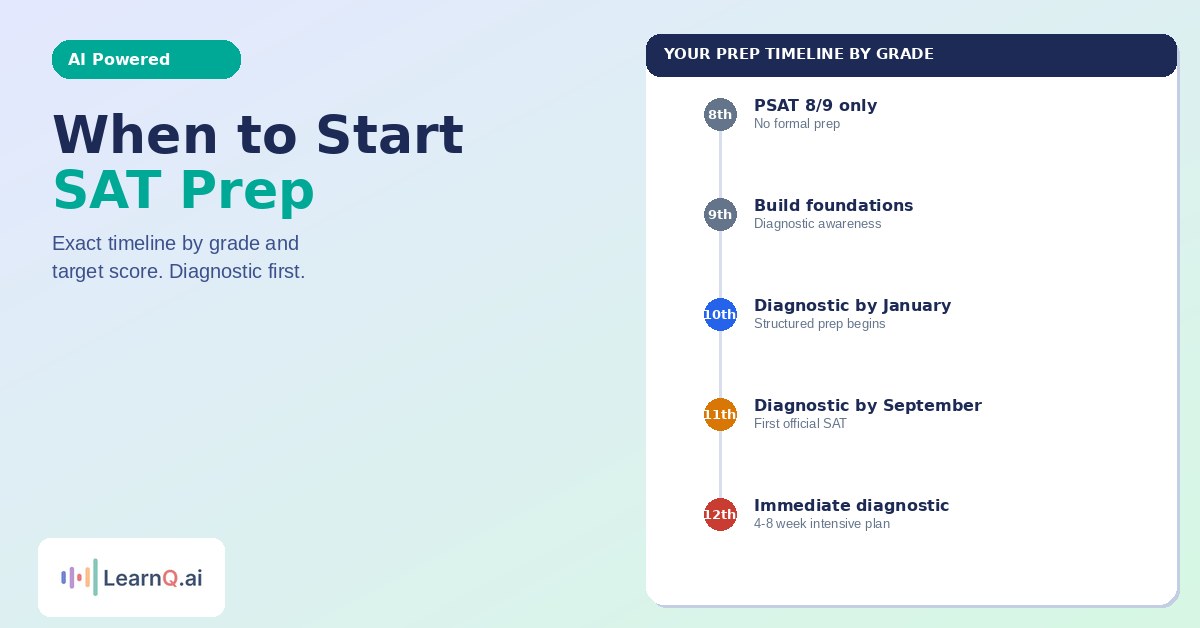
Start SAT prep 3-6 months before your target test date. 10th graders should begin with a diagnostic test by January; 11th graders should start no later than September. The exact timing within that window depends on your target score and your gap from your current baseline – not your grade alone. Every plan should start with a full-length diagnostic, not a calendar date.
There is no single correct grade to start SAT prep. There is a correct sequence: diagnostic first, then a timeline built backward from your target test date and your score gap. This guide gives you the exact timeline for each grade, what a good starting point looks like, and the warning signs that you are starting too late.
The One Rule That Matters More Than Grade Level
Before any grade-specific advice: your score gap determines your timeline more than your grade does. A 10th grader who is already scoring near their target needs less prep time than an 11th grader with a 300-point gap. Grade level determines which window is available to you; score gap determines how much of that window you actually need to use.
General rule of thumb by score gap:
| Score Gap (current to target) | Recommended Prep Time |
|---|---|
| Under 100 points | 4-8 weeks of focused practice |
| 100-200 points | 2-3 months of structured prep |
| 200-300 points | 3-5 months of structured prep |
| 300+ points | 5-6+ months, often across two testing cycles |
These are averages, not guarantees. A student who studies efficiently on their weakest question types can beat these timelines; a student who studies broadly without diagnostic focus often needs longer than the table suggests. See the 200-point improvement guide for how to structure efficient prep regardless of your starting timeline.
Grade-by-Grade Timeline
8th Grade: No formal prep needed
There is no meaningful reason to start structured SAT prep in 8th grade. If your school offers the PSAT 8/9, take it – it is free, low-stakes, and gives an early diagnostic baseline. Beyond that, the highest-leverage activity is building strong reading habits and solid Algebra I foundations. Formal test-prep drilling this early tends to produce burnout without proportional score benefit, since the content itself (Algebra II-level math, advanced grammar rules) has often not yet been taught in school.
What to do: Take the PSAT 8/9 if offered. Read broadly. Build math fundamentals. Nothing more.
9th Grade: Foundation building, not formal prep
9th grade is still primarily about academic foundations rather than test-specific preparation. The SAT draws on content through Algebra II, much of which a 9th grader has not yet covered in school. Drilling SAT-style questions before the underlying math is taught produces frustration, not score gains.
What to do: Take the PSAT 8/9 or PSAT 10 if your school offers it, purely as a diagnostic. Focus on strong grades in English and math coursework. Start developing awareness of the test format – understanding that the Digital SAT is adaptive, uses the Bluebook app, and covers Reading and Writing plus Math – without diving into content drilling yet.
If you are a highly advanced 9th grader already covering Algebra II, light diagnostic-driven prep can begin, but this is the exception, not the rule.
10th Grade: The ideal window to begin structured prep
Sophomore year is the sweet spot for most students to begin real, structured SAT preparation. By 10th grade, Algebra I and much of Algebra II are complete or in progress – the highest-frequency SAT Math content. Reading and writing skills are developed enough to build test-specific strategy on top of them. And a full 12-18 months remain before the primary junior-year testing window, which is enough time to close significant score gaps without time pressure.
The exact timeline:
- By January of 10th grade: Take a full-length diagnostic test. This is the starting point for everything else – target scores, study plans, and pacing decisions all depend on knowing your baseline.
- Spring of 10th grade: Take the PSAT 10 as a real, scored benchmark. Compare it against your diagnostic to confirm your baseline and identify weak areas by question type. See the average PSAT score by grade guide to understand what your PSAT 10 score means relative to your peers.
- Summer before 11th grade: This is the highest-leverage window in the entire timeline. Use it for structured, focused prep on your weakest question types, without competing against a full school course load.
- Fall of 11th grade: Take the PSAT/NMSQT – your only National Merit-eligible attempt. See the PSAT vs SAT comparison for how this score predicts your SAT performance.
- Spring of 11th grade: First official SAT attempt, following a full summer and fall of preparation.
Starting in 10th grade gives you a first official SAT attempt in spring of 11th grade with a full year of runway, plus a fall-of-12th-grade retake window if needed.
11th Grade: Still workable, but the timeline compresses
Junior year is when most students actually take their first SAT, even if they did not start formal prep in 10th grade. If you are starting fresh in 11th grade, the timeline compresses but remains entirely workable.
The exact timeline:
- By September of 11th grade, at the latest: Take a full-length diagnostic test. Waiting past this point significantly narrows your prep window before common spring test dates.
- September through December: Structured prep focused on your weakest question types, identified from the diagnostic. See the 3-month SAT study plan for a complete week-by-week structure at this timeline.
- December or March: First official SAT attempt. Most students see their largest single-attempt score gain between their first and second sitting, so treat this as valuable data even if it is not your target score yet.
- May or June: Second SAT attempt if a retake is needed, using score-report data from the first attempt to focus remaining prep time. See the SAT retake strategy guide for how to decide whether and when to retake.
- Fall of 12th grade: Final retake window before most application deadlines.
Starting in September of 11th grade still allows 3-5 months of prep before spring test dates – a fully workable timeline for most score gaps under 200 points.
12th Grade: Compressed but not hopeless
Starting in senior year is late, but not without options – particularly for students applying to test-optional or test-flexible schools, or those with a smaller score gap. The compressed timeline demands intensive, tightly focused prep rather than broad review.
The exact timeline:
- Immediately: Take a diagnostic the day you decide to prepare. There is no time to delay this step.
- 4-8 weeks of intensive prep: Focus exclusively on your 2-3 weakest question types identified from the diagnostic. Broad review is not an efficient use of a compressed timeline. See the 1-month SAT study plan for a day-by-day structure built for exactly this situation.
- Earliest available test date: Typically August, October, or November of senior year, depending on when prep began. Check SAT score release timing against your application deadlines before selecting a date.
- One retake, if the timeline allows: Early Decision and Early Action deadlines (typically November 1) leave very little room for a second attempt if your first test is in October or November. Regular Decision deadlines (typically January 1) allow more flexibility.
If your timeline in senior year does not realistically allow for meaningful score improvement, prioritise other application components – essays, activities, and letters of recommendation – over marginal SAT gains. A senior with a strong overall application outperforms a senior with a slightly higher SAT score and a rushed, weaker application.
Red Flags You Are Starting Too Late
You have not taken a diagnostic test and your target test date is under 8 weeks away. Without a baseline, you cannot know whether 8 weeks is enough time or wildly insufficient for your specific gap.
You have a 250+ point gap and your first Early Decision deadline is under 3 months away. This combination usually means either accepting a lower score, requesting an application deadline extension where possible, or shifting focus to test-optional applications.
You have taken the SAT twice already with minimal improvement between attempts. This is not a signal to keep repeating the same approach a third time – it signals a need to change how you are preparing, not simply add more hours. Diagnostic-driven, question-type-specific prep consistently outperforms generic full-length practice test repetition.
You are relying entirely on full-length practice tests without reviewing specific errors. Taking test after test without analysing which question types produce the most misses wastes time. A single diagnostic followed by targeted practice on 2-3 weak areas produces faster gains than five untargeted full-length tests.
The Diagnostic-First Principle
Every timeline in this guide starts the same way: a full-length diagnostic test, not a calendar date. This matters because two students in the same grade with the same target school can have completely different starting points – one might be 50 points from their target, the other 300 points away. The grade-based windows above tell you when a window exists; the diagnostic tells you how much of that window you actually need.
Take LearnQ.ai’s free 40-minute diagnostic to establish your baseline and get a question-type breakdown immediately – no waiting for a scheduled PSAT or official SAT date. This is the single most useful first step at any grade level, whether you are a 10th grader planning 18 months ahead or a 12th grader with 6 weeks remaining.
Once you have a baseline, Mia, LearnQ’s AI tutor, builds a targeted study plan around your specific weak question types rather than a generic content review – the difference between a 6-month and a 3-month timeline for the same score gap often comes down to how targeted the practice is. Take a free full-length practice test to confirm your progress against real test conditions. See LearnQ’s full Digital SAT platform for structured, grade-appropriate study plans.
For official practice material at any starting point, College Board’s Bluebook app provides 8 free full-length tests. See which Bluebook tests are most predictive of your actual score at your current level before choosing which to prioritise.
Quick-Reference Summary
| Grade | Action | Timing |
|---|---|---|
| 8th | PSAT 8/9 if offered; no formal prep | Whenever school administers it |
| 9th | Diagnostic awareness only; build foundations | Ongoing |
| 10th | Full diagnostic, then structured prep | Diagnostic by January; PSAT 10 in spring |
| 10th (summer) | Highest-leverage prep window | Summer before 11th grade |
| 11th | Structured prep if not already started | Diagnostic by September at the latest |
| 11th | First official SAT | December or March |
| 12th | Compressed, intensive prep if needed | Immediate diagnostic; 4-8 week focused plan |
FAQ
What grade should you start SAT prep?
Most students should begin structured SAT prep in the spring of 10th grade or the summer before 11th grade – roughly 12-18 months before their primary junior-year testing window. This timing works because Algebra I and II coursework is largely complete, reading and writing skills are developed enough for strategic work, and there is enough runway to close significant score gaps without time pressure. Earlier grades (8th-9th) should focus on foundational academics rather than formal test prep.
Is it too late to start SAT prep in 11th grade?
No. Junior year is when most students actually begin formal prep and take their first official SAT, even under an ideal timeline. Starting in September of 11th grade still allows 3-5 months of preparation before common spring test dates (March, May, June), which is a fully workable window for most score gaps under 200 points.
How many months before the SAT should I start studying?
3-6 months is the general range for most students, with the exact timing depending on your score gap: under 100 points typically needs 4-8 weeks, 100-200 points needs 2-3 months, 200-300 points needs 3-5 months, and 300+ point gaps often benefit from 5-6+ months spread across two testing cycles. Always confirm your specific gap with a diagnostic test before committing to a timeline.
What should I do first when starting SAT prep?
Take a full-length diagnostic test before anything else. Grade level tells you which timing window is available; the diagnostic tells you your actual starting point and which specific question types need the most work. Skipping this step and diving straight into generic review or repeated full-length practice tests wastes time compared to diagnostic-driven, targeted preparation.
Can 8th or 9th graders take the SAT?
Technically yes, but it is rarely useful for college admissions purposes. Most colleges expect scores from 10th, 11th, or 12th grade, since these better reflect a student’s academic level closer to application time. Taking the SAT in 8th or 9th grade is typically reserved for academic talent search programs, not standard college admissions planning.
What if I have a large score gap and limited time before my deadline?
Prioritise targeted, diagnostic-driven prep over broad review – focus on your 2-3 weakest question types rather than reviewing everything. If the timeline genuinely does not allow for meaningful improvement (for example, a 250+ point gap with under 3 months before an Early Decision deadline), consider whether other application components deserve more of your remaining time, or whether a slightly later application round is worth pursuing.
Sources: College Board Digital SAT overview; IvyStrides grade-by-grade SAT prep timeline (ivystrides.com, June 2026); Groza Learning Center SAT/ACT timing guide (grozalearningcenter.com, May 2026); GrowWise SAT prep timeline by grade (growwiseschool.org, May 2026); FullPracticeTests SAT timeline planner 2025-2026 (fullpracticetests.com)

The LearnQ Editorial Team is made up of certified Digital SAT tutors, college admissions specialists, and AI education researchers. Our tutors have personally helped over 10,000 US high school students improve their SAT scores, with an average improvement of 150+ points. We combine hands-on tutoring expertise with AI-powered insights from the LearnQ platform, which has analyzed millions of Digital SAT practice questions. Every article we publish is reviewed against the latest College Board Bluebook guidelines and cross-checked with real student performance data. Our mission is simple: give every student the same quality of prep that was once only available at expensive tutoring centers.