

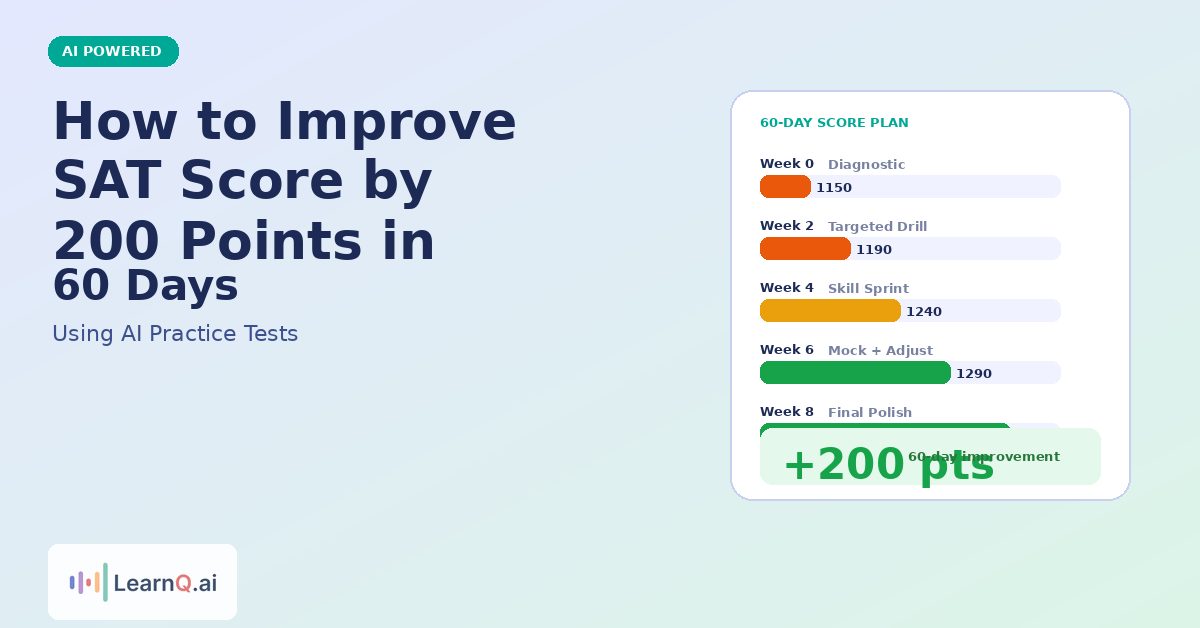
Improving your SAT score by 200 points in 60 days is achievable when you combine a full diagnostic, targeted AI practice tests, and a structured week-by-week plan.
Most students who grind through random practice problems plateau fast. They finish five mock tests, check answers, and wonder why the needle barely moved. The problem is not effort. The problem is direction.
A 200-point improvement is not about studying more. It is about studying the exact skills that are bleeding your score, in the exact format the Digital SAT uses, with feedback that arrives before you repeat the same mistake on test day. AI-powered practice platforms have changed what is possible in a short prep window. Students who approach the next 60 days with a clear system regularly hit 150 to 200-point jumps.
Why 60 Days Is Enough (If You Do It Right)
College Board data shows students who complete focused SAT preparation can improve by 90 to 200 points, with practice test quality being the single biggest differentiator. The students who see 200-point gains are not studying three times longer than students who see 50-point gains. They are studying smarter.
Sixty days gives you enough cycles to run a diagnostic, build a targeted plan, drill weak areas intensively, run full-length adaptive tests, and review before test day. That is the complete loop. Students who skip the diagnostic and jump straight to practice lose two to three weeks of targeted study time because they are practicing the wrong things.
The August SAT is now 12 weeks away, which means your window to build real improvement is open right now. Waiting two more weeks narrows that window significantly.
Step 1: Take a Full Diagnostic First
Do not begin practicing content until you have a baseline score. Take one full-length Digital SAT under timed conditions using College Board’s Bluebook app or a platform that mirrors the adaptive two-module format. If you need to understand how the timing works, read our breakdown of how long the Digital SAT is.
After the diagnostic, categorize every wrong answer:
- Did you not know the concept?
- Did you know it but make a careless error?
- Did you run out of time?
- Did the question format confuse you?
This categorization tells you which lever to pull first. Students who skip straight to content review often spend 20 hours patching a section that costs them 30 points while ignoring a section that costs them 80 points.
Step 2: Let AI Identify Your Exact Weak Spots
This is where the approach shifts from generic to surgical. A good AI practice platform does not just score your test. It maps your errors to specific skill tags, reading question types, math domains, and module difficulty levels.
After running your diagnostic results through an AI system, you will get something like this:
| Skill Area | Questions Missed | Estimated Points Lost |
|---|---|---|
| Algebra: Linear equations in context | 5 of 8 | ~40 pts |
| Reading: Command of Evidence (textual) | 4 of 6 | ~30 pts |
| Writing: Transitions and sentence structure | 3 of 5 | ~25 pts |
| Geometry: Circles and area | 2 of 4 | ~15 pts |
That table is worth more than 10 random practice tests. It tells you that fixing two skill areas alone recovers 70 points before you touch anything else.
Understanding how adaptive testing works matters here too. The Digital SAT’s Module 2 difficulty is entirely determined by your Module 1 performance. Raising your Module 1 accuracy by even 15% can route you to the harder module, which carries higher score ceilings. A student targeting 1400 or above almost certainly needs to fix their Module 1 accuracy before anything else.
Step 3: Follow a Week-by-Week 60-Day Plan
Structure converts good intentions into real score gains. Here is how to frame the 60 days.
Weeks 1 to 2: Diagnostic and Priority Setting
Run your full diagnostic and extract your top three skill gaps using an AI platform’s error breakdown. Read the skill explanations, not just the answer keys. Do 15 to 20 focused practice questions per gap category. Do not run another full mock yet. You are learning the error patterns, not practicing under pressure.
Weeks 3 to 5: Targeted Drilling
Spend 90 to 120 minutes per session working through AI-generated drills in your two or three weakest areas. A good adaptive platform increases difficulty progressively as you improve, so you are never practicing problems that are too easy or too hard for where you actually are.
For math, write out the reasoning for each wrong answer before moving to the next question. For reading and writing, find the evidence in the passage before selecting an answer. Most reading errors come from choosing an answer that feels right rather than one that is directly supported by the text.
Weeks 6 to 7: Full-Length Adaptive Tests
Run two full adaptive mocks under real conditions, including the timed breaks. After each, run the error categorization again. By week 7, your weakest areas should show measurable improvement, and a new area will likely surface as the next priority. Adjust your drilling schedule accordingly.
Understanding the Module 1 routing strategy becomes critical here. Students who know how the adaptive routing works can pace themselves strategically in Module 1 to maximize their Module 2 difficulty assignment.
Week 8: Final Polish and Test Conditions
No new content in week 8. Run one more full mock three to four days before test day. Review only your persistent error types. Get your sleep schedule aligned with the test time. The prep work is done. This week is about confidence and execution.
What AI Practice Tests Do Differently
Standard practice tests show you what you got wrong. AI practice tests show you why you got it wrong and what to do before the next question.
The Digital SAT is a multistage adaptive test. This means that static, linear practice books cannot simulate the actual experience. If you score well in Module 1, your Module 2 becomes significantly harder and carries higher potential scores. Preparing on materials that do not reflect this adaptive escalation creates a false sense of readiness.
AI-powered platforms can model this adaptive structure, serve questions calibrated to your real performance level, and flag when you are drifting into a wrong pattern mid-session. This is the core advantage. You are not just getting more practice. You are getting practice that mirrors what you will actually face.
Research from College Board also confirms that quality of practice materials matters as much as quantity. Practice tests that mirror the adaptive progression from Module 1 to Module 2 produce better score outcomes than those that do not. Students who train on materials that are either too easy or too hard develop inaccurate expectations that hurt performance on test day.
How LearnQ.ai Accelerates This Process
LearnQ.ai is built for exactly this 60-day window. The AI tutor Mia identifies your weak areas from your first diagnostic and builds a personalized study path around them. Every practice session adapts to your current performance level rather than following a fixed curriculum.
The platform includes over 5,000 Digital SAT practice questions across all question types, full adaptive mock tests that replicate the Bluebook format, and gamified study sessions that make daily practice sustainable. Students consistently hit 150 to 200-point improvements using LearnQ’s structured prep path. You can also explore why gamified SAT prep works if you want to understand the science behind keeping your practice sessions consistent over 60 days.
LearnQ.ai is free to start. No payment required to take your diagnostic and see your personalized improvement roadmap.
FAQ
How long does it take to improve your SAT score by 200 points?
Most students need 8 to 12 weeks of focused, structured prep to see a 200-point improvement. The 60-day timeline is achievable when you begin with a diagnostic, drill targeted weak areas, and use adaptive AI practice tests rather than random study sessions. Students who prep broadly without identifying their specific skill gaps typically see smaller improvements in the same time window.
Can AI practice tests really improve your SAT score?
Yes. AI practice tests improve scores by doing two things static prep books cannot: adapting difficulty in real time to your current level, and tagging your errors to specific skill gaps so you know exactly what to drill next. College Board data confirms that students who use practice materials that mirror the Digital SAT’s adaptive format outperform those using linear, non-adaptive resources.
How many practice tests should I take before the SAT?
For a 60-day plan targeting 200 points, aim for five to seven full-length adaptive mocks spread across the prep window. The goal is not volume but quality. Each mock should be followed by a full error analysis. Running ten tests without analyzing your mistakes produces far less improvement than running five tests with deep post-test review.
What is the easiest way to gain SAT points quickly?
The fastest points come from fixing your highest-frequency error types. After a diagnostic, identify the two or three question types where you miss the most questions. Drill those categories intensively for two to three weeks before running another full mock. Students typically recover 50 to 80 points from two focused skill areas before touching anything else.
Is a 200-point SAT improvement realistic?
Yes. College Board research confirms that more than 16,000 students have achieved 200-point improvements using structured preparation. The students who reach this threshold consistently share three habits: they start with a cold diagnostic, they drill targeted weaknesses rather than reviewing everything, and they use adaptive practice materials that match the Digital SAT format.
How does the Digital SAT’s adaptive format affect prep strategy?
The Digital SAT routes you to either an easy or hard Module 2 based on your Module 1 performance. Students routed to the hard module have access to higher score ranges. This means your prep strategy should prioritize Module 1 accuracy above all else. Understanding this routing mechanism changes how you approach question pacing and which skills you prioritize in the final weeks before test day.
What score do I need for top universities?
Selective universities typically look for scores in the 1400 to 1600 range. Ivy League and near-Ivy schools generally admit students with scores above 1470. Mid-tier selective schools look for 1250 to 1400. For a detailed breakdown of what specific scores mean for college admission, see our guide on what a 1400 SAT score means.
Do I need a tutor to improve my SAT score by 200 points?
Not necessarily. Students who use AI-powered adaptive platforms with clear error-tracking and personalized question feeds can replicate many of the benefits of one-on-one tutoring. The key advantage of a tutor is that they can identify thinking errors in real time. AI platforms fill this gap by flagging incorrect reasoning patterns across many practice sessions and adjusting your question feed accordingly.
Sources: College Board SAT research data (2024); Tutor Doctor research on SAT prep hours and score gains (February 2026); Amikka Learning student outcomes data (March 2026)

The LearnQ Editorial Team is made up of certified Digital SAT tutors, college admissions specialists, and AI education researchers. Our tutors have personally helped over 10,000 US high school students improve their SAT scores, with an average improvement of 150+ points. We combine hands-on tutoring expertise with AI-powered insights from the LearnQ platform, which has analyzed millions of Digital SAT practice questions. Every article we publish is reviewed against the latest College Board Bluebook guidelines and cross-checked with real student performance data. Our mission is simple: give every student the same quality of prep that was once only available at expensive tutoring centers.