

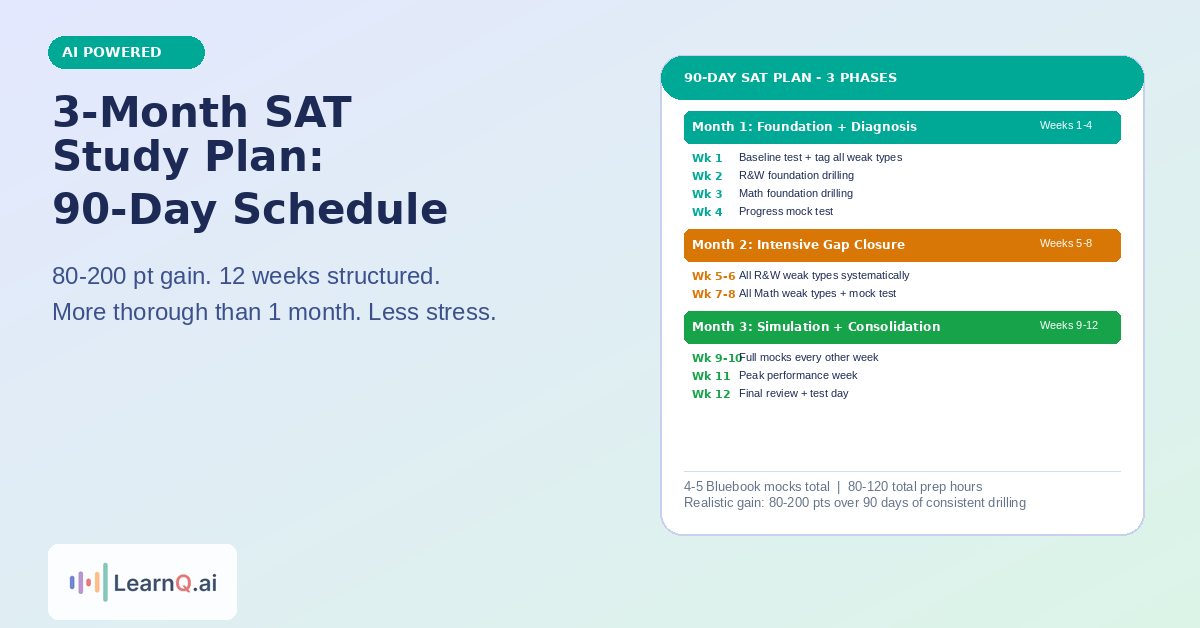
Three months is the optimal SAT prep window. It is long enough to close content gaps and see real score movement, but short enough to maintain intensity without burnout. Students who follow a structured 90-day plan typically improve 80-200 points – more than in any shorter window.
The three-month plan works differently from the one-month version. With 30 days, you have to pick your two weakest question types and drill them exclusively. With 90 days, you have time to address all your weak areas systematically, build deeper mathematical fluency, run multiple full mock tests, and still have a consolidation week before test day. The extra time produces better and more durable score gains.
This plan is built around the Digital SAT’s adaptive format: your Month 1 work is about understanding where your score is leaking, Month 2 is about closing those specific leaks through targeted drilling, and Month 3 is about simulating test conditions until your accuracy holds under pressure.
Who This Plan Is For
Three months is the right prep window if you want to improve your score by 80-200 points, can study 45-90 minutes most weekdays and 2-3 hours on weekends, and have a clear test date on the calendar 12 weeks out.
If you want to improve 200+ points, a 4-6 month plan is more realistic – see the improve by 200 points guide for the extended approach. If you have less than 6 weeks, the structure of this plan still applies but compressed – focus the first week on diagnosis and the remaining weeks entirely on your top 2-3 weak types.
Realistic Score Gains by Starting Level
| Starting Score | 3-Month Realistic Target | Primary Focus Areas |
|---|---|---|
| Below 1000 | 1050-1150 | Core Algebra, Boundaries/grammar, Central Ideas |
| 1000-1100 | 1150-1250 | Algebra systems, Transitions, Conventions |
| 1100-1200 | 1250-1350 | Advanced Math, Rhetorical Synthesis, CoE Quant |
| 1200-1300 | 1300-1420 | All weak types + Hard Module 2 routing |
| 1300-1400 | 1380-1480 | Hard Module 2 specific types + time management |
| 1400+ | 1440-1530 | Precise Hard Module 2 gap closure |
Understanding how adaptive testing works is the foundation of this plan: your accuracy in Module 1 determines which Module 2 you receive, and Module 2 difficulty is the main lever on your final score. Three months gives you time to improve Module 1 accuracy enough to consistently route to Hard Module 2 – which raises your ceiling.
Month 1 (Weeks 1-4): Foundation and Diagnosis
Goal: Know exactly where your score is leaking. Build foundation-level accuracy on your weakest question types from the ground up.
Time commitment: 45-60 minutes weekdays, 2-2.5 hours Saturdays, 1.5 hours Sundays.
Week 1: Baseline and Diagnosis
Day 1: Take a full-length Bluebook practice test (Test 11 or Test 7 – see which Bluebook tests are most accurate) under real timed conditions. No interruptions.
Days 2-3: Score your test and categorize every wrong answer by question type. Use the framework in the Digital SAT question types guide to tag each error. Build a ranked list: which question types produced the most errors?
Days 4-7: Drill your single weakest question type only – 25-30 questions per day. Do not time yourself yet. Focus entirely on understanding the method for that question type. If Transitions is your worst R&W type: read the relationship between the two sentences before looking at choices. If Systems of Equations is your worst Math type: practice both the algebraic approach and the Desmos graphing approach for every problem.
Week 1 output: A ranked list of your 4-5 weakest question types, and first-pass familiarity with the method for your single weakest type.
Week 2: R&W Foundation
Spend this week entirely on Reading and Writing weak types. Two types maximum – your two worst from Week 1 diagnosis.
Weekdays (45 min each):
- 20-25 targeted questions on your weakest R&W type
- Review every wrong answer before moving on – not just noting the right answer, but articulating why each wrong choice is wrong
- Track accuracy at the end of each session (wrong/total)
Saturday (2.5 hrs): One full R&W module (27 questions, 32 minutes) under timed conditions. Review all errors. Identify any new weak types that appeared.
Sunday (1.5 hrs): Drill your second-worst R&W type.
Key R&W types to prioritize: Transitions, Rhetorical Synthesis, Quantitative Command of Evidence, and Words in Context produce the most score variation across students. Standard English Conventions (Boundaries and Form/Structure/Sense) are high-volume types – 14 questions per test – worth prioritizing if either is weak. See the complete Standard English Conventions guide for every grammar rule tested.
Week 3: Math Foundation
Shift focus entirely to Math weak types this week.
Weekdays (45 min each):
- Algebra (linear equations, systems, inequalities): the largest Math domain at ~35% of Math questions
- Advanced Math (quadratics, nonlinear functions, equivalent expressions): equally large at ~35%
- Drill 20-25 questions per session on your weakest Math domain
- Use Desmos on every applicable question – do not save it for test day. The Desmos SAT guide covers the techniques (intersection points, sliders, regression) that save the most time in these question types
Saturday (2.5 hrs): One full Math module (22 questions, 35 minutes) timed. Review errors in detail.
Sunday (1.5 hrs): Problem Solving and Data Analysis (statistics, ratios, percentages) – a smaller domain but one where a few conceptual errors can cost 3-4 questions.
Week 4: Integrated Review + Second Baseline
Weekdays: Alternate between R&W and Math drilling. One section per day. Rotate through your target question types.
Saturday: Take your second full-length Bluebook practice test. This is your first progress check. Compare question-type accuracy to Week 1 baseline.
Sunday: Review every wrong answer. Update your weak type list – after four weeks of drilling, some types will have improved. Identify what is now your highest-leverage remaining gap.
Month 1 checkpoint: If your Week 4 Bluebook score has not moved from Week 1, something is wrong with your review process – you are likely noting correct answers without understanding why wrong answers were wrong. The score should move 30-60 points after a month of consistent drilling.
Month 2 (Weeks 5-8): Intensive Drilling
Goal: Systematically close all remaining weak areas. Build accuracy on both R&W and Math weak types to 70%+ before moving to timed practice.
Time commitment: 60-75 minutes weekdays, 3 hours Saturday (including mock section), 2 hours Sunday.
Weeks 5-6: Deepen R&W Accuracy
By Week 5, you have identified your top R&W weak types from two practice tests. This is where you address them all systematically rather than rotating.
Week 5 focus – Rhetorical Synthesis and Transitions: These two types together account for 7-9 questions per test and are the most under-drilled at every score level. Drill 30-35 of each type across the week. For Rhetorical Synthesis specifically: the question tells you the goal. The notes give you the raw material. Every wrong answer either uses the wrong notes, accurately combines notes but fails the stated goal, or distorts what the notes say. Practice identifying which failure mode each wrong answer represents.
Week 6 focus – Information and Ideas types: Central Ideas and Details, Command of Evidence (Textual and Quantitative), and Inferences. For Quantitative CoE – the question most students find hardest in this domain – the key is finding the exact data point in the chart that the claim refers to, then checking whether each answer choice accurately represents that number. Wrong answers use real numbers from the chart but apply them to the wrong variable or time period.
Saturday each week: Full R&W module timed. Compare accuracy on target types to Week 2.
Weeks 7-8: Deepen Math Accuracy
Week 7 focus – Advanced Math: Quadratics and polynomials (find roots, vertex, axis of symmetry – use Desmos graphing), nonlinear functions (exponential growth and decay – identify initial value vs. rate), and equivalent expressions (factoring, expanding, rewriting – Desmos does not help here, know the algebraic patterns).
Week 8 focus – Algebra consolidation + Geometry: Return to your weakest Algebra type (usually Systems of Equations or Linear Inequalities) for final accuracy consolidation. Add Geometry and Trigonometry review: area and volume formulas are on the reference sheet, so focus on multi-step problems and basic trig ratios (SOHCAHTOA covers 90% of SAT trig questions).
Saturday each week: Full Math module timed.
Month 2 checkpoint – Week 8 full mock test:
Take your third full-length Bluebook practice test at the end of Week 8. Compare to Week 1 and Week 4 scores. At this point, most students following this plan consistently are 60-120 points above their starting baseline. If your improvement is less than 50 points after two months of consistent drilling, review your error analysis process – are you spending more time drilling or more time reviewing wrong answers? The review is where the learning happens.
Read the Digital SAT Module 1 strategy guide before your Week 8 mock. At this stage in your prep, you should be consistently routing to Hard Module 2. If you are still getting Easy Module 2, your Module 1 accuracy needs more work before Month 3 simulation begins.
Month 3 (Weeks 9-12): Simulation and Consolidation
Goal: Lock in gains under real test conditions. Build the stamina and consistency to perform at your ceiling on test day.
Time commitment: 60 minutes weekdays, full mock test every other Saturday, focused review Sunday.
Weeks 9-10: Full Mock Tests + Targeted Drilling
The shift in Month 3 is toward full-length simulation rather than isolated section drilling. You have built the accuracy in Month 2 – now you need to hold it under the pressure of a complete 2-hour 14-minute test.
Week 9:
- Weekdays: 45-60 min of targeted drilling on your 1-2 remaining weak types from the Month 2 checkpoint
- Saturday: Full Bluebook mock (Test 11 if not yet used – the most accurate predictor)
- Sunday: Full review of mock test by question type
Week 10:
- Weekdays: Mixed timed practice – one full R&W module and one full Math module on alternating days, reviewed carefully
- Saturday: Full Bluebook mock (Test 7 if not yet used)
- Sunday: Review + identify any Hard Module 2 specific types that are still costing points
At this stage, the difference between students who plateau and students who keep improving comes down to Hard Module 2. Your easy question accuracy is high. Your remaining gaps are in Hard Module 2 specific question types – the hardest instances of Rhetorical Synthesis, Nonlinear Functions, and multi-step Geometry that only appear when you have routed to the hard track. LearnQ.ai’s full-length adaptive practice test provides question-type breakdown analytics by difficulty level – useful for pinpointing Hard Module 2 specific gaps.
Week 11: Peak Performance Week
This is the highest-intensity week of the plan. Your mock test scores should be close to or at your target score by now. The goal this week is to simulate the exact test-day experience until it feels routine.
Monday-Thursday: Mixed timed practice, 60 minutes each. Rotate: one full R&W module, one full Math module, another R&W module, another Math module.
Friday: Rest or 20 minutes of light review only. No new drilling.
Saturday: Full Bluebook mock test under the most realistic conditions possible – same time of day as your real test, same location type, no pausing, phone off. This is your final score prediction.
Sunday: Full review. Identify 1-2 specific question types to revisit in Week 12. Note any test-taking strategy adjustments needed (pacing, skipping and returning, use of scratch paper).
Mia, LearnQ.ai’s AI tutor, is particularly useful this week for getting targeted explanation of any Hard Module 2 question types that appeared in your Week 11 mock. Ask Mia to generate five more questions of that exact type with step-by-step explanations – this targeted 20-minute session is more effective than broad review at this stage.
Week 12: Final Consolidation
Days 1-3: Light review only. 30-40 minutes per day maximum. Go through your error log from Week 11 mock. Revisit your 1-2 remaining target types with 10-15 questions each – not new drilling, just reinforcement of accuracy you have already built.
Day 4: Rest. No studying. Eat well, sleep 8 hours.
Day 5 (night before): Pack your bag: printed admission ticket, valid photo ID, fully charged device with Bluebook installed and exam setup complete, charger, snack, light layer. Review the formula sheet for 10 minutes. Do not study new content. Sleep 8 hours.
Test day: Apply the Module 1 accuracy strategy from the Module 1 guide: your first 15 questions in each module set your routing. Prioritize accuracy over speed there. Use Desmos on every applicable Math question – you have been practicing this for three months.
After test day: if your score does not fully reflect your preparation, do not panic. Score variation of 30-50 points from your practice average is normal. Review the SAT retake guide – a second attempt after another targeted 4-6 week cycle almost always produces meaningful improvement for students who have already done the 90-day foundation work.
Daily Time Commitments Summary
| Phase | Weekdays | Weekends |
|---|---|---|
| Month 1 (Weeks 1-4) | 45-60 min | Sat: 2.5 hrs / Sun: 1.5 hrs |
| Month 2 (Weeks 5-8) | 60-75 min | Sat: 3 hrs (mock section) / Sun: 2 hrs |
| Month 3 (Weeks 9-12) | 60 min | Sat: Full mock (2h 14m + review) / Sun: 2 hrs |
Total estimated prep hours: 80-120 hours across 3 months. Research consistently shows 40-80 hours for a 100-point gain and 80-120 hours for a 150-200 point gain with focused, targeted prep.
Using LearnQ.ai for This Plan
The 90-day structure above works with any practice resource. To run it with LearnQ.ai:
- Week 1 diagnosis: Free 45-minute diagnostic replaces the manual error-tagging from the first Bluebook test with an automatic question-type breakdown
- Months 1-2 drilling: The session-adaptive algorithm automatically adjusts question difficulty as your accuracy improves – no need to manually escalate difficulty
- Month 3 simulation: Full-length practice tests with question-type analytics give you both a score and a breakdown by type after each mock
- Consistency: Play and Practice keeps daily sessions engaging through XP and streaks – critical for sustaining 90 days of consistent prep
- Hard Module 2 gaps: Mia, the AI tutor, explains wrong answers and generates similar questions on demand for any type you are struggling with
Start free – no payment required for the diagnostic and limited daily practice.
3-Month vs 1-Month: Which Plan Is Right for You?
Choose the 3-month plan if:
- You want to improve 80-200 points
- You have a clear test date 12+ weeks away
- You want to address all your weak areas rather than just the top 2-3
- You are aiming for a highly selective school where every 10 points matters
Choose a 1-month intensive approach if:
- You have 30 days or fewer
- Your target improvement is 50-100 points
- Your weak areas are already narrowed to 2-3 specific question types
- You can commit to 60-90 minutes per day
Both plans use the same core structure: diagnose, drill targeted types, simulate, consolidate. The 3-month version simply allows you to be more thorough at each stage and to run more mock tests for more accurate score prediction.
FAQ
How much can I improve my SAT score in 3 months?
Most students improve 80-200 points with a structured 90-day plan and consistent prep. The range depends on your starting score – students at 1000-1200 typically see the largest gains, while students already above 1350 see smaller incremental improvements. Students who follow this plan with genuine targeted drilling (not just completing practice questions) consistently fall in the 100-180 point improvement range.
How many hours per week should I study for the SAT in 3 months?
Aim for 5-8 hours per week: roughly 45-75 minutes on 4-5 weekdays and 2-3 hours on Saturday for a mock test or intensive session, plus 1.5-2 hours on Sunday for review. Total prep across 3 months: 80-120 hours. More than 10 hours per week tends to produce diminishing returns and increases the risk of burnout before test day.
How many practice tests should I take in a 3-month SAT plan?
Four to five full Bluebook practice tests across 90 days: one at the start (baseline), one at Week 4 (Month 1 checkpoint), one at Week 8 (Month 2 checkpoint), one in Week 11 (final benchmark), and optionally one in Week 9 or 10. Taking more than five full tests reduces the time available for targeted drilling – which produces better score gains than additional testing without focused prep in between.
What is the best resource for a 3-month SAT study plan?
Use College Board’s Bluebook for all full-length practice tests (8 available free), Khan Academy for free question-type drilling, and LearnQ.ai’s adaptive platform for session-level drill difficulty adjustment and question-type analytics. The combination of these three covers the full prep loop at minimal cost.
Should I study every day for the SAT?
Studying 5-6 days per week is better than 7. One full rest day per week allows consolidation of what you have learned and prevents the mental fatigue that degrades practice quality in later weeks. The plan above assumes 5 weekday sessions and 2 weekend sessions, with one free day built in.
What should I do if I am falling behind the 3-month plan?
Do not try to catch up by doubling sessions. Instead, prioritize the remaining days: always keep the Bluebook mock tests on schedule (they are diagnostic checkpoints), and compress the drilling by reducing to your highest-value 1-2 question types rather than cycling through all weak types. A focused 3-month plan done at 70% of the intended volume still produces better results than unfocused prep at 100% volume.
Can I start this plan without a specific test date?
Yes – but set one before you begin Month 2. Students who register for a specific test date before starting Month 2 tend to maintain better consistency than students with an open-ended prep window. Check College Board’s test date calendar and register for a date 10-12 weeks from when you plan to start Month 2.
Sources: College Board Digital SAT overview; Acely 3-month SAT study plan (acely.com, 2026); EduAvenues SAT prep schedule by timeline (eduavenues.com, January 2025); CleverHarvey SAT study plan guide (cleverharvey.com, March 2026); Think Academy US Digital SAT prep guide (thethinkacademy.com, December 2025)

The LearnQ Editorial Team is made up of certified Digital SAT tutors, college admissions specialists, and AI education researchers. Our tutors have personally helped over 10,000 US high school students improve their SAT scores, with an average improvement of 150+ points. We combine hands-on tutoring expertise with AI-powered insights from the LearnQ platform, which has analyzed millions of Digital SAT practice questions. Every article we publish is reviewed against the latest College Board Bluebook guidelines and cross-checked with real student performance data. Our mission is simple: give every student the same quality of prep that was once only available at expensive tutoring centers.