

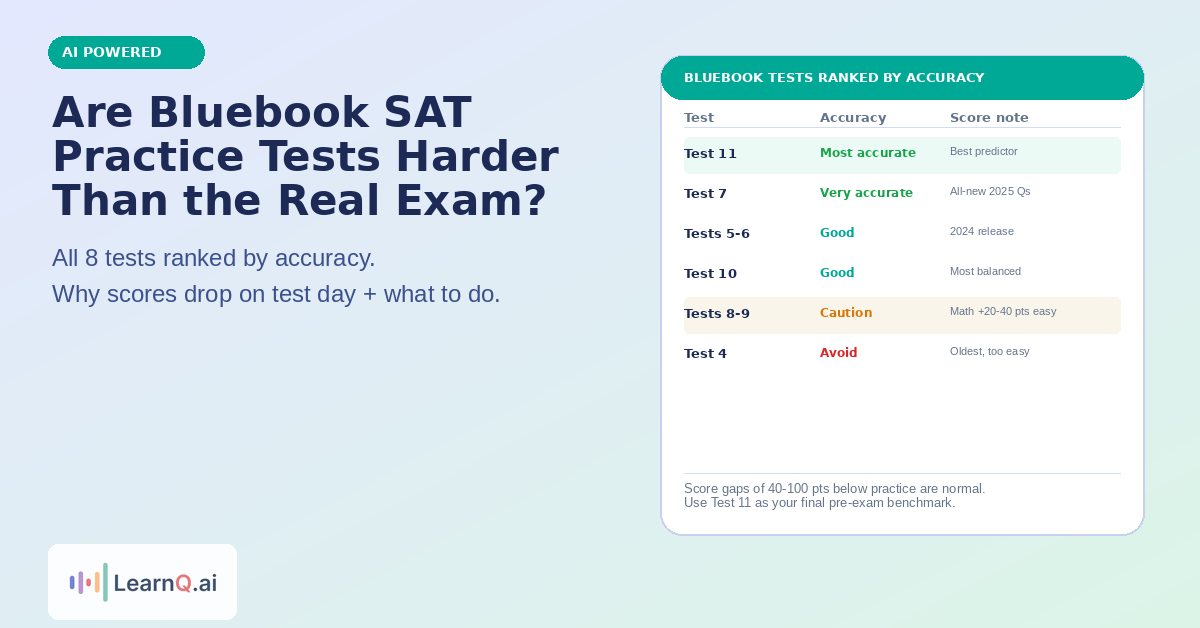
Bluebook practice tests use the same adaptive format as the real Digital SAT, but they vary significantly in accuracy as score predictors – Test 11 is the closest to the real exam, while Tests 8 and 9 have Math sections that are 20-40 points easier than what most students face on test day.
If your Bluebook practice scores are consistently 80-120 points above your actual SAT results, you are not alone and you are not doing anything wrong. The score gap between Bluebook practice and real SAT performance is one of the most common – and most frustrating – experiences in Digital SAT prep. This guide explains exactly why it happens, which tests are the most accurate predictors, and what to do about the gap.
The Short Answer: Yes, Bluebook Tests Are Adaptive – But Not All Are Equal
College Board’s Bluebook app offers 8 full-length practice tests (Tests 4 through 11 as of mid-2026). All of them use the same two-module adaptive structure as the real Digital SAT: your Module 2 difficulty is determined by your Module 1 performance.
So yes, Bluebook practice tests are adaptive in the same way the real exam is. But adaptive format alone does not guarantee accurate score prediction. The difficulty of the questions within each module – and how that difficulty compares to what appears on actual test day – varies substantially across the 8 available tests.
Understanding how adaptive testing works at the algorithmic level is the foundation for understanding why this matters. The real SAT’s Hard Module 2 is calibrated against years of student performance data. Older practice tests in the Bluebook library were calibrated against earlier data – and the test has gotten harder since those tests were written.
All 8 Bluebook Tests Ranked by Accuracy (Most to Least Predictive)
Based on analysis from expert tutors who have observed real SAT administrations and tracked score prediction accuracy across hundreds of students.
Tier 1: Closest to Real Test Difficulty
Test 11 – the most accurate predictor available. Released in early 2026, this test was specifically designed to address the longstanding gap between practice and real SAT scores. Its Reading and Writing passages include content sourced from actual SAT administrations. The scoring curve was calibrated against real test data. If you only have time to take one Bluebook test before your exam, make it Test 11.
Test 7 – second most accurate. Released in 2025 using entirely new questions (no recycled content from retired Tests 1-3), Test 7 reflects current SAT difficulty more accurately than Tests 8-10. Its vocabulary is harder and scoring aligns well with recent real SAT administrations.
Tier 2: Solid Predictors with Minor Caveats
Tests 5 and 6 – released in 2024 as College Board’s first attempt to bring practice tests in line with real exam difficulty. These introduced regression-based Desmos questions and harder Reading passages. Test 5 is slightly more accurate than Test 6 as a score predictor – Test 6 runs a touch harder than the typical real SAT, which can make your projected score look lower than warranted.
Test 10 – the most balanced of the 2025 batch (Tests 8-10). Math difficulty is more reasonable than Tests 8 and 9. A reliable mid-prep test once foundational skills are established.
Tier 3: Use With Caution – Score May Be Inflated
Tests 8 and 9 – both include Math sections that are noticeably easier than what most students face on test day. Students who score perfectly or near-perfectly on these tests frequently report lower-than-expected Math scores on the actual exam. If you use either of these tests, mentally adjust your Math score downward by 20-40 points for planning purposes.
Test 4 – the oldest remaining Bluebook test, with the most generous scoring curve of any available test. Some Math topics tested are no longer emphasized on the current SAT. Useful for early-stage practice to build familiarity with the format, but not reliable as a score predictor.
Why Do Bluebook Scores Come Out Higher Than Real SAT Scores?
The score gap has several causes, and understanding them helps you avoid being blindsided.
1. Real Hard Module 2 Is Harder Than Practice Hard Module 2
This is the single biggest factor. The Digital SAT’s adaptive scoring algorithm routes students to Hard Module 2 if they perform well in Module 1. On the real exam, Hard Module 2 is designed to challenge the very best students – the questions are nuanced, multi-step, and require the kind of reasoning under pressure that practice alone does not fully replicate.
Bluebook’s practice Hard Module 2 is calibrated against older data. The actual exam’s Hard Module 2 has evolved to be more difficult as College Board has collected more student performance data. The Digital SAT Module 1 strategy guide explains how routing decisions affect your score ceiling – and why Hard Module 2 scores on practice tests may be slightly generous compared to test day.
2. You Are Familiar With the Logic Patterns
After taking multiple Bluebook tests, students subconsciously begin to recognize recurring argument structures, question patterns, and trap answer types specific to the Bluebook library. This familiarity inflates accuracy on practice tests in ways that do not transfer to unseen questions on the real exam.
The solution is to supplement Bluebook tests with practice questions from sources you have not seen before – third-party platforms, Khan Academy’s question bank, or adaptive platforms like LearnQ.ai that serve questions you have never encountered.
3. No Test-Day Pressure
Practice test performance almost always outperforms real test performance simply because the stakes are different. On test day, time pressure feels more acute, small anxieties compound, and students make decisions they would not make in a relaxed practice setting. This is not unique to the SAT – it is a documented phenomenon across standardized testing.
4. Some Tests Use Easier Scoring Curves
Tests 8 and 9 have scoring curves (the raw-to-scaled conversion) that are more generous than what College Board uses on recent real administrations. A raw score that would produce a 680 on a 2025 real SAT might produce a 710 on Test 8. This is the most correctable source of score inflation – it can be addressed simply by adjusting your expectations based on which test you are using.
How to Use Bluebook Tests More Accurately
Use Test 11 as your benchmark test
If you take only one full-length Bluebook test in the month before your exam, make it Test 11. It is the most current and most carefully calibrated test in the library. Its score is the most reliable predictor of what you will see on test day.
Adjust scores from older tests
If you scored a 1480 on Test 9, treat it as approximately 1440-1460 for planning purposes. The Math section of older tests runs easy. This adjustment prevents overconfidence going into the real exam.
Never skip the post-test review
Taking the test matters less than what you do afterward. Every wrong answer on a Bluebook test should be categorized by question type, reviewed until you understand not just the right answer but why the wrong answers are wrong, and flagged for follow-up drilling. Students who take 4 Bluebook tests with careful review consistently outperform students who take 8 tests and skim the answer key.
Supplement with questions you have never seen
Once you have taken 3-4 Bluebook tests, the question pool starts feeling familiar. Use LearnQ.ai’s adaptive practice library – which serves questions calibrated to your current accuracy level – to drill question types with fresh content. The LearnQ full-length practice test also mirrors the Bluebook adaptive format and provides question-type breakdown analytics alongside your score.
Track question-type accuracy, not just total score
Your overall Bluebook score can look healthy while one or two question types are bleeding points. After each test, record how many questions you missed by type (Transitions, Algebra, Rhetorical Synthesis, etc.). The pattern across tests – not the single test score – tells you where to drill. The Digital SAT adaptive testing guide explains how question-type accuracy in Module 1 determines your routing.
When the Real SAT Felt Harder: What to Do Next
If you recently took the real SAT and scored lower than your Bluebook practice suggested, the gap is almost certainly explained by the factors above – not by a random bad day.
The most productive response is to review which module felt harder than expected. If Hard Module 2 Math felt significantly more difficult than any Bluebook test, you likely need more drilling on Advanced Math question types (nonlinear functions, equivalent expressions) that appear at higher frequency in the real Hard Module 2.
If Reading and Writing felt harder, vocabulary and Rhetorical Synthesis are usually the culprits – these question types scale in difficulty significantly in Hard Module 2 in ways that older Bluebook tests do not fully capture.
LearnQ.ai’s adaptive diagnostic identifies exactly which question types are costing you the most points in 45 minutes, and Mia, the AI tutor, builds follow-up practice specifically around those gaps. If you are targeting a significant score improvement after a disappointing real SAT result, the 200-point improvement guide covers the most effective 60-day approach.
FAQ
Are Bluebook SAT practice tests the same as the real SAT?
Bluebook tests use the same adaptive format, the same Desmos calculator, and the same question types as the real Digital SAT. However, they are not identical – the difficulty of recent real SAT administrations, particularly Hard Module 2, exceeds what most Bluebook tests include. Test 11 is the closest match to current real SAT difficulty.
Which Bluebook practice test is most accurate?
Test 11 (released early 2026) is the most accurate predictor of real SAT performance. It was specifically designed to close the gap between practice and real exam scores. Test 7 is the second most accurate. Tests 8 and 9 have Math sections that are 20-40 points easier than recent real SAT administrations.
Why did I score lower on the real SAT than on practice tests?
The most common causes are: (1) Real Hard Module 2 is harder than practice Hard Module 2, (2) familiarity with Bluebook question patterns inflates practice scores, (3) test-day pressure affects performance, and (4) some older Bluebook tests use more generous scoring curves than the real exam. A gap of 40-100 points is normal and does not indicate that your preparation was wrong.
How many Bluebook tests should I take?
At minimum: one as a baseline before starting prep, and Test 11 in the final two weeks before your exam. For most students, 3-4 total Bluebook tests with thorough review after each is more effective than taking 8 tests without careful analysis. Quality of review matters more than quantity of tests.
Is the Bluebook adaptive algorithm the same as the real SAT?
Yes – Bluebook uses the same two-module adaptive structure. Your Module 2 difficulty is determined by your Module 1 performance, just as on the real exam. The difference is that the question pool in practice Hard Module 2 is calibrated against older data, while the real exam’s Hard Module 2 draws from continuously updated question banks.
What if my Bluebook score is much higher than my real SAT score?
This is a documented pattern – particularly for students scoring above 1400 in practice. The most common driver is that real Hard Module 2 Math is harder than any Bluebook practice Hard Module 2. Rather than assuming the real exam was an outlier, focus your prep on Advanced Math question types at the hardest difficulty level, and use Test 11 as your next practice benchmark. Understanding how the scoring algorithm works helps set accurate expectations for score ceilings based on module routing.
Should I take third-party practice tests in addition to Bluebook?
Yes – especially after you have taken 3-4 Bluebook tests and the question pool starts feeling familiar. Third-party adaptive platforms serve questions you have not encountered before, which prevents the familiarity inflation that affects later Bluebook test scores. LearnQ’s full-length practice test mirrors the Bluebook adaptive format and provides question-type performance breakdown alongside your score.
Are SAT practice tests on Bluebook free?
Yes. All 8 practice tests (Tests 4 through 11) in the Bluebook app are completely free. According to College Board, Bluebook is available on Windows, Mac, iPad, and school Chromebooks. There is no charge for any of the practice tests or the testing interface.
Sources: Larry Learns: Bluebook practice tests ranked by accuracy (2026); Strategic Test Prep: Bluebook tests ranked (February 2026); College Board SAT Suite; AlphaTest Bluebook accuracy analysis (alphatestai.com, December 2025)

The LearnQ Editorial Team is made up of certified Digital SAT tutors, college admissions specialists, and AI education researchers. Our tutors have personally helped over 10,000 US high school students improve their SAT scores, with an average improvement of 150+ points. We combine hands-on tutoring expertise with AI-powered insights from the LearnQ platform, which has analyzed millions of Digital SAT practice questions. Every article we publish is reviewed against the latest College Board Bluebook guidelines and cross-checked with real student performance data. Our mission is simple: give every student the same quality of prep that was once only available at expensive tutoring centers.