

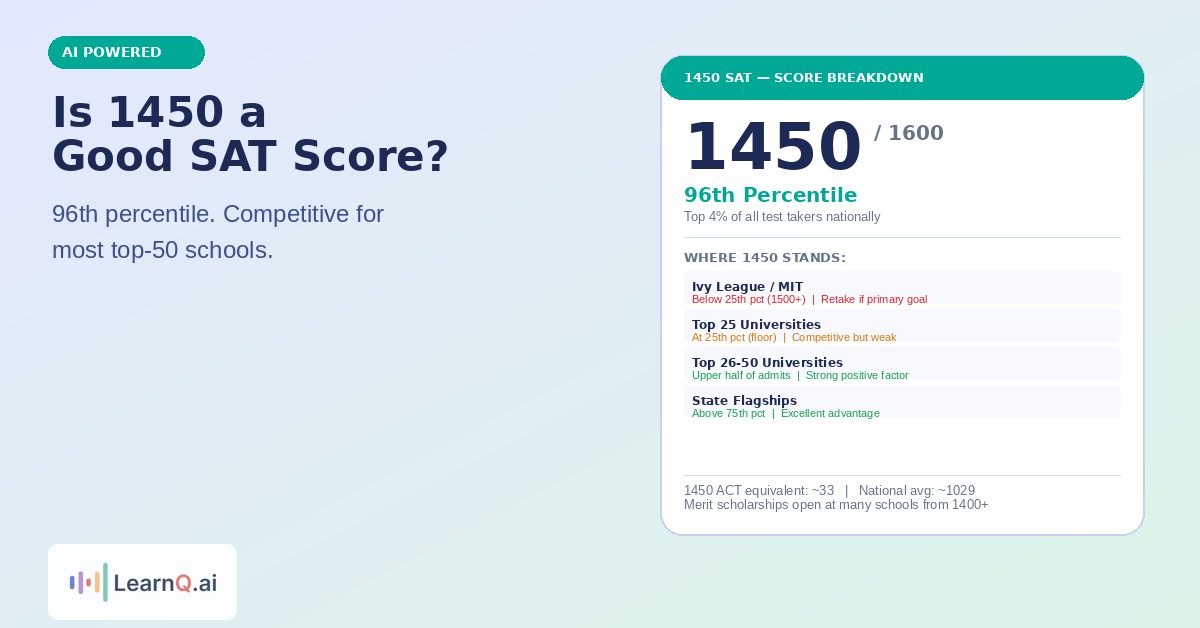
Yes, a 1450 SAT is an excellent score. It places you at approximately the 96th percentile nationally, meaning you scored higher than 96 out of every 100 students who took the test. A 1450 is competitive for most top-50 universities and opens doors to significant merit scholarships.
The question of whether 1450 is “good enough” depends entirely on your target schools. For many highly selective universities – Georgetown, Emory, Carnegie Mellon, USC – a 1450 puts you in the top quarter of admitted students. For Ivy League schools and MIT, it falls below the typical 25th percentile. This guide breaks down exactly where a 1450 lands at different college tiers, what it means for scholarships, and whether it’s worth retaking.
What Percentile Is a 1450 SAT?
A 1450 SAT score falls at approximately the 96th percentile based on College Board’s 2025 percentile data. This means you outperformed 96% of all students who took the Digital SAT in the most recent testing cycle.
To put that in context: the national average SAT score is approximately 1029 (521 Reading and Writing, 508 Math). A 1450 is 421 points above average – placing you firmly in the top 4% of all test takers nationwide.
The percentile table below shows how 1450 compares to surrounding scores:
| SAT Score | Approximate Percentile |
|---|---|
| 1600 | 99th+ |
| 1550 | 99th |
| 1500 | 98th |
| 1450 | 96th |
| 1400 | 93rd |
| 1350 | 90th |
| 1300 | 86th |
| 1250 | 81st |
| 1200 | 76th |
One important note: above 1450, each additional 50 points gains only about 2-3 percentile points. Going from 1450 to 1550 moves you from the 96th to the 99th percentile – meaningful for elite schools, but a much smaller percentile jump than the same 100 points would deliver at lower score ranges. Our full SAT score percentile guide explains why improvement ROI decreases significantly above 1450.
Is 1450 Good Enough for Your Target Schools?
The answer depends on where you want to apply. Here is a clear breakdown by college tier:
Ivy League and Elite Universities
For Harvard, Princeton, Yale, MIT, Columbia, and similar schools, a 1450 falls below the 25th percentile of admitted students. The typical middle 50% at these schools runs 1500-1580. A 1450 does not disqualify you – other application elements can compensate – but your SAT score becomes a relative weakness in these applicant pools.
Verdict: Below competitive range. Worth retaking if Ivies are a primary goal.
Top 25 Universities (Non-Ivy)
Schools like Duke, Northwestern, Johns Hopkins, Georgetown, Carnegie Mellon, and Vanderbilt have middle 50% SAT ranges of roughly 1450-1570. A 1450 places you right at the 25th percentile – inside the range but at the lower boundary.
Verdict: Competitive, but you’re at the floor. A 1500+ would meaningfully strengthen your application at these schools.
Top 26-50 Universities
This tier includes Emory, USC, Wake Forest, Tufts, University of Virginia, Boston College, and similar schools. Middle 50% ranges typically run 1350-1510. A 1450 puts you solidly in the upper half of admitted students at most of these schools.
Verdict: Strong – comfortably in range for most schools in this tier. Your SAT is a positive factor.
Strong State Flagship Universities
Schools like University of Michigan, University of North Carolina, UCLA, University of Texas at Austin, and University of Wisconsin-Madison have middle 50% ranges of roughly 1280-1480. A 1450 puts you above the 75th percentile at most state flagships.
Verdict: Excellent – your score strengthens your application significantly at this tier.
Merit Scholarships
A 1450 triggers automatic merit awards at many universities. Schools like Tulane, University of Alabama, University of Denver, and numerous private colleges offer substantial merit scholarships for scores in the 1400-1450 range. Some schools offer full-tuition scholarships starting at 1450 with strong GPA.
How Does a 1450 Break Down by Section?
A 1450 total can reflect different section score combinations – and colleges pay attention to this breakdown. Common splits include:
| R&W Score | Math Score | Total | Notes |
|---|---|---|---|
| 750 | 700 | 1450 | Balanced – strong for most programs |
| 700 | 750 | 1450 | Math-heavy – stronger for STEM programs |
| 780 | 670 | 1450 | R&W dominant – may need Math improvement for STEM |
| 720 | 730 | 1450 | Balanced – competitive broadly |
If your Math score is significantly lower than your R&W score (e.g., 670 Math + 780 R&W = 1450), consider whether your target programs are math-intensive. Computer science, engineering, and economics programs often weight Math scores more heavily. A 700+ Math score at a 1450 total is generally considered well-balanced.
Use LearnQ’s Digital SAT score calculator to see how different section score combinations affect your total and percentile.
Should You Retake the SAT With a 1450?
The retake decision depends on your specific goals:
Retake if:
- Your primary target schools have a 75th percentile above 1500 (Ivy League, MIT, Caltech, top 15 schools)
- Your Math and R&W scores are significantly imbalanced and you can identify specific question types costing you points
- You are targeting programs (engineering, CS, finance) where Math score matters particularly
- You have time to prep properly before the next test date – at least 6-8 weeks of targeted drilling
Do not retake if:
- Your target schools are in the top 26-75 range where 1450 is solidly competitive
- You have a strong GPA and activities portfolio and the marginal improvement from retaking is minimal
- The time cost of retaking would reduce time available for other application elements (essays, activities)
- You’re applying to schools where your 1450 already puts you above the 75th percentile
The key insight: going from 1450 to 1500 moves you about 2 percentile points nationally, but that shift matters more at some schools than others. At Duke or Georgetown (where 1450 is the 25th percentile), adding 50 points matters. At Emory or USC (where 1450 is near the median), the improvement is less consequential. Check each target school’s middle 50% before deciding.
What the Score Difference Between 1400 and 1450 Means
If you are comparing a 1400 SAT to 1450, the 50-point gap narrows the percentile difference to about 3 points (93rd vs 96th). Both are excellent scores – the practical difference in admissions is less about the national percentile and more about how each score compares to individual school middle 50% ranges.
At a school like Northeastern (middle 50%: 1420-1530), a 1450 puts you squarely in range while a 1400 puts you just below the 25th percentile. At a school like Tulane (middle 50%: 1330-1480), both 1400 and 1450 are above the median.
The SAT ACT score conversion shows a 1450 SAT is approximately equivalent to a 33 ACT – useful context if you’re deciding which test to submit or whether to also take the ACT.
How to Get From 1450 to 1500+
If you’ve decided to retake, the path from 1450 to 1500 is achievable with targeted prep. At the 96th percentile, random drilling no longer works – you need to identify the specific question types costing you points and drill those precisely.
The most common gaps at the 1450-1490 range:
Reading and Writing: Rhetorical Synthesis (hardest R&W type, always last in the module), Quantitative Command of Evidence (data interpretation), and Cross-Text Connections. These three types together account for 8-10 questions per test and are the most under-drilled at high score levels.
Math: Nonlinear functions in Advanced Math (exponential growth/decay, function behavior), multi-step Geometry problems, and hard Systems of Equations. At 700+ Math, the remaining losses are almost always in Hard Module 2 – the questions that appear only when you’ve routed to the hard track.
The Digital SAT Module 1 strategy guide explains how routing to Hard Module 2 sets your score ceiling. At 1450, you are almost certainly routing to Hard Module 2 consistently – your gains need to come from within that module.
For a structured improvement approach, the 200-point SAT improvement guide covers the diagnostic-drill-retest loop that produces consistent score gains, though at 1450 you would be targeting a 50-100 point increase rather than 200.
Start with LearnQ’s free diagnostic to identify exactly which question types are costing you points at your current level. At 1450, the gap is usually 3-5 specific question types in Hard Module 2 – not a broad content problem.
1450 SAT and Test-Optional Colleges
With many selective colleges now reinstating testing requirements (MIT, Yale, Harvard, Dartmouth, Brown all require scores as of 2025-2026), the strategic calculation around submitting scores has changed.
For schools that remain test-optional: a 1450 is generally worth submitting. The 96th percentile is a strong data point and most admissions guidance suggests submitting if your score is at or above the 50th percentile of a school’s admitted students – which a 1450 satisfies at nearly every school outside the top 15.
For schools that require scores: a 1450 is competitive at most selective schools in the top 26-75 range and outstanding at state flagships. At Ivy-level schools, it is a below-median score that will require the rest of your application to compensate.
Check each school’s current test policy at Common App – policies are updated annually and the landscape has shifted significantly since 2022.
Practice Test Strategy at the 1450 Level
At 1450, the most common mistake is taking more full-length practice tests without targeting specific weaknesses. If you take Bluebook Test 11 and score 1450, then take Test 7 and score 1460, you have not learned anything actionable – you have confirmed your current ceiling.
What actually moves the needle at this score range: identify the 3-4 question types you are missing most in Hard Module 2, drill 50-100 questions of each type over 2-3 weeks, then retest. The Bluebook practice test accuracy guide explains which of the 8 practice tests best simulate the real Hard Module 2 difficulty at the 1450+ level (Tests 11 and 7 are the most predictive).
LearnQ.ai’s full-length adaptive practice test provides question-type breakdown analytics alongside your score – giving you the specific Hard Module 2 question types to target rather than just a total score.
FAQ
Is 1450 a good SAT score?
Yes. A 1450 SAT is an excellent score, placing you at the 96th percentile – meaning you scored higher than 96% of test takers. It is competitive for most top-50 universities and qualifies for merit scholarships at many schools. The main limitation is that it falls below the 25th percentile at Ivy League and elite schools (MIT, Caltech) where the typical range is 1500-1580.
What colleges can I get into with a 1450 SAT?
A 1450 is solidly competitive at schools like USC, Emory, Georgetown (at the lower end), Wake Forest, Tufts, University of Virginia, Boston College, Northeastern, and most state flagships. It is below the typical 25th percentile at Harvard, Princeton, MIT, Yale, Columbia, and peer institutions. See each school’s Common Data Set for the most current middle 50% ranges.
What percentile is a 1450 SAT?
A 1450 SAT is approximately the 96th percentile based on College Board’s most recent data. This means 96% of students who took the SAT scored at or below 1450.
Is it worth retaking the SAT if I got a 1450?
It depends on your goals. If you are targeting Ivy League or top-15 schools where the 25th percentile is 1500+, retaking is worth considering. If your target schools are in the top 26-75 range, a 1450 is already competitive and retaking may not be the best use of your time. Always compare your 1450 to the specific middle 50% ranges of your target schools before deciding.
What is a 1450 SAT equivalent to on the ACT?
A 1450 SAT converts to approximately a 33 ACT using the official concordance table. Both represent the 96th percentile and are equivalent for college admissions purposes. See the full SAT to ACT conversion chart for complete concordance data.
Does a 1450 SAT qualify for merit scholarships?
Yes. Many universities offer substantial merit scholarships for scores in the 1400-1450+ range. Schools like University of Alabama (Presidential Scholarship), Tulane, University of Denver, and numerous private liberal arts colleges offer awards ranging from partial to full tuition for students with strong GPA plus 1450 SAT. Requirements vary – check each school’s merit aid page directly.
How much can I realistically improve from a 1450?
Most students at 1450 can realistically improve 30-70 points with 6-8 weeks of targeted prep focused on their specific Hard Module 2 weaknesses. Going from 1450 to 1500+ requires identifying and drilling the exact question types you are missing – typically 3-4 specific types rather than broad content review. The marginal effort per point is higher at 1450 than at 1200, but a 1500 is genuinely achievable for most students at this level.
What is the national average SAT score compared to 1450?
The national average SAT score is approximately 1029 (521 Reading and Writing, 508 Math) based on College Board’s class of 2025 data. A 1450 is 421 points above the national average and places you in the top 4% of all test takers – well above the threshold for competitive consideration at most selective universities.
Sources: College Board SAT Score Percentile data 2025; Common App college admissions data; Magoosh SAT score ranges guide (magoosh.com, 2026); PrepScholar SAT percentile data (prepscholar.com, 2025); Larry Learns SAT percentile analysis (larrylearns.com, April 2026)

The LearnQ Editorial Team is made up of certified Digital SAT tutors, college admissions specialists, and AI education researchers. Our tutors have personally helped over 10,000 US high school students improve their SAT scores, with an average improvement of 150+ points. We combine hands-on tutoring expertise with AI-powered insights from the LearnQ platform, which has analyzed millions of Digital SAT practice questions. Every article we publish is reviewed against the latest College Board Bluebook guidelines and cross-checked with real student performance data. Our mission is simple: give every student the same quality of prep that was once only available at expensive tutoring centers.