

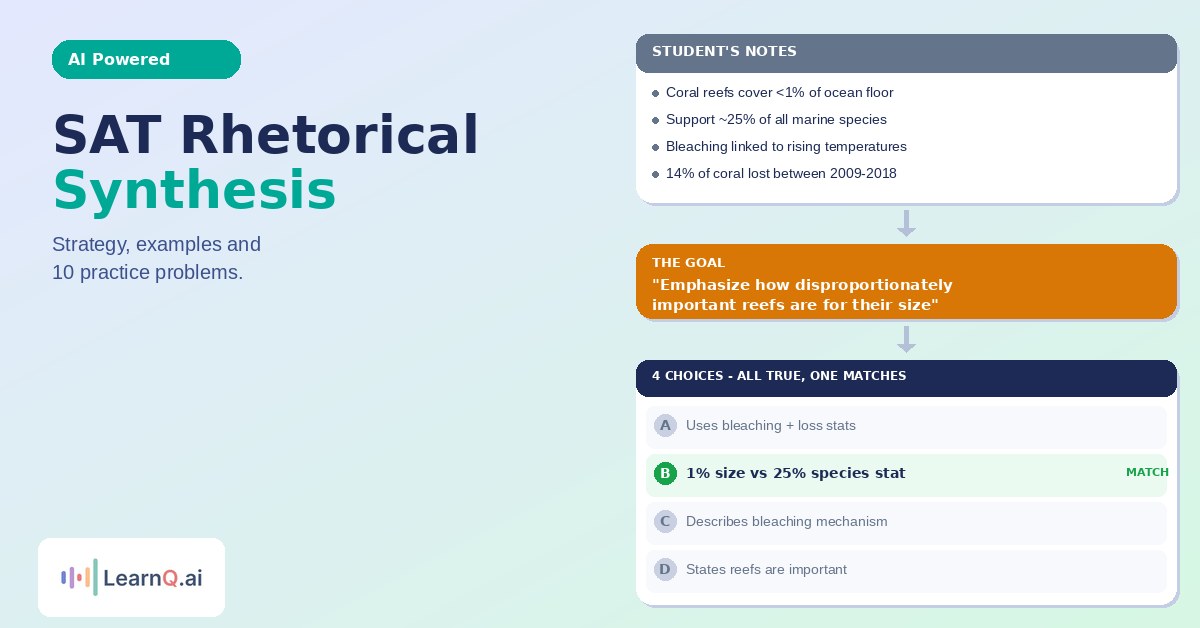
Rhetorical Synthesis questions give you a set of bulleted research notes and a stated goal – then ask which sentence best accomplishes that goal. All four answer choices are factually accurate and grammatically correct. The only thing separating right from wrong is whether the sentence does exactly what the goal asks – no more, no less. Students who read the goal first, before the notes, solve these questions faster and more accurately than students who read everything and then hunt for the “best” answer.
Rhetorical Synthesis is one of the most distinctive question types on the Digital SAT because it is not a reading comprehension task at all. You are not being tested on whether you understood the notes – you almost certainly did, since they are short factual statements. You are being tested on whether you can match information to a specific, precisely worded objective.
Where Rhetorical Synthesis Fits on the Test
Rhetorical Synthesis sits in the Expression of Ideas domain of Reading and Writing, alongside Transitions questions. According to College Board’s test structure, Expression of Ideas makes up approximately 20% of the R&W section – roughly 8-12 questions across both modules. You will typically see 2-4 Rhetorical Synthesis questions per full test, and they always appear at the end of each module, after all other question types.
For the full breakdown of all 8 R&W question types and where Rhetorical Synthesis fits, see the Digital SAT question types guide. Transitions questions – the other Expression of Ideas subtype – are covered in the Transitions strategy guide.
The Format: What Every Question Looks Like
Every Rhetorical Synthesis question follows an identical structure:
The setup line: “While researching a topic, a student has taken the following notes:”
The notes: 4-6 bullet points, each a short, factual statement – names, dates, statistics, findings, or descriptions.
The goal: A single sentence stating what the student wants to accomplish, such as “The student wants to emphasize a difference between the two studies” or “The student wants to introduce the topic to an audience unfamiliar with it.”
The question: “Which choice most effectively uses relevant information from the notes to accomplish this goal?”
The four choices: Complete sentences, each built from real information in the notes. All four are factually correct and grammatically sound. Only one accomplishes the stated goal precisely.
This format is the same every time, which is exactly why a fixed method works so well.
The Core Strategy: Read the Goal First
The single most important habit for Rhetorical Synthesis questions is reading the goal sentence before carefully studying the notes. Here is why this matters:
The notes always contain more information than you need. If you read every bullet point first and try to hold all of it in your head, you risk anchoring on an interesting detail that turns out to be irrelevant. Reading the goal first acts as a filter – you scan the notes already knowing which ones matter and which ones are noise.
The 3-step method:
Step 1: Read the goal with total precision. Every word matters. “Emphasize a difference” is not the same task as “introduce a comparison.” “Explain why” is not the same as “explain how.” Underline or mentally flag the exact verb and object of the goal – this is what the correct answer must do.
Step 2: Scan the notes for only what the goal requires. If the goal is to highlight one researcher’s specific contribution, you need the note about that contribution – not every biographical detail about the researcher. If the goal is to compare two things, you need at least one fact about each.
Step 3: Test each choice against the goal, not against the notes. The most common wrong-answer trap is a sentence that is completely accurate and well-supported by the notes but fails to achieve the specific goal. Do not ask “is this true?” Ask “does this accomplish exactly what the goal asked for?”
The Trap That Catches Most Students
The single most damaging habit on Rhetorical Synthesis questions is treating them like reading comprehension. Students trained to “find evidence in the passage” naturally gravitate toward the answer choice with the most detail, or the one that sounds most complete. That instinct is wrong here.
The correct answer uses exactly what is necessary to achieve the goal – neither more nor less. A choice can be 100% accurate, well-written, and packed with relevant facts, and still be wrong if it does not match the specific rhetorical aim. Conversely, a shorter, simpler sentence that precisely hits the goal is correct even if it “leaves out” interesting information from the notes.
Common goal-precision traps:
- “Emphasize importance” vs. “explain a cause” – these sound similar but require different information
- “Introduce a topic to an unfamiliar audience” vs. “summarize findings for an expert audience” – the correct answer changes based on assumed audience knowledge
- “Highlight a similarity” vs. “highlight a difference” – one asks you to connect two things, the other to distinguish them
- Two answer choices both draw from the same true notes but frame them with different emphasis – only one matches the goal’s specific verb
10 Worked Examples
Example 1 – Emphasize significance
Notes:
- Coral reefs cover less than 1% of the ocean floor.
- They support an estimated 25% of all marine species.
- Coral bleaching has increased due to rising ocean temperatures.
- A 2020 study found 14% of the world’s coral was lost between 2009 and 2018.
Goal: The student wants to emphasize how disproportionately important coral reefs are relative to their size.
Correct answer: A sentence combining the “less than 1%” and “25% of species” facts – the two notes that establish the size-to-importance disproportion. The bleaching and loss statistics are relevant to reef decline generally but do not address size-versus-importance specifically.
Example 2 – Introduce to an unfamiliar audience
Notes:
- The Taj Mahal was commissioned by Mughal emperor Shah Jahan.
- It was built in memory of his wife, Mumtaz Mahal.
- Construction began in 1632 and finished around 1648.
- It is made of white marble with intricate inlay work.
Goal: The student wants to explain why the Taj Mahal was built.
Correct answer: The sentence stating Shah Jahan commissioned it in memory of his wife. This is the only note that answers “why.” Construction dates and materials describe the building, not its purpose.
Example 3 – Highlight a difference
Notes:
- “The Scarlet Letter” was written by Nathaniel Hawthorne in 1850.
- It focuses on hypocrisy, sin, and guilt in a Puritan community.
- “David Copperfield” was written by Charles Dickens in 1850.
- It addresses class inequality and social mobility in Victorian England.
Goal: The student wants to highlight a difference in thematic focus between the two novels.
Correct answer: A sentence contrasting “hypocrisy, sin, and guilt in a Puritan community” against “class inequality and social mobility in Victorian England.” The shared publication year (1850) is a similarity, not a difference, so it should not appear in the correct answer here.
Example 4 – Emphasize scale
Notes:
- The Sahara is the largest hot desert in the world.
- It covers approximately 3.6 million square miles.
- Temperatures can exceed 120 degrees Fahrenheit.
- It spans portions of 11 countries.
Goal: The student wants to emphasize the extreme heat of the Sahara.
Correct answer: The sentence using the 120-degree temperature statistic. Size and country-count are impressive but irrelevant to the specific goal of “heat.”
Example 5 – Summarize a finding for a general audience
Notes:
- A study tracked 500 participants over 10 years.
- Researchers measured sleep duration and cardiovascular health markers.
- Participants sleeping under 6 hours nightly had 23% higher rates of hypertension.
- The study was published in a peer-reviewed medical journal in 2024.
Goal: The student wants to summarize the study’s key finding for a general audience unfamiliar with the research.
Correct answer: A sentence stating that people who sleep less than 6 hours a night had significantly higher rates of high blood pressure. Study size, methodology, and publication details are appropriate for an academic audience, not a general one – the goal specifically asks for the finding, in accessible terms.
Example 6 – Compare two researchers’ contributions (higher difficulty)
Notes:
- Dr. Sylvia Earle led the first team of women aquanauts in 1970 (“Tektite II”).
- She later conducted a record-setting solo dive to 1,250 feet (“Jim Suit”).
- Robert Ballard co-founded the JASON Project, connecting students to live ocean exploration.
- Ballard also discovered the wreck of the Titanic in 1985.
Goal: The student wants to draw a similarity between Earle and Ballard by highlighting a specific pioneering project each led.
Correct answer: A sentence mentioning both the “Jim Suit” dive and the “JASON Project” together, framing both as pioneering achievements. A choice that only mentions one researcher, or that focuses on the Titanic discovery (not a “project” in the same sense), fails the goal’s specific requirement of comparing pioneering projects from both individuals.
Example 7 – Explain a mechanism (cause, not effect)
Notes:
- Rising ocean temperatures cause coral to expel the algae living in their tissues.
- This process is called coral bleaching.
- Bleached coral is not dead but is more vulnerable to disease and starvation.
- Some corals recover if temperatures drop quickly enough.
Goal: The student wants to explain what causes coral bleaching.
Correct answer: The sentence about rising temperatures causing coral to expel algae. Do not select an answer about bleached coral’s vulnerability or recovery – those describe effects and outcomes, not the cause the goal specifically asks for.
Example 8 – Two true choices, only one matches the goal (hard)
Notes:
- The bridge was completed in 1937 after four years of construction.
- It was the longest suspension bridge in the world at the time.
- Its total length is 8,980 feet.
- The bridge remains an iconic symbol of the city today.
Goal: The student wants to emphasize the engineering achievement the bridge represented at the time it was built.
Trap: A choice stating “the bridge remains an iconic symbol of the city today” is true and about the bridge, but it addresses cultural significance now, not engineering achievement at the time of construction.
Correct answer: The sentence combining “longest suspension bridge in the world at the time” with the length statistic (8,980 feet) – this directly supports “engineering achievement at the time.”
Example 9 – Concede a point before making another (advanced goal wording)
Notes:
- Renewable energy adoption has grown significantly since 2015.
- Solar and wind now account for over 20% of electricity generation in several countries.
- Storage technology remains a major limitation for renewable reliability.
- Battery costs have fallen by more than 80% over the past decade.
Goal: The student wants to acknowledge a limitation of renewable energy while noting progress being made to address it.
Correct answer: A sentence combining the storage limitation with the falling battery cost statistic – this is the only combination that both “acknowledges a limitation” and “notes progress addressing it.” A sentence using only the 20% generation statistic ignores the “acknowledge a limitation” requirement entirely.
Example 10 – Distinguishing “example” goals from “summary” goals
Notes:
- The novel uses non-linear narrative structure, jumping between three time periods.
- One storyline follows a grandmother in 1950s rural Georgia.
- A second storyline follows her granddaughter in present-day Atlanta.
- The two storylines converge in the final chapter.
Goal: The student wants to provide a specific example of the novel’s non-linear structure.
Correct answer: A sentence describing the two specific storylines (grandmother in 1950s Georgia, granddaughter in present-day Atlanta) as an example of how the non-linear structure works. A sentence that only restates “the novel uses non-linear narrative structure” without a concrete example fails the goal, since the goal specifically asks for an example, not a restatement.
Quick-Reference: Common Goal Verbs and What They Require
| Goal Verb/Phrase | What the Correct Answer Must Do |
|---|---|
| Emphasize / highlight | Select the note(s) most directly supporting that specific point – not everything true |
| Introduce to an unfamiliar audience | Use accessible, general information – avoid jargon or narrow statistics |
| Summarize a finding | State the outcome or conclusion, not the methodology |
| Explain why / explain a cause | Select the note describing motivation or mechanism, not effects or descriptions |
| Draw a similarity | Combine one fact from each of two things being compared, framed as alike |
| Draw a difference | Combine contrasting facts from two things, framed as different |
| Acknowledge a limitation | Include the negative or limiting fact, not just positive progress |
| Provide a specific example | Use concrete details, not a general restatement of the concept |
Practice and Next Steps
Rhetorical Synthesis questions reward precision, not reading speed. Because all four choices are factually correct, rushing does not help – careful goal-reading does. Most students see meaningful improvement after 10-15 practice questions applying the goal-first method deliberately.
Practice with real questions using College Board’s Bluebook app, which includes 8 free full-length practice tests. See which Bluebook tests are most predictive of your actual score range.
Rhetorical Synthesis sits alongside Transitions in the Expression of Ideas domain – see the Transitions strategy guide for the other question type in this domain. The Standard English Conventions guide covers the grammar-focused questions that appear alongside Expression of Ideas in the same R&W modules. The Module 1 strategy guide explains how your accuracy across all R&W question types in Module 1 determines your Module 2 difficulty and score ceiling.
LearnQ’s free diagnostic test identifies exactly how many Expression of Ideas questions you are missing and whether the pattern points to Rhetorical Synthesis or Transitions specifically. Mia, the AI tutor, generates additional Rhetorical Synthesis practice questions on demand and explains precisely why each wrong choice fails to match the stated goal.
If Rhetorical Synthesis is one of several R&W areas holding back your score, the 200-point improvement guide shows how to prioritise question types for maximum score gain. Take a free full-length practice test on LearnQ’s Digital SAT platform to see how Rhetorical Synthesis accuracy fits into your overall R&W performance.
FAQ
What are Rhetorical Synthesis questions on the Digital SAT?
Rhetorical Synthesis questions present a set of bulleted research notes and a stated goal, then ask which sentence best uses information from the notes to accomplish that specific goal. All four answer choices are factually accurate and grammatically correct – the only distinguishing factor is whether the sentence precisely matches the stated rhetorical aim, such as emphasizing a difference, introducing a topic, or summarizing a finding.
How many Rhetorical Synthesis questions are on the Digital SAT?
Typically 2-4 per full test, within the Expression of Ideas domain of Reading and Writing. Expression of Ideas accounts for approximately 20% of the R&W section (roughly 8-12 questions total), split between Rhetorical Synthesis and Transitions questions.
What is the best strategy for Rhetorical Synthesis questions?
Read the goal sentence carefully before studying the notes in detail. This lets you scan the notes already knowing which facts are relevant, rather than trying to hold every detail in mind and hunting for the “best” answer afterward. Then test each answer choice against the specific goal, not against general accuracy – the correct answer uses exactly what the goal requires, no more and no less.
Why do students get Rhetorical Synthesis questions wrong even when they understand the notes?
The most common cause is treating the question like reading comprehension – looking for the answer with the most detail or that sounds most complete, rather than the one that precisely matches the stated goal. All four choices are typically true and well-supported by the notes, so accuracy alone cannot distinguish them. Students must evaluate each choice specifically against the goal’s exact wording (e.g., “emphasize a difference” vs. “introduce a comparison”) rather than against the notes generally.
Do I need to read every bullet point in the notes carefully?
Not with equal attention. Read the goal first, then scan the notes specifically for the information that goal requires. The notes typically contain more information than any single correct answer will use, and reading every detail with equal weight before knowing the goal often leads students to anchor on irrelevant facts.
How is Rhetorical Synthesis different from Transitions questions?
Both are in the Expression of Ideas domain, but they test different skills. Transitions questions ask you to select the transition word or phrase that best connects two given sentences based on their logical relationship (contrast, cause-effect, etc.). Rhetorical Synthesis questions ask you to construct or select a sentence using provided notes to accomplish a specific writing goal. See the Transitions strategy guide for the full breakdown of that question type.
Sources: College Board Digital SAT Expression of Ideas domain overview; Fiveable Digital SAT Rhetorical Synthesis study guide (fiveable.me, June 2026); Achievable SAT Rhetorical Synthesis lesson (app.achievable.me); TestPrepKart SAT Expression of Ideas guide (testprepkart.com, June 2026); Test Ninjas SAT Rhetorical Synthesis guide (test-ninjas.com)

The LearnQ Editorial Team is made up of certified Digital SAT tutors, college admissions specialists, and AI education researchers. Our tutors have personally helped over 10,000 US high school students improve their SAT scores, with an average improvement of 150+ points. We combine hands-on tutoring expertise with AI-powered insights from the LearnQ platform, which has analyzed millions of Digital SAT practice questions. Every article we publish is reviewed against the latest College Board Bluebook guidelines and cross-checked with real student performance data. Our mission is simple: give every student the same quality of prep that was once only available at expensive tutoring centers.