

Transitions questions appear 2-3 times per Digital SAT in the Expression of Ideas domain. They give you a short passage with a blank and ask which transition word or phrase best connects two ideas. The correct answer is never about what sounds smooth – it is about which word accurately describes the logical relationship between the two sentences. Students who learn to identify the relationship first, before reading the answer choices, get these right almost every time.
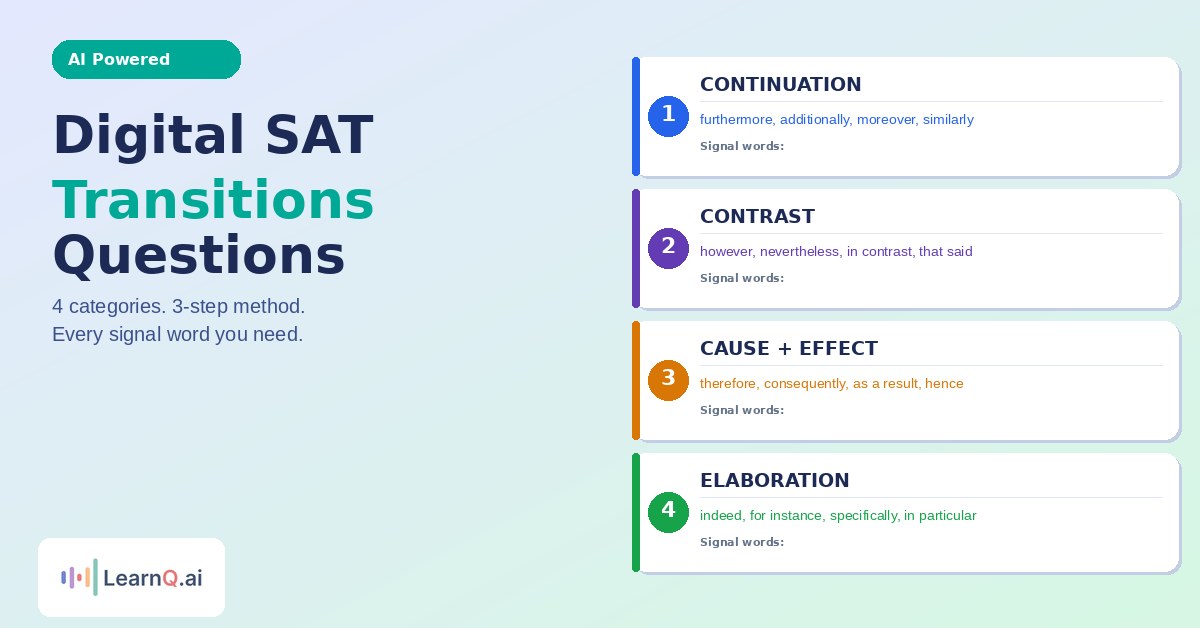
Transitions questions are among the most learnable question types on the Digital SAT. There are exactly four logical relationships tested, a finite set of signal words for each, and a three-step method that removes all guesswork. This guide covers everything you need.
Where Transitions Questions Appear
Transitions questions are part of the Expression of Ideas domain in Reading and Writing. According to College Board’s test structure, Expression of Ideas accounts for approximately 20% of the R&W section – around 8-12 questions total across both modules. Transitions is one of two question types in this domain (the other being Rhetorical Synthesis).
You will typically see 2-3 Transitions questions per test. They appear toward the end of each module, after the Craft and Structure questions. The format is always the same: a passage of 2-4 sentences with a blank where a transition word or phrase belongs, followed by the question: “Which choice completes the text with the most logical transition?”
For a full breakdown of all 8 R&W question types and how Transitions fits into the overall section, see the Digital SAT question types guide.
The 4 Logical Relationships Tested
Every Transitions question tests one of four relationships. Memorise these categories – they cover 100% of what appears on the test.
Category 1: Continuation (Addition)
The second sentence adds to, reinforces, or extends the idea in the first sentence. Both sentences point in the same direction.
Signal words in the passage: also, and, in addition, as well, similarly, likewise, both
Transition words that signal continuation:
- Furthermore, Moreover, Additionally, In addition, Also, Similarly, Likewise, What is more
How to spot it: Read both sentences. If you can mentally connect them with “and also…” the relationship is continuation.
Example: “The study found that regular exercise improves cardiovascular health. ______, participants who exercised three times per week reported significantly lower stress levels.”
Relationship: The second sentence adds another benefit. Answer: Furthermore / Additionally
Category 2: Contrast
The second sentence contradicts, qualifies, or moves in a different direction from the first. There is a turn between the two ideas.
Signal words in the passage: but, yet, despite, although, even though, while, unlike, instead, rather
Transition words that signal contrast:
- However, Nevertheless, Nonetheless, Yet, In contrast, On the other hand, Despite this, Even so, That said
How to spot it: If one sentence is positive and the other negative, or if the second sentence surprises you given the first, it is contrast.
Example: “Early trials showed the vaccine to be highly effective against the original strain. ______, its efficacy against newer variants dropped significantly within six months.”
Relationship: Unexpected negative result after positive finding. Answer: However / Nevertheless
Category 3: Cause and Effect
One sentence describes a cause; the other describes its result or consequence. The relationship is directional: X caused Y.
Signal words in the passage: because, since, as a result, due to, leading to, causing
Transition words that signal cause and effect:
- Therefore, Thus, Consequently, As a result, Hence, For this reason, Accordingly
How to spot it: Test by asking “Because of the first sentence, the second sentence happened.” If that logic holds, it is cause and effect.
Example: “Ocean temperatures in the region rose by nearly 3 degrees Celsius over the decade. ______, coral bleaching events became significantly more frequent and severe.”
Relationship: Rising temperatures caused bleaching. Answer: As a result / Consequently
Category 4: Elaboration and Emphasis
The second sentence clarifies, exemplifies, or underscores a point already made. It does not add new information – it deepens the existing claim.
Signal words in the passage: in fact, indeed, of course, clearly, specifically, for instance, for example
Transition words that signal elaboration:
- Indeed, In fact, Specifically, For example, For instance, In particular, That is, Notably
How to spot it: If the second sentence restates or zooms into the first with more detail or a concrete example, it is elaboration.
Example: “The architect’s later work departed radically from her early minimalist style. ______, her final three buildings incorporated ornate facades, layered structural forms, and extensive use of colour.”
Relationship: The second sentence gives specific examples of the departure. Answer: Indeed / Specifically
The 3-Step Method
Step 1: Cover the answer choices and read both sentences
Before looking at A, B, C, or D, read the full passage. Identify the sentence before the blank and the sentence after the blank. Do not read the choices yet.
Step 2: Name the relationship in your own words
Ask: what is the connection between these two sentences? Use one of the four categories: continuation, contrast, cause-effect, or elaboration. You can also simply say “the second sentence goes in the same direction” or “the second sentence flips direction.”
Also scan for signal words already in the passage. A word like “despite” or “although” already in the sentence is a clue the passage is signalling contrast. A phrase like “as a result” already present means the blank is likely filling a cause-effect role.
Critical rule: the transition word connects the sentence before the blank to the sentence after the blank, regardless of where in that sentence the blank appears. Even if the blank is mid-sentence or at the end, the blank is bridging the idea from the prior sentence to the current one.
Step 3: Match the category to the choices, then eliminate
Open the choices. Immediately eliminate any word that belongs to the wrong category. If the relationship is contrast, eliminate all continuation and cause-effect words without reading further. You will usually be left with 1-2 choices in the right category, and can then eliminate by precision.
Common precision traps:
- “Furthermore” (adds a new similar point) vs “In other words” (restates the same point) – both are continuation-type, but they do different jobs
- “However” (general contrast) vs “Nevertheless” (concedes the first point but maintains the second despite it) – both contrast, but “nevertheless” implies the second sentence persists despite the first
- “Therefore” (logical consequence) vs “For example” (elaboration) – never confuse these even when both feel like “follow-ups”
8 Worked Examples
Example 1 – Continuation
“The new transit line reduced average commute times by 22 minutes. ______, ridership across the entire network increased by 18% in the first year.”
Step 2: Both sentences are positive outcomes of the same project. Same direction.
Step 3: “Furthermore” – adds a second benefit. Answer: Furthermore
Example 2 – Contrast
“The species had been classified as endangered for over two decades. ______, recent population surveys suggest numbers have recovered to sustainable levels.”
Step 2: Negative status, then unexpectedly positive news. Flip in direction.
Step 3: “However” – signals the unexpected positive turn. Answer: However
Example 3 – Cause and Effect
“The drought lasted nearly three years, depleting reservoir levels across the region. ______, local governments implemented strict water rationing programmes.”
Step 2: The drought (cause) produced a government response (effect).
Step 3: “As a result” – the rationing is the direct consequence of the drought. Answer: As a result
Example 4 – Elaboration
“The composer’s methods were considered deeply unconventional by her contemporaries. ______, she refused to use standard notation, preferring instead a system of symbols she had invented herself.”
Step 2: The second sentence gives a specific example of how she was unconventional.
Step 3: “Indeed” or “For instance” – both elaborate. “For instance” is more precise because it introduces a concrete example. Answer: For instance
Example 5 – Continuation trap (near-synonym precision)
“The revised guidelines improved patient outcomes in clinical settings. ______, they reduced administrative burden for frontline staff.”
Step 2: Both sentences are positive additions – same direction.
Trap: “Therefore” sounds like a follow-up but implies the second sentence is caused by the first. It is not – both are independent benefits.
Step 3: “Additionally” – adds a separate benefit without implying causation. Answer: Additionally
Example 6 – Contrast with signal word already present
“Early critics dismissed the novel as overly sentimental. ______, despite these initial reactions, it went on to win three major literary awards.”
Step 2: “Despite” is already in the sentence, handling the contrast. The blank comes before “despite,” so it is bridging from the dismissal to the award-winning outcome – the overall arc is still contrast.
Step 3: “Nevertheless” – the novel won awards despite initial dismissal. Answer: Nevertheless
Example 7 – Cause and effect vs. contrast (common confusion)
“The researchers expected the new compound to dissolve quickly in water. ______, it remained stable for over 72 hours.”
Step 2: Expected one thing, got the opposite. This feels like cause-effect but it is contrast: the result contradicted the expectation.
Step 3: “Instead” or “However” – the result went against the expectation, not because of it. Answer: However / Instead
Example 8 – Hard: double signal words
“Coral reefs support an estimated 25% of all marine species. Because of their ecological importance, many governments have designated reef systems as protected zones. ______, enforcement of these protections has proven difficult in international waters.”
Step 2: Reefs are protected (positive) but enforcement is hard (negative). The blank bridges from the protection policy to the enforcement problem – contrast.
Step 3: “However” – despite the protections existing, enforcement fails. Answer: However
The Most Common Wrong Answer Traps
Trap 1: Choosing by sound. “Furthermore” sounds sophisticated and often appears in well-written prose. Students select it when the passage calls for contrast. Always identify the relationship first.
Trap 2: Confusing cause-effect with elaboration. “Therefore” (cause-effect) and “Indeed” (elaboration) both follow logically from the prior sentence. The distinction: “therefore” means the first sentence caused or necessitated the second; “indeed” means the second sentence is deepening or confirming the first claim without being caused by it.
Trap 3: Missing a signal word already in the passage. If “despite” or “although” already appears in the sentence containing the blank, the contrast role is already filled. The blank likely needs a different relationship type.
Trap 4: Direction of the blank. The blank always connects to the sentence that came before it. If the blank appears at the start of the second sentence, it connects sentence 1 to sentence 2. If it appears mid-sentence, it still connects to the prior sentence – not to whatever comes after the blank in the same sentence.
Practice and Next Steps
Transitions questions reward pattern recognition. After completing 10-15 targeted practice questions using the 3-step method, most students find these among the most consistent questions on the test.
For Transitions practice within a full R&W module context, use the free tests in College Board’s Bluebook app. See which Bluebook tests are most predictive at your current score level.
Transitions sit in the Expression of Ideas domain alongside Rhetorical Synthesis. The Standard English Conventions guide covers the Boundaries and Form/Structure/Sense questions that appear in the same R&W modules. The Module 1 strategy guide explains how your accuracy on Expression of Ideas questions in Module 1 affects your Module 2 routing – and therefore your score ceiling.
LearnQ’s free 40-minute diagnostic shows exactly how many Expression of Ideas questions you are missing and what pattern drives the errors. Mia, the AI tutor, generates additional Transitions practice questions on demand and explains why each wrong choice fails – faster than reviewing answer explanations alone.
If Transitions is one of several R&W question types you need to improve, the 200-point improvement guide shows how to prioritise question types by expected score gain. Take a free full-length practice test on LearnQ’s platform to see where Transitions sits in your overall R&W accuracy profile.
FAQ
How many Transitions questions are on the Digital SAT?
Typically 2-3 per test, all within the Expression of Ideas domain of the Reading and Writing section. Expression of Ideas accounts for approximately 20% of R&W questions total (around 8-12 questions across both modules), split between Transitions and Rhetorical Synthesis questions.
What are the four types of transitions tested on the Digital SAT?
The four logical relationships are: continuation or addition (furthermore, additionally, moreover), contrast (however, nevertheless, in contrast), cause and effect (therefore, consequently, as a result), and elaboration or emphasis (indeed, for instance, specifically). Every Transitions question tests one of these four relationships.
What is the best strategy for SAT Transitions questions?
Cover the answer choices, read both sentences, identify the logical relationship between them using one of the four categories, then open the choices and eliminate by category first. Do not choose based on what sounds smooth – choose based on which word accurately describes the specific relationship between the two sentences.
Why do students get Transitions questions wrong?
The most common errors: choosing by sound rather than logic, confusing cause-effect words (therefore) with elaboration words (indeed), missing a signal word already present in the passage, and misidentifying which sentence the blank is connecting to. The blank always connects the sentence containing it to the sentence that came before it, regardless of where in the sentence the blank appears.
Are Transitions questions the same on the PSAT and SAT?
Yes. The PSAT/NMSQT and Digital SAT use the same question types and the same four logical relationship categories for Transitions. Practice on SAT materials transfers directly to the PSAT. See the PSAT vs SAT comparison for a full breakdown of what is identical and what differs between the two tests.
How do I tell the difference between “furthermore” and “however”?
“Furthermore” adds a new similar idea in the same direction as the previous sentence. “However” introduces an idea that goes against or qualifies the previous sentence. If both sentences are moving in the same positive or negative direction, use furthermore. If the second sentence introduces a turn, limitation, or contradiction, use however.
Sources: College Board Digital SAT Expression of Ideas domain overview; Test Innovators Digital SAT Transitions guide (testinnovators.com, June 2024); The Test Advantage SAT transition words strategy guide (thetestadvantage.com, February 2026); Strategic Test Prep transitions question mastery guide (strategictestprep.com, May 2026); IVY Lounge Test Prep complete transition word guide 2026 (ivyloungetestprep.com, January 2026)

The LearnQ Editorial Team is made up of certified Digital SAT tutors, college admissions specialists, and AI education researchers. Our tutors have personally helped over 10,000 US high school students improve their SAT scores, with an average improvement of 150+ points. We combine hands-on tutoring expertise with AI-powered insights from the LearnQ platform, which has analyzed millions of Digital SAT practice questions. Every article we publish is reviewed against the latest College Board Bluebook guidelines and cross-checked with real student performance data. Our mission is simple: give every student the same quality of prep that was once only available at expensive tutoring centers.