

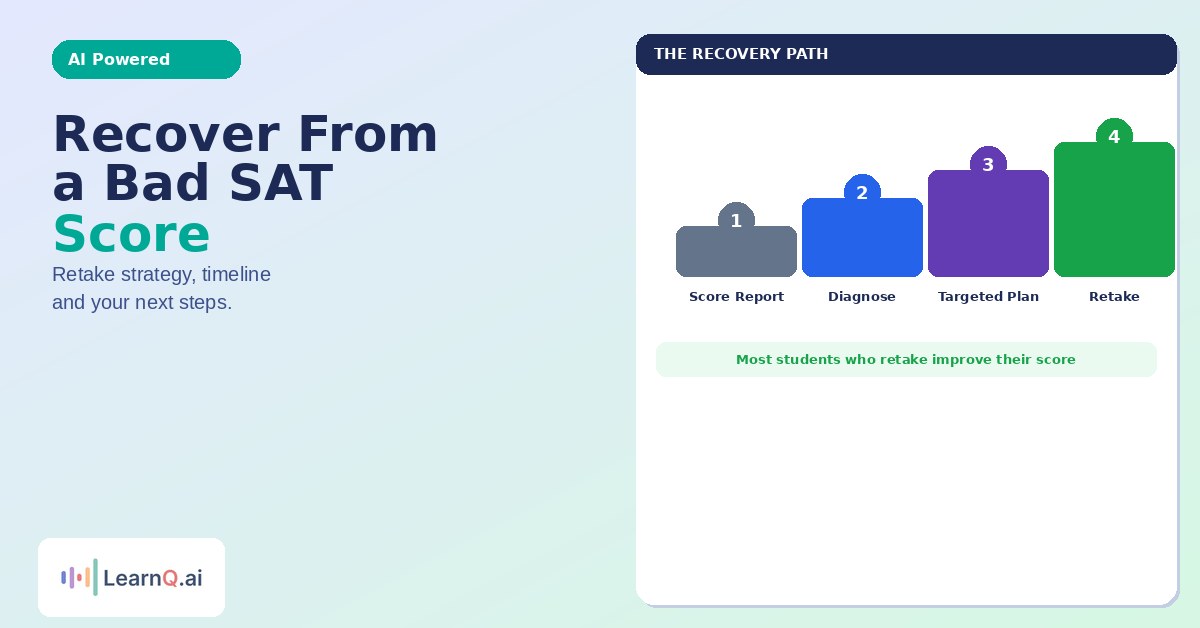
A disappointing SAT score is recoverable. Most students who retake the SAT improve their score, and average gains on a second attempt typically run 20-30 points, with motivated students who change their approach seeing 50-150+ points. The score you got is data, not a verdict – and there is a clear, structured path from here to your next attempt.
If you are reading this shortly after seeing a score that did not match what you hoped for, take a breath first. One test date does not define your college prospects, and the vast majority of students who take a focused, honest look at what went wrong end up in a stronger position on their next attempt. This guide walks through exactly what to do next: how to decide whether a retake makes sense, how to build a plan that actually changes the outcome, and how score policies like Score Choice and superscoring work in your favor.
First: What a Bad Score Does and Does Not Mean
A single SAT score does not mean you lack the ability to do well. It usually means one or more specific, fixable things happened: certain question types were weak, pacing broke down in one section, test-day nerves affected performance, or preparation before the first attempt was thinner than it needed to be. Every one of those causes has a direct fix.
It also does not mean your college options are closed. Superscoring, Score Choice, test-optional admissions, and the sheer frequency of SAT test dates all exist specifically because College Board and most colleges recognize that a single sitting is not a perfect measure of a student’s ability. See the SAT score percentile guide for context on how individual scores map to college competitiveness ranges – a low score relative to your target range is a gap to close, not a ceiling.
Step 1: Should You Retake? A Decision Framework
Work through these questions in order before committing to a retake date.
Is your score below your target schools’ typical range? If your score sits below the 25th percentile for schools on your list, a retake is almost always worth it – you need a higher score to be competitive. If you are already within or above the middle 50% range for your target schools, the case for retaking weakens.
Is one section pulling down your total more than the other? If your Reading and Writing and Math scores are significantly uneven, a retake focused entirely on the weaker section can meaningfully raise your superscore even with only modest overall improvement. Most colleges that require the SAT also superscore, combining your best section scores across different test dates.
Do you have a specific explanation for what went wrong? “I don’t know why I didn’t do better” is not a plan. “I ran out of time in Reading and Writing Module 2” or “I consistently missed Advanced Math nonlinear function questions” is a plan. If you cannot name at least one or two specific, fixable causes from your score report, spend time diagnosing before scheduling anything.
Do you have enough time before your deadline for a real prep cycle? Four weeks is the minimum realistic window for a focused retake; 8-12 weeks allows for deeper skill-building if your gap is 100+ points. Less than two weeks is rarely enough time to produce meaningful score movement – if that is all you have left, focus energy elsewhere in your application instead.
Did your practice test scores meaningfully exceed your official score? If yes, test-day nerves or unfamiliarity with real testing conditions may have cost you points that a calmer, better-prepared retake could recover. If your official score matched your practice scores closely, the number reflects your real current level, and the priority becomes building actual skill rather than hoping for a better day.
You should generally retake if: your score is clearly below your target range, your sections are uneven enough that superscoring would help, you can name specific causes from your score report, and you have enough time left for one real prep cycle.
You should generally not retake, or should retake with modest expectations, if: your score already fits your realistic college list, you have no specific plan beyond “study more,” or the time would be better spent on essays, coursework, or other application components.
Step 2: Diagnose Before You Study Anything
The single biggest reason retakes fail to improve scores is repeating the same preparation approach that produced the disappointing score in the first place. Before opening any prep material, review your official score report in detail.
What to look for:
- Section split. Is Reading and Writing or Math dragging down your total more? This determines where most of your prep time should go.
- Question-type breakdown. Your report shows performance by domain – which R&W categories (Craft and Structure, Information and Ideas, Standard English Conventions, Expression of Ideas) and which Math domains (Algebra, Advanced Math, Problem Solving and Data Analysis, Geometry) produced the most missed questions.
- Pacing signals. If you left questions blank or rushed the final stretch of a module, the issue may be time management rather than content knowledge – a different fix entirely from a knowledge gap.
- Adaptive routing. If you landed in the easier Module 2 for a section, your Module 1 accuracy in that section is the actual lever to focus on, since Module 1 performance determines whether you unlock the higher-scoring harder Module 2.
Build a short list of your top 2-3 weak areas from this review. A retake plan built around 2-3 specific fixes consistently outperforms a retake plan built around “reviewing everything again.”
Step 3: Build a Retake Plan That Changes the Outcome
Once you know your specific weak areas, choose a timeline based on how much time you have and how large your score gap is.
4-week intensive window: Appropriate for smaller gaps (under 100 points) or when a single section needs focused work. Concentrate entirely on your top 2-3 weak question types rather than broad review. See the 1-month SAT study plan for a day-by-day structure built for this exact situation.
8-12 week window: Appropriate for gaps of 100-250 points or when multiple areas need rebuilding. This allows time for genuine skill development, not just familiarity. See the 3-month SAT study plan for a complete week-by-week structure.
Whatever the timeline, the plan should include:
1. An error log from your previous attempt or diagnostic – every wrong answer converted into a specific, reusable rule (“I missed Transitions questions because I chose based on how the word sounded rather than the logical relationship – fix: identify the relationship first, then match”)
2. Targeted practice on your top 2-3 weak areas, not generic full-length test repetition
3. At least one or two full-length timed practice tests before the real retake, to rebuild pacing and stamina under real conditions
4. A specific, realistic target score based on your current level plus a reasonable improvement range – not an arbitrary round number
For a structured framework on turning diagnostic data into a study plan, see the 200-point improvement guide, which covers how to prioritise weak areas for maximum score gain per hour invested.
Understanding Score Choice and Superscoring
These two policies exist specifically to reduce the pressure around any single sitting – understanding them changes how much a “bad” score actually matters.
Score Choice lets you choose which test date’s results to send to each college, rather than automatically sending your full testing history. Most colleges accept Score Choice, meaning your disappointing attempt never has to be seen if you do not choose to send it. A smaller number of highly selective schools require all scores from every attempt – always confirm each target school’s specific policy before assuming Score Choice applies.
Superscoring means a college combines your highest section scores across multiple test dates into a new, higher composite. If you scored 650 Reading and Writing / 720 Math in one sitting and 710 Reading and Writing / 680 Math in a later sitting, a superscoring college would combine the 710 and the 720 for a new total higher than either individual attempt. Most colleges that require the SAT also superscore, which is precisely why a retake focused on your weaker section is often the highest-leverage move available – you do not need to beat your entire previous total, only improve one section enough to raise the combined result.
Confirm each target school’s specific policy (Score Choice vs. all-scores-required, superscore vs. highest-single-sitting) on their admissions website before finalizing your retake strategy.
How Many Times Should You Retake?
There is no hard limit on SAT attempts, but there is a point of diminishing returns. A pattern of scores that hover in a narrow range across three or more attempts (for example, 1280, 1260, 1290, 1270) signals to admissions officers that additional attempts are not producing real improvement – and can raise questions about planning rather than ability.
General guidance: Two attempts is the most common pattern – typically spring of junior year, then fall of senior year if a retake is warranted. A third attempt makes sense only when there is a specific, addressed reason the first two did not reach the target (a clear pacing fix, a specific content gap that has since been closed). Beyond three or four attempts without meaningful movement, the better use of remaining time and effort is usually elsewhere in the application – or a serious look at whether the ACT might be a stronger format for your specific strengths. See the SAT to ACT conversion chart to compare your current SAT performance against a projected ACT equivalent.
Talking to Parents About a Disappointing Score
If you are a student preparing to share a score that did not meet expectations, leading with a plan rather than just the number changes the conversation. Instead of “I got a bad score,” try “I got [score], and here’s what I found in my score report and what I’m planning to do differently before the next attempt.” This reframes the conversation from a single data point to a process already in motion – which is both more accurate and considerably less stressful for everyone involved.
If you are a parent reading this after your student shared a disappointing score: the data above holds. Most students who retake improve, and the ones who improve the most are the ones who diagnose specifically and adjust their approach rather than simply repeating the same study habits under more pressure. A calm, plan-focused response tends to produce better outcomes than an anxious one.
What to Do Right Now
Check your score release timeline first. If you have not received your official score yet, see when Digital SAT scores come out for the current release calendar so you know exactly when to expect your detailed report.
Once your score report is available, review it in full before deciding anything. The section split, question-type breakdown, and pacing signals in that report are more useful than the total score for planning your next step. See the SAT retake guide for the complete framework on registration timing, cost, and how retakes are viewed by admissions offices.
Take a fresh diagnostic if your official score report alone does not give you enough detail. LearnQ.ai’s free 40-minute diagnostic breaks down performance by exact question type, giving you the same targeting data as an official score report in less time.
Build your plan around 2-3 specific fixes, not broad review. Mia, LearnQ’s AI tutor, can generate targeted practice on your exact weak question types and explain the pattern behind each wrong answer – the fastest way to convert a disappointing score into a specific, actionable plan. Take a free full-length practice test partway through your prep to confirm real progress under timed conditions. See LearnQ’s full Digital SAT platform for structured retake plans at any timeline.
Official practice material is available free through College Board’s Bluebook app – the same platform your actual test will run on.
FAQ
Is it bad to retake the SAT?
No. Retaking the SAT does not look bad to colleges, and most institutions expect students to test more than once. Many colleges explicitly superscore, combining your best section results across multiple dates, which is specifically designed to reward retaking. The exception is a pattern of many attempts with no meaningful improvement, which can raise questions about planning – but one or two purposeful retakes is a completely standard, unremarkable part of the admissions process.
How much do SAT scores typically improve on a retake?
The average improvement on a first retake is approximately 20-30 points total, according to aggregated test-prep data. Motivated students who diagnose their weak areas specifically and change their preparation approach commonly see 50-150+ point improvements, particularly if their first attempt was taken with minimal or generic preparation. Students who simply repeat the same study approach without addressing specific weaknesses tend to see much smaller gains.
Do colleges see all my SAT scores?
It depends on the college’s policy. Most colleges accept Score Choice, which lets you choose which test date’s scores to send, meaning a disappointing attempt never has to be seen. A smaller number of highly selective schools require submission of your entire testing history. Always check each specific target school’s policy on their admissions website, since assuming Score Choice applies everywhere can lead to submission mistakes.
What is superscoring and how does it help after a bad score?
Superscoring means a college combines your highest section scores across multiple test dates into a new, higher composite score, rather than only considering your best single-sitting total. If your Reading and Writing score was strong on one attempt and your Math score was strong on a different attempt, a superscoring college would combine both highs into a result higher than either individual sitting. This means a retake focused on just your weaker section can meaningfully raise your final superscore, even without a big jump in your overall raw performance.
How long should I wait before retaking the SAT?
At minimum, 4 weeks – enough time for a focused intensive plan on your top 2-3 weak areas. For gaps of 100+ points, 8-12 weeks allows for deeper skill rebuilding rather than surface-level review. Retaking with less than 2-3 weeks of preparation rarely produces meaningful score movement, since there is not enough time to address the specific causes behind the first score.
How many times can you retake the SAT?
There is no official limit, but there are diminishing returns after 3-4 attempts without meaningful improvement. A pattern of similar scores across multiple sittings can look like poor planning to admissions officers rather than genuine improvement effort. Most students test twice – once in spring of junior year and again in fall of senior year if needed – with a third attempt reserved for cases where a specific, since-addressed issue explains why the first two fell short.
Should I switch to the ACT after a bad SAT score?
Sometimes, though not automatically. If your SAT score reflects real content gaps, switching tests will not fix those gaps – the ACT tests overlapping material. However, if your SAT struggles were specifically related to the SAT’s adaptive digital format, evidence-based reading style, or pacing structure, some students genuinely perform better on the ACT’s more traditional, fixed-difficulty format. See the SAT to ACT score conversion chart to compare your current performance level, and consider taking one official practice test of each before committing either way.
Sources: College Board Digital SAT overview; FullPracticeTests SAT retake decision guide 2026 (fullpracticetests.com); MySatCoach SAT retake decision framework (mysatcoach.com, March 2026); Compass Prep superscoring and Score Choice policies (compassprep.com, April 2026); OnePrep retake strategy guide (oneprep.co, March 2026); UWorld College Prep pros and cons of retaking the SAT (collegeprep.uworld.com, December 2025)

The LearnQ Editorial Team is made up of certified Digital SAT tutors, college admissions specialists, and AI education researchers. Our tutors have personally helped over 10,000 US high school students improve their SAT scores, with an average improvement of 150+ points. We combine hands-on tutoring expertise with AI-powered insights from the LearnQ platform, which has analyzed millions of Digital SAT practice questions. Every article we publish is reviewed against the latest College Board Bluebook guidelines and cross-checked with real student performance data. Our mission is simple: give every student the same quality of prep that was once only available at expensive tutoring centers.