

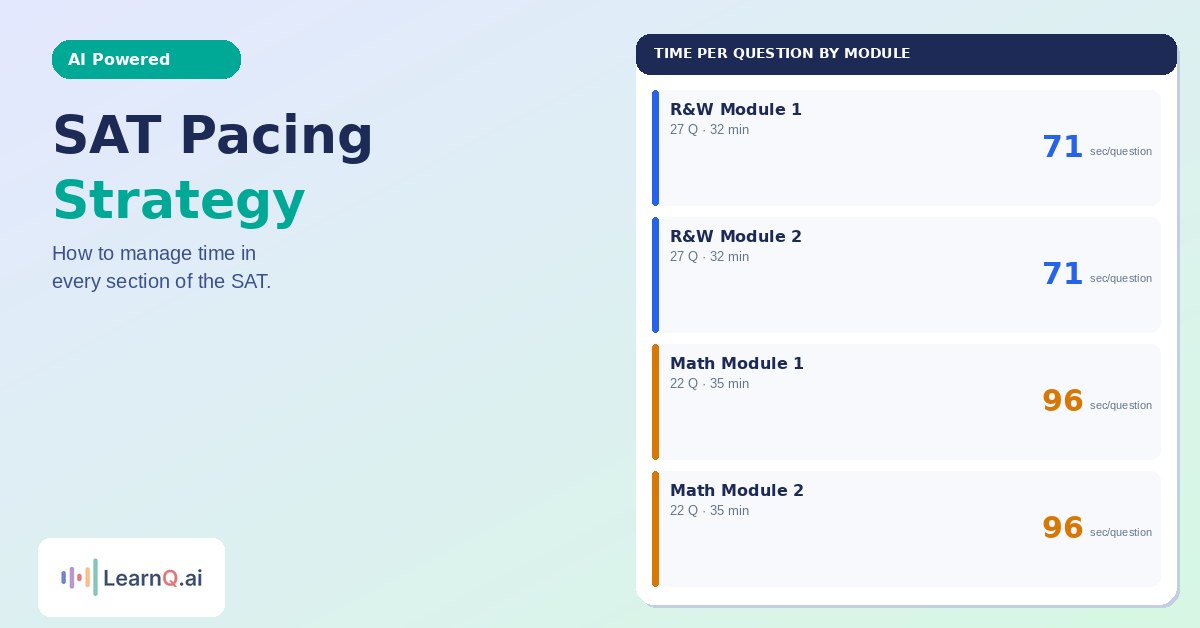
On the Digital SAT you have approximately 71 seconds per Reading and Writing question and 96 seconds per Math question. A skip-and-return system – moving on from a stuck question after roughly 60-90 seconds and returning to it only if time remains – is the most effective pacing strategy across both sections. Pacing is not about finishing fast; it is about protecting your accuracy on Module 1, since a strong Module 1 unlocks the harder, higher-scoring Module 2.
Time management is one of the most decisive factors in Digital SAT performance, and it is entirely separate from content knowledge. Students consistently lose points not because they didn’t know the material, but because they spent too long on one question and ran out of time for others they could have answered correctly. This guide covers the exact time budget for every section, the skip-and-return method in detail, and how pacing interacts with the test’s adaptive scoring structure.
The Exact Time Budget, Section by Section
The Digital SAT gives you 134 minutes total across four modules: two Reading and Writing modules and two Math modules. See the complete timing and section breakdown for the full test structure including breaks.
| Section | Questions | Time | Seconds Per Question |
|---|---|---|---|
| Reading & Writing Module 1 | 27 | 32 min | ~71 seconds |
| Reading & Writing Module 2 | 27 | 32 min | ~71 seconds |
| Math Module 1 | 22 | 35 min | ~96 seconds |
| Math Module 2 | 22 | 35 min | ~96 seconds |
These are averages, not fixed targets for every question. Some Reading and Writing questions (short grammar and Standard English Conventions items) take 30-45 seconds once you recognize the rule being tested. Others (dense Craft and Structure or Transitions questions) can reasonably take 90 seconds to two minutes. Similarly, easy Math questions might take 40-60 seconds, while a hard multi-step Advanced Math or Geometry question can legitimately need two to three minutes. The average matters for planning; the per-question flexibility matters for execution.
The Skip-and-Return Method
This is the single highest-leverage pacing technique on the Digital SAT, and it works because of one structural fact: there is no penalty for wrong answers, and every question is worth the same number of points regardless of difficulty. A hard question you get wrong after spending four minutes on it costs you exactly as much as an easy question you never reached because you ran out of time. Protecting your ability to reach every question is usually worth more than perfecting any single hard one.
How it works:
- Set a time ceiling per question before you start – roughly 60-75 seconds for Reading and Writing, 90-100 seconds for Math, adjusted slightly based on your personal pace and target score.
- If you hit the ceiling and are not close to an answer, flag the question and move on. The Bluebook app lets you flag any question and jump back to it later within the same module.
- Finish every question in the module first, even if that means guessing on flagged questions temporarily. Since there is no guessing penalty, an educated guess beats a blank.
- Return to flagged questions with whatever time remains, working from the ones you feel most confident about to the ones you feel least confident about.
Why this beats “push through until you solve it”: Every minute spent past your ceiling on a single question is a minute not spent on the remaining questions in that module – including ones you could likely answer correctly and quickly. A student who spends 4 minutes on one hard question and then rushes the final 5 questions of the module typically loses more points than a student who skipped that hard question, answered the final 5 carefully, and returned to the hard one with 90 seconds left.
Pacing and the Adaptive Format: Why Module 1 Matters More
The Digital SAT’s adaptive structure changes what “good pacing” means compared to a fixed-difficulty test. Each section (R&W and Math) has two modules. Your accuracy in Module 1 determines whether Module 2 presents easier or harder questions – and the harder Module 2 has a meaningfully higher score ceiling than the easier one. See the Module 1 strategy guide for the full mechanics of how this routing works.
The pacing implication: Rushing through Module 1 to “save time” for Module 2 is usually the wrong instinct. A rushed, error-prone Module 1 risks routing you into the easier Module 2, which caps your maximum possible score regardless of how well you perform in it afterward. Module 1 deserves your most careful, unhurried pacing – even if that means using more of your skip-and-return flexibility in Module 1 to protect accuracy, and moving more efficiently through Module 2 once you know which difficulty tier you are working within.
A practical checkpoint system:
For Reading and Writing (32 minutes, 27 questions per module): aim to be around question 9 with roughly 21 minutes remaining, and question 18 with roughly 10 minutes remaining. If you are significantly behind either checkpoint, that is a signal to tighten your per-question ceiling on remaining questions rather than letting the pace slide further.
For Math (35 minutes, 22 questions per module): aim to be around question 11 (the halfway point) with roughly 17-18 minutes remaining. Math questions increase in difficulty toward the end of each module, so budgeting slightly more time for the back half is reasonable – but only within a plan, not as an excuse to drift in the front half.
Section-Specific Pacing Notes
Reading and Writing
Each question is paired with its own short passage (25-150 words), so you reset context 54 times total across the test. This structure rewards reading with intent rather than reading everything twice. Read the passage once, identify what the question is asking, and answer – re-reading out of anxiety rather than genuine confusion usually costs more time than it saves.
Standard English Conventions questions (grammar and punctuation rules) are typically the fastest R&W question type once you recognize the specific rule being tested – many can be answered in 30-45 seconds. Craft and Structure questions (including Words in Context) and Expression of Ideas questions (including Transitions) typically take longer, since they require understanding a logical or rhetorical relationship rather than applying a fixed rule. Budgeting unevenly across question types – fast on grammar, more deliberate on logic-based questions – produces better pacing than treating every R&W question as equally time-consuming. See the full R&W question type breakdown for how much of the section each type represents.
Math
The built-in Desmos calculator is available throughout the entire Math section, which changes the nature of the time challenge: calculation speed is rarely the bottleneck, but knowing what to calculate and how to set up the problem often is. Roughly 30% of Math questions require reading a word-problem context before any calculation begins – budget reading time into your per-question estimate, not just solving time.
Difficulty is not evenly distributed within a module. The hardest, most time-consuming Math questions – covered in the hardest Digital SAT Math questions guide – tend to cluster in specific positions within each module rather than appearing randomly. Recognizing a genuinely hard question early (multi-step algebra, nonlinear systems, unfamiliar geometry setups) and applying the skip-and-return method immediately – rather than three minutes in – protects the rest of your module pacing.
Common Pacing Mistakes
Checking the timer constantly. Frequent timer-checking breaks concentration and feeds anxiety without actually improving decision-making. Check time with intention at your planned checkpoints (roughly every 8-10 questions), not reflexively after every question.
Re-reading out of anxiety rather than genuine confusion. If you understood the passage or problem the first time, a second read rarely adds new information – it mostly adds time and self-doubt. Reserve re-reading for cases where you genuinely missed something, not as a default habit.
Treating every question as equally time-consuming. A 30-second grammar question and a 2-minute multi-step Advanced Math question are both worth one point. Spending equal time on both wastes the time budget that harder or more valuable-to-you questions actually need.
Refusing to guess and move on. Since there is no penalty for wrong answers, leaving a question blank is strictly worse than guessing. A flagged, guessed question you can return to is always better than an unanswered one if time runs out.
Rushing Module 1 to “bank time” for Module 2. As covered above, Module 1 accuracy determines your access to the higher-scoring Module 2 – rushing it to save time for later usually backfires by capping your ceiling before Module 2 even begins.
How to Practice and Build Pacing Skill
Pacing is a trainable skill, separate from content knowledge, and it requires its own dedicated practice rather than assuming it will improve automatically alongside content review.
Timed section drills: Practice individual modules under strict time limits before attempting full-length tests. This isolates pacing practice from full-test fatigue and lets you calibrate your personal per-question ceiling.
Checkpoint tracking: During practice tests, note your position at the checkpoints described above (question 9 at ~21 minutes remaining for R&W, question 11 at ~17-18 minutes for Math). Consistently falling behind a checkpoint signals where your pacing plan needs adjustment.
Time-stamped review: After a practice test, mark how long you spent on each question (many students find writing “2m,” “skip+return,” or similar shorthand next to each question effective). Look for patterns – specific question types or domains where you consistently overspend time – and target those directly in practice rather than treating pacing as a single, undifferentiated skill. See the 200-point improvement guide for how targeted, diagnostic-driven practice compounds faster than general review.
Take LearnQ.ai’s free diagnostic test to see your current pacing and accuracy patterns by question type in one session. Mia, LearnQ’s AI tutor, can generate timed practice sets targeting your specific slow question types, building pacing discipline exactly where you need it rather than through generic timed drills. Take a free full-length practice test under real timed conditions to test your checkpoint pacing before test day. See LearnQ’s full Digital SAT platform for structured, pacing-aware study plans.
For official timed practice on the same interface you will use on test day, College Board’s Bluebook app provides 8 free full-length tests with the exact module structure and timer described in this guide. For Math-specific pacing practice, see the SAT Math practice hub organized by topic and difficulty.
FAQ
How much time do you have per question on the Digital SAT?
Approximately 71 seconds per question in Reading and Writing (27 questions in 32 minutes per module) and approximately 96 seconds per question in Math (22 questions in 35 minutes per module). These are averages – easier questions typically take less time, and harder questions reasonably take more, so treat these as planning benchmarks rather than fixed per-question targets.
What is the skip-and-return pacing strategy?
Skip-and-return means setting a time ceiling for each question (roughly 60-75 seconds for R&W, 90-100 seconds for Math), flagging and moving past any question that exceeds that ceiling without a clear path to the answer, finishing the rest of the module first, and then returning to flagged questions with remaining time. Since there is no penalty for wrong answers and every question is worth the same point value, this method protects your ability to reach easier, quickly-answerable questions rather than losing time on one difficult question.
Does pacing affect which Module 2 you get on the Digital SAT?
Indirectly, yes. Module 1 accuracy – not pacing speed itself – determines whether you route into the harder or easier Module 2, and the harder Module 2 carries a higher score ceiling. Poor pacing that leads to careless errors or unanswered questions in Module 1 can lower your accuracy enough to affect this routing. This is why rushing through Module 1 to save time for Module 2 is generally poor strategy – protecting Module 1 accuracy matters more than banking time.
Should I check the timer often during the SAT?
No. Frequent timer-checking breaks concentration and tends to increase anxiety without improving decision-making, since most students register the anxious feeling of checking rather than the actual number. Check time with intention at planned checkpoints (roughly every 8-10 questions) rather than reflexively after every question.
What should I do if I run out of time on a section?
Since there is no penalty for wrong answers on the Digital SAT, always select an answer for every question before time expires, even a guess, rather than leaving anything blank. If you know you are running low on time, a “letter of the day” strategy – picking one answer choice and applying it consistently to remaining unanswered questions – is more effective than random guessing across different letters.
How many practice tests should I take to improve my pacing?
Pacing improves through a combination of short timed-section drills (which isolate pacing practice from full-test fatigue) and full-length practice tests under real timed conditions (which test whether your pacing holds up over the complete test). Most students benefit from several timed-section drills per week during active preparation, combined with a full-length practice test roughly every one to two weeks to confirm the pacing is holding under realistic conditions.
Sources: College Board Digital SAT overview; OnePrep Digital SAT format and timing breakdown (oneprep.xyz, April 2026); AdmitStudio SAT test pacing strategies (admitstudio.com, February 2026); Princeton Review SAT time management tips (princetonreview.com); EdisonOS Digital SAT pacing guide (edisonos.com, May 2026)

The LearnQ Editorial Team is made up of certified Digital SAT tutors, college admissions specialists, and AI education researchers. Our tutors have personally helped over 10,000 US high school students improve their SAT scores, with an average improvement of 150+ points. We combine hands-on tutoring expertise with AI-powered insights from the LearnQ platform, which has analyzed millions of Digital SAT practice questions. Every article we publish is reviewed against the latest College Board Bluebook guidelines and cross-checked with real student performance data. Our mission is simple: give every student the same quality of prep that was once only available at expensive tutoring centers.