

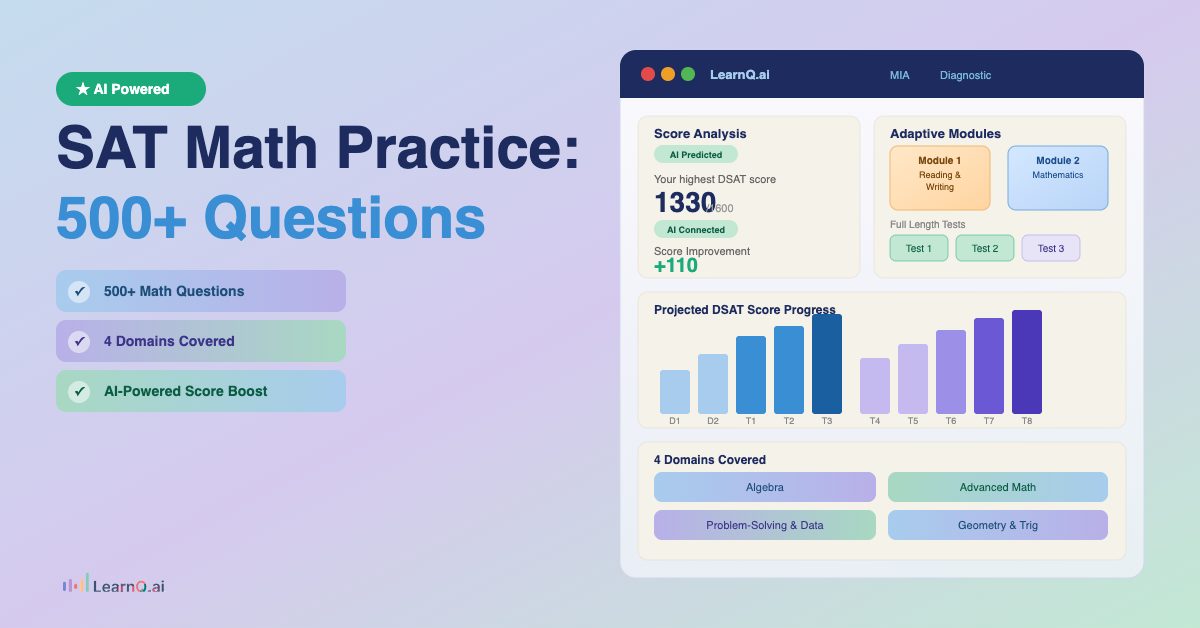
SAT math practice works best when each question is matched to your skill level and sorted by topic, so weak areas get reps fast and time isn’t wasted on questions you’ve already mastered.
The Digital SAT is shorter, faster, and adaptive. That changes how you should practice. Random question banks no longer cut it.
This guide walks you through how to structure your sat math practice, what 500+ questions sorted by topic actually unlocks, and how adaptive testing fits into a real prep schedule. You’ll also see exactly what topics show up on test day, how to spot the patterns, and where to start if you have only a few weeks.
If you want to skip ahead and try a full timed exam first, you can take a free Digital SAT practice test to see your starting score before you build a study plan.
Why SAT Math Practice Has Changed
The old paper SAT rewarded brute force. You could grind hundreds of questions, recognize patterns, and slowly climb. The Digital SAT does not work that way.
The Math section has 44 questions across 2 modules of 35 minutes each, for 70 minutes of active math time. Module 1 contains a mix of easy, medium, and hard items. Your performance there decides whether Module 2 feels like a warm-up or a wall.
That second module is the adaptive part. If you cruised through Module 1, the test serves harder questions, which unlock the higher score band. If you struggled, you get an easier set, which caps the maximum score available.
The takeaway: every question in Module 1 carries weight. Targeted, topic-by-topic sat math practice is how you make sure you’re not handing easy points back to the algorithm.
Quick tip: Treat your first full diagnostic as data, not a verdict. The point is to find your three weakest topics, not to rank your worth.
What 500+ Adaptive Questions Actually Means
A library of 500+ adaptive questions is not just a long list. The real value comes from three things: topic tagging, difficulty calibration, and adaptive sequencing.
Topic tagging means each question is sorted by domain (Algebra, Advanced Math, Problem-Solving and Data Analysis, Geometry and Trigonometry) and by skill within the domain (linear inequalities, quadratics, ratios, right triangles, and so on). You can drill one skill until it clicks without sifting through unrelated items.
Difficulty calibration means each question has a known difficulty score, so you can practice at the level that actually challenges you. Easy reps build confidence, but only stretch reps move your score.
Adaptive sequencing is what mirrors test day. The system serves you a slightly harder question after a correct answer and a slightly easier one after a miss. Your practice ends up matching your real ability band, not a random shuffle.
How LearnQ.ai’s 500+ Question Bank Is Structured
The table below shows how 500+ adaptive questions break down by topic, difficulty, and recommended use case.
| Domain | Skills Covered | Approx. Questions | Best For |
|---|---|---|---|
| Algebra | Linear equations, inequalities, systems, functions | 150+ | Score floor, foundations |
| Advanced Math | Quadratics, polynomials, exponentials, nonlinear systems | 140+ | High-score unlock |
| Problem-Solving & Data Analysis | Ratios, percentages, units, tables, statistics | 120+ | Word problem fluency |
| Geometry & Trigonometry | Angles, triangles, circles, area, volume, basic trig | 90+ | Final score push |
Around 35% of math questions on test day come from Algebra and another 35% from Advanced Math, so those two domains usually deserve the most reps. (See the College Board’s official Digital SAT structure for the current weighting.)
How to Structure Your SAT Math Practice Sessions
Random practice burns time. Structured sessions move scores. Use a simple weekly rhythm to keep momentum without burning out.
A balanced week mixes diagnostic, drill, and review. Diagnostic days reveal weak spots. Drill days fix them. Review days lock in the gains.
A Sample 5-Day Practice Week
The plan below assumes you have 60 to 90 minutes of focused sat math practice on each study day.
| Day | Focus | What You Do | Time |
|---|---|---|---|
| Monday | Diagnostic mini-test | 22 mixed questions, timed | 35 min |
| Tuesday | Algebra drill | 20 questions, weakest skill | 45 min |
| Wednesday | Advanced math drill | 20 questions, weakest skill | 45 min |
| Thursday | Mixed review | 15 missed-question redo + explanations | 60 min |
| Friday | Full Module 1 simulation | Timed Module 1, mixed difficulty | 35 min |
This pattern hits every domain across the week, builds endurance, and keeps adaptive feedback flowing into your study choices.
The 3-Question Rule
If you miss a question, do three things before moving on. Read the explanation, redo the problem on paper without looking, and write the rule or formula in your own words. This locks the concept in instead of letting it leak away.
The 4 Math Domains, Decoded
The Digital SAT math section pulls from four domains. Each one has a different feel, and your prep strategy should reflect that.
Algebra
Algebra is the score floor. If you can solve linear equations, systems, and inequalities quickly, you protect your baseline score. Most students should aim for near-perfect accuracy here.
Common traps include sign errors, distributing across parentheses, and misreading inequality direction. Drill until these become automatic.
Advanced Math
This is the score ceiling. Quadratics, polynomials, exponentials, and nonlinear systems separate a 650 from a 750.
Focus on factoring patterns, the quadratic formula, function notation, and how to translate word problems into nonlinear equations. Use Desmos for graphical checks, since the calculator is built into the test.
Problem-Solving and Data Analysis
This domain is heavy on word problems, ratios, percentages, and reading tables or graphs. The math is rarely hard. The reading is.
Practice slowing down on the setup and moving fast on the calculation. Most missed points here come from misreading the question, not from algebra.
Geometry and Trigonometry
Geometry is the smallest domain but high-yield once you know the formulas. Right triangles, circles, area, volume, and basic trig (SOH CAH TOA) cover most of what shows up.
Build a one-page formula sheet, review it daily for two weeks, and you’ll close the gap fast.
How Adaptive Practice Beats Static Question Banks
A static PDF of 100 math questions does not know who you are. It serves you the same item whether you’re scoring 1100 or 1500. Most of your time gets spent on questions that are either too easy or way too hard.
Adaptive practice adjusts after every answer. Get an algebra question right? The next one steps up in difficulty. Miss a geometry question? You get more reps on that skill at a slightly easier level until you’re ready to push back up.
That feedback loop matters because the actual Digital SAT is adaptive. You should practice in the same conditions you’ll face on test day. (Read more about how long the Digital SAT takes and how the modules are structured for the full timing breakdown.)
Why this matters: Two hours of adaptive sat math practice usually moves your score more than five hours of random drilling. You spend your time at the edge of your ability, where learning happens fastest.
Common Mistakes Students Make in SAT Math Practice
Most prep mistakes are small habits that compound over weeks. Spotting them early saves you a lot of frustration.
Practicing untimed for too long. Untimed work feels productive, but the test is timed. Build timing pressure in by week two of prep at the latest.
Skipping the explanation when you get it right. A correct answer with the wrong reasoning is a future wrong answer. Read the explanation even when you nailed it.
Avoiding your weakest topic. Students drift toward what feels comfortable. The fastest score jumps come from spending extra time on the topic you secretly hope won’t show up.
Ignoring Desmos. The Digital SAT has a built-in graphing calculator. If you’re not using it for nonlinear equations, you’re leaving easy points on the table.
Cramming the week before. Math skills consolidate with sleep and spacing. A steady eight weeks beats a frantic one week every time.
How LearnQ.ai’s Adaptive SAT Math Practice Works
LearnQ.ai gives you 500+ adaptive math questions sorted by domain and skill, plus full Digital SAT practice tests that mirror the real exam’s adaptive structure. Your score, weak spots, and recommended next questions update after every session.
Mia, AI Tutor, walks you through every missed problem in plain language. She breaks down the wrong answer, shows the correct method step by step, and assigns follow-up questions on the same skill so the gap actually closes.
Students across 190+ countries have run more than 200,000 practice tests on LearnQ.ai, with adaptive feedback driving an average score lift of 100+ points when prep is consistent. You can start free with the LearnQ.ai Digital SAT prep platform and add Mia or full diagnostics anytime through pricing.
A Simple 4-Week Practice Plan
If you have a month before your test date, here’s a realistic schedule built around adaptive sat math practice.
Week 1: Diagnose. Take a full Digital SAT practice test. Identify your three weakest skills across the four math domains. Spend the rest of the week on light algebra drilling to rebuild fundamentals.
Week 2: Foundations. Drill 20 to 30 questions per day across algebra and problem-solving. Time half of them. Review every miss using the 3-question rule.
Week 3: Stretch. Move into advanced math and geometry. Increase difficulty and add a timed Module 1 simulation twice this week.
Week 4: Polish. Take two full practice tests, four days apart. Spend the in-between days reviewing missed questions only. Sleep well the last 48 hours.
This sequence works because it follows the cognitive science of skill building: assess, drill at the edge, simulate, recover.
Frequently Asked Questions
How many SAT math practice questions do I actually need to do?
Most students see meaningful score gains after 300 to 500 targeted questions, especially when half of those are at or above their current ability level. Quality and topic targeting beat raw volume every time.
Is sat math practice on the Digital SAT different from the old SAT?
Yes. The Digital SAT is multistage adaptive, meaning your second math module’s difficulty depends on how you do in the first. You should practice with adaptive tools that mirror this format, not static PDFs from the paper-test era.
How long should each SAT math practice session be?
Aim for 45 to 75 minutes per session. That’s long enough to build endurance and short enough to keep focus sharp. Two to four sessions per week works for most students.
Can I use a calculator on every SAT math question?
Yes. The Digital SAT allows a calculator on the entire math section, and Desmos is built into the test interface. Practice with Desmos so you’re fluent on test day.
What’s the fastest way to raise my SAT math score?
Find your three weakest skills, drill them adaptively for two weeks, then take a full timed practice test. This focused-then-simulated cycle moves scores faster than balanced practice across all topics.
How many math questions are on the Digital SAT?
There are 44 math questions split across two 35-minute modules, for 70 minutes of math time total. The full test has 98 questions across math and reading and writing combined, with one 10-minute break in the middle.
Should I memorize math formulas for the SAT?
The Digital SAT provides a reference sheet with common geometry formulas. You should still memorize quadratic, slope, distance, and basic trig formulas to save time, since flipping back to the reference slows you down.
What score counts as a strong Digital SAT math score?
A 700+ math score puts you in the top 10% of test-takers and is competitive for selective colleges. A 750+ math score is competitive for highly selective STEM programs. Your target should match the schools on your list.
Sources: College Board, Digital SAT structure

The LearnQ Editorial Team is made up of certified Digital SAT tutors, college admissions specialists, and AI education researchers. Our tutors have personally helped over 10,000 US high school students improve their SAT scores, with an average improvement of 150+ points. We combine hands-on tutoring expertise with AI-powered insights from the LearnQ platform, which has analyzed millions of Digital SAT practice questions. Every article we publish is reviewed against the latest College Board Bluebook guidelines and cross-checked with real student performance data. Our mission is simple: give every student the same quality of prep that was once only available at expensive tutoring centers.