

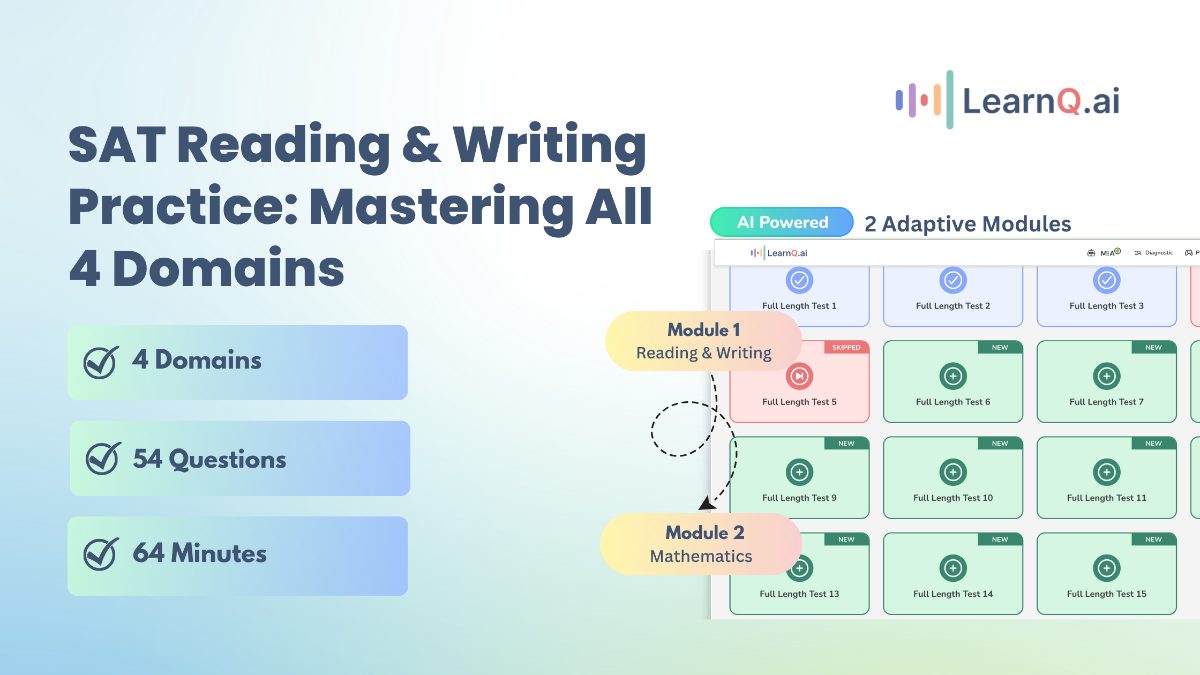
The best SAT Reading and Writing practice targets all four domains: Information and Ideas, Craft and Structure, Expression of Ideas, and Standard English Conventions.
The Reading and Writing section of the Digital SAT has 54 questions spread across these four domains. Each domain tests a distinct set of skills. Studying them together, without knowing which domain a question belongs to, is one of the most common mistakes students make.
This guide breaks down exactly what each domain tests and how to practice it strategically.
What Is the SAT Reading and Writing Section?
The Digital SAT Reading and Writing section consists of 54 questions delivered across two adaptive modules. You get 64 minutes total, which works out to roughly 71 seconds per question. The questions are short: each one pairs a passage of 25 to 150 words with a single question.
Unlike the old paper SAT, you will not read a long passage and then answer 10 questions about it. Every question here stands on its own. That changes how you should practice.
For a full breakdown of the test structure, see what is on the Digital SAT.
| Domain | Question Share | Primary Skill |
|---|---|---|
| Information and Ideas | ~26% | Reading comprehension, evidence use |
| Craft and Structure | ~28% | Vocabulary in context, text structure |
| Expression of Ideas | ~20% | Revision, rhetorical purpose |
| Standard English Conventions | ~26% | Grammar and usage |
Source: College Board SAT structure page
Domain 1: Information and Ideas
Information and Ideas questions ask you to understand what a text says and how evidence supports a claim. You will interpret data in charts or tables, identify the main idea, and evaluate whether a conclusion follows logically from the text.
There are three main question types in this domain: comprehension, command of evidence (textual), and command of evidence (quantitative). Command of evidence questions are the ones that trip students up most. They ask you to find the specific detail that best supports or weakens a conclusion.
How to practice Information and Ideas:
Work on reading short passages quickly and identifying the author’s main point in one sentence. Then practice matching conclusions to the evidence that supports them. If you find yourself re-reading a passage three times, that is a pacing problem, not a comprehension problem.
Train yourself to find the answer in one focused read.
Tip: For quantitative evidence questions, look at the chart or table before reading the passage. Knowing what the data shows first will help you read the text with a purpose.
Domain 2: Craft and Structure
Craft and Structure is the vocabulary domain, but not in the way you remember from standardized tests of the past. You will not be asked to define a word in isolation. Instead, you will read a sentence and choose the word that best fits the meaning and tone of the passage.
This domain also includes questions about text structure and purpose. You may be asked why an author uses a specific example, how two passages relate to each other, or what the primary purpose of a text is.
How to practice Craft and Structure:
Read widely in academic and journalistic writing to build your sense of how words function in context. For structure questions, practice labeling what each paragraph or sentence does (introduces, counters, illustrates, concludes) before choosing your answer. The correct answer for a purpose question always matches the function of the text, not just its content.
| Question Type | What It Tests | Common Mistake |
|---|---|---|
| Words in Context | Meaning and tone fit | Picking a word that is a synonym but wrong tone |
| Text Structure and Purpose | Author’s organizational choice | Confusing topic with purpose |
| Cross-Text Connections | Relationship between two passages | Missing the point of disagreement |
Domain 3: Expression of Ideas
Expression of Ideas questions are revision questions. You will be given a draft passage and asked how to improve it. This might mean adding a sentence that transitions between two ideas, choosing which sentence best introduces a paragraph, or deciding where a detail should be placed for maximum clarity.
This domain tests your rhetorical sense: your instinct for what makes writing clear, organized, and effective. It is not about grammar. None of the answer choices will be grammatically wrong.
Your job is to choose the one that works best.
How to practice Expression of Ideas:
Read good writing and ask yourself why specific sentences are placed where they are. When practicing these questions, always read the full paragraph before evaluating answer choices. Students who only read the surrounding sentence miss the organizational logic of the passage and pick answers that are locally correct but globally wrong.
Tip: For transition questions, identify the relationship between the two ideas (contrast, addition, cause-effect, example) before looking at the answer choices. The correct transition word will always match the logical relationship.
Domain 4: Standard English Conventions
Standard English Conventions is the grammar domain. It covers sentence boundaries (avoiding run-ons and fragments), punctuation, subject-verb agreement, pronoun usage, and modifier placement. These questions tend to be the most mechanical, which means they are also the most learnable with the right practice.
Students who struggle here usually have a few specific gaps, not a general grammar problem. The most common issues are comma splices, misplaced modifiers, and apostrophe misuse. Identifying your specific weaknesses and targeting them is far more efficient than reviewing all of grammar from scratch.
How to practice Standard English Conventions:
Take a short diagnostic to identify which grammar rules you actually miss. Then practice those rules in isolation with targeted drills before mixing them back into full-length practice sets. Reviewing rules you already know is wasted time.
For SAT-specific conventions, note that the test heavily favors concise, clear sentences. When in doubt, the shorter answer that is grammatically correct is usually right.
How the Adaptive Structure Affects Your Practice
The Digital SAT’s Reading and Writing section uses multistage adaptive testing, which means the second module’s difficulty adjusts based on how well you do in the first. Do well on module 1 and you get a harder module 2 with a higher score ceiling. Struggle on module 1 and the second module becomes easier, with a lower ceiling.
This matters for how you practice. Simply doing easy-to-medium questions will not prepare you for the harder adaptive module. You need to regularly practice with hard questions in all four domains.
Most students underestimate how different hard-tier questions feel from medium-tier ones, especially in Craft and Structure and Expression of Ideas.
Building a Full SAT Reading and Writing Practice Plan
A strong practice plan covers all four domains in rotation. Here is a simple weekly structure to follow:
- Days 1 and 2: Information and Ideas (comprehension and evidence questions)
- Days 3 and 4: Craft and Structure (vocabulary in context and text purpose)
- Day 5: Expression of Ideas (revision and transition questions)
- Day 6: Standard English Conventions (grammar drills on your weak rules)
- Day 7: Full mixed-domain practice set under timed conditions
Review every wrong answer the same day you practice. The explanation matters more than the score. Understanding exactly why the wrong answers were wrong is what builds the pattern recognition you need on test day.
Practice Smarter with LearnQ.ai
Knowing the four domains is one thing. Getting the right practice for your specific weak spots is another. LearnQ.ai has helped 200,000+ students across 190+ countries prepare for the Digital SAT with fully adaptive practice tests that adjust to your level, just like the real exam.
Mia, LearnQ’s AI Tutor, identifies exactly which domain is dragging your score down and serves up targeted questions to close the gap fast. You can start with a free diagnostic at learnq.ai and see your score potential in minutes. Check out LearnQ.ai pricing for plan options that fit your timeline.
Frequently Asked Questions
What are the 4 domains of the SAT Reading and Writing section?
The four domains are Information and Ideas, Craft and Structure, Expression of Ideas, and Standard English Conventions. Together they cover all 54 questions in the Reading and Writing section of the Digital SAT.
How many questions are in the SAT Reading and Writing section?
There are 54 Reading and Writing questions on the Digital SAT, delivered in two adaptive modules of 27 questions each. You have 64 minutes total for this section, according to the College Board.
Is the SAT Reading and Writing section hard?
The difficulty depends on the domain. Many students find Standard English Conventions the most straightforward because grammar rules are learnable. Craft and Structure tends to be harder because vocabulary-in-context and text-purpose questions require nuanced reading skills.
How should I start my SAT Reading and Writing practice?
Start with a diagnostic test to find out which of the four domains is your biggest weakness. Then practice that domain in focused sets before moving to mixed practice. Targeted practice by domain is more efficient than random question sets.
What is adaptive testing on the Digital SAT?
Adaptive testing means the second module’s difficulty adjusts based on your first module performance. A stronger first module leads to harder questions with a higher maximum score. This is why practicing hard-difficulty questions in all four domains is essential, not just easy and medium questions.
Can I use a formula sheet on the SAT Reading and Writing section?
No. The formula reference sheet provided on the Digital SAT applies only to the Math section. The Reading and Writing section does not include any reference materials. See our Digital SAT formula sheet guide for details on what the Math reference sheet covers.
How long does the SAT Reading and Writing section take?
You have 64 minutes for the Reading and Writing section across two modules. Each module is 32 minutes. There is a 10-minute break between the Reading and Writing section and the Math section.
What is the best way to improve vocabulary for the SAT?
Focus on words in context rather than memorizing long vocabulary lists. The Digital SAT tests whether you can choose the word that best fits the meaning and tone of a specific passage. Reading academic articles and literary essays regularly is more effective than flashcard drills alone.
Do all four domains appear in both modules?
Yes. All four domains appear across both Reading and Writing modules. The proportion of each domain stays roughly consistent between module 1 and module 2, though the difficulty of individual questions changes based on your adaptive path.
How is the SAT Reading and Writing section scored?
The Reading and Writing section is scored on a scale of 200 to 800. It is combined with the Math section score (also 200 to 800) to produce a total SAT score between 400 and 1600.
Sources: College Board SAT Test Structure

The LearnQ Editorial Team is made up of certified Digital SAT tutors, college admissions specialists, and AI education researchers. Our tutors have personally helped over 10,000 US high school students improve their SAT scores, with an average improvement of 150+ points. We combine hands-on tutoring expertise with AI-powered insights from the LearnQ platform, which has analyzed millions of Digital SAT practice questions. Every article we publish is reviewed against the latest College Board Bluebook guidelines and cross-checked with real student performance data. Our mission is simple: give every student the same quality of prep that was once only available at expensive tutoring centers.