

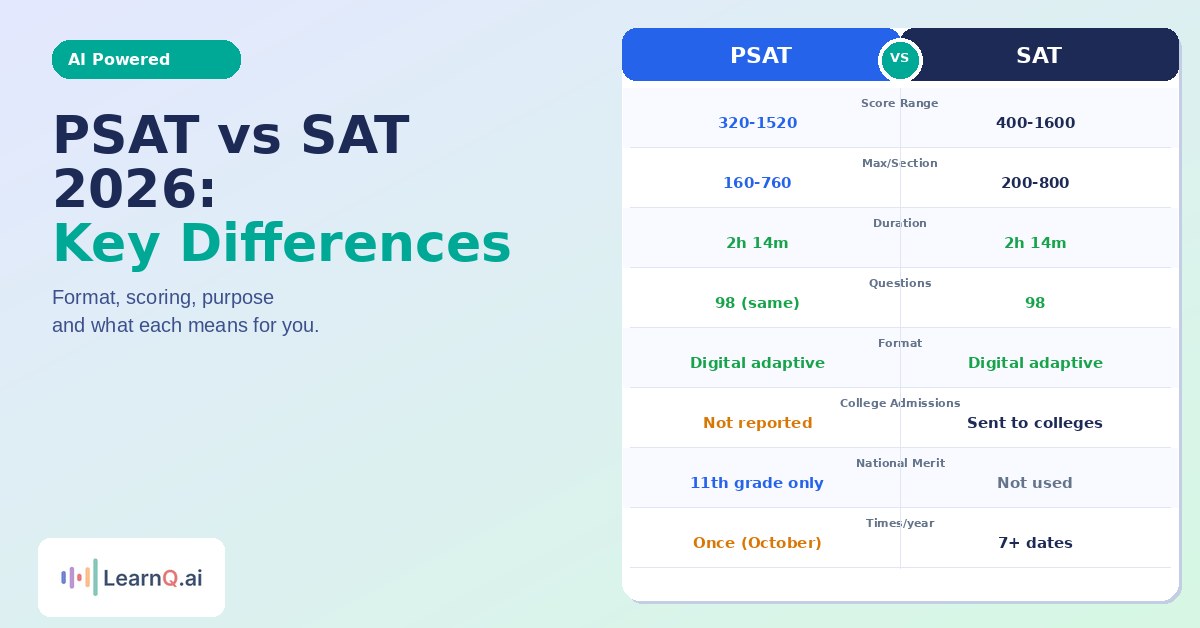
The PSAT and SAT use the same digital format, the same question types, the same Bluebook app, and the same 2 hours and 14 minutes of testing time. The differences are three: the PSAT has a lower score ceiling (1520 vs 1600), slightly easier hard questions, and – critically – only your 11th-grade PSAT/NMSQT qualifies you for National Merit scholarships while the SAT is what colleges actually see.
If you just received your PSAT score and want to know what it means for the SAT, or you are trying to decide how seriously to prepare for the PSAT, you are in the right place. This guide covers every meaningful difference between the two tests in 2026, what each one is actually used for, how your PSAT score predicts your SAT performance, and exactly what to do next depending on your grade and goals.
Side-by-Side Comparison: PSAT vs SAT 2026
| Feature | PSAT/NMSQT | SAT |
|---|---|---|
| Score range | 320-1520 | 400-1600 |
| Section scores | 160-760 each | 200-800 each |
| Total testing time | 2 hours 14 minutes | 2 hours 14 minutes |
| Number of questions | 98 (same as SAT) | 98 |
| Format | Digital adaptive (Bluebook) | Digital adaptive (Bluebook) |
| Sections | Reading and Writing, Math | Reading and Writing, Math |
| Question types | Identical to SAT | Identical to PSAT |
| Difficulty ceiling | Slightly lower | Includes harder questions above 1520 |
| College admissions | Not reported to colleges | Primary admissions data point |
| National Merit | 11th grade only qualifies | Not used for National Merit |
| Offered | Once per year (October) | 7+ times per year |
| Cost | Free or low-cost via school | ~$68 |
| Score report | Detailed breakdown by skill | Detailed breakdown by skill |
The two most important rows: score range and National Merit. Everything else is nearly identical.
What Is the PSAT and What Is It Actually For?
The PSAT/NMSQT (Preliminary SAT / National Merit Scholarship Qualifying Test) serves two purposes that have nothing to do with each other:
Purpose 1: Practice for the SAT. The PSAT gives you a realistic, full-length experience of the Digital SAT – same format, same interface, same question types – before your SAT scores actually matter. Your detailed score report shows performance by question type (not just by section), which is the most actionable diagnostic data you can get before starting targeted SAT prep.
Purpose 2: National Merit Scholarship qualification. Only your 11th-grade PSAT/NMSQT taken in October qualifies you for consideration. The National Merit Scholarship Corporation uses a Selection Index derived from your section scores to identify roughly 50,000 high-scoring juniors each year. About 16,000 of those advance to Semifinalist status and approximately 7,500 ultimately receive scholarships.
These two purposes are independent. A student who scores 900 on the PSAT gains useful diagnostic data but has zero National Merit prospects. A student who scores 1450 gains both. Understanding which purpose applies to you determines how seriously you should prepare.
What the PSAT is not: It is not a college admissions factor. Colleges do not receive your PSAT scores unless you earn National Merit recognition and your school reports it. A poor PSAT score has no direct admissions consequence.
What Is the SAT and What Is It Actually For?
The Digital SAT is the College Board’s primary college readiness assessment. Unlike the PSAT, SAT scores are sent to colleges as part of the admissions process. Most four-year colleges accept the SAT, and many still consider it alongside GPA, coursework rigor, and other factors.
The SAT is offered roughly seven times per year (March, May, June, August, October, November, December), giving students flexibility to take it multiple times. Most students take it once or twice in 11th and 12th grade. Colleges typically focus on your highest score, and many apply superscoring (combining the highest section scores across multiple attempts).
See the SAT retake strategy guide for the framework on how many times to take the SAT and when.
Format: What Is the Same
This is the part that matters most for your prep strategy: preparing for the PSAT and preparing for the SAT are the same activity.
Both tests in 2026:
- Are administered exclusively on College Board’s Bluebook app
- Use the same two-section structure: Reading and Writing (Module 1 + Module 2), then Math (Module 1 + Module 2)
- Use the same adaptive format – Module 2 difficulty adjusts based on your Module 1 performance in each section
- Ask the same question types across all four skill domains: Craft and Structure, Information and Ideas, Standard English Conventions, Expression of Ideas (R&W); Algebra, Advanced Math, Problem Solving and Data Analysis, Geometry (Math)
- Run for exactly 2 hours and 14 minutes including the break
- Have 98 questions total (54 R&W, 44 Math)
- Apply no penalty for wrong answers
- Provide the same on-screen tools: annotation, answer eliminator, flag for review, built-in Desmos calculator for Math
Any practice you do for either test directly benefits the other. SAT practice materials, including the eight free tests in Bluebook, are the best preparation for the PSAT because they test the same skills at the same or higher difficulty. See which Bluebook practice tests are most accurate for guidance on which tests to prioritise at your score level.
The Digital SAT Module 1 strategy guide applies equally to PSAT Module 1 – the adaptive routing logic is identical.
Format: What Is Different
Score Scale
The PSAT/NMSQT is scored 320-1520. The SAT is scored 400-1600. The 80-point gap at the top is not arbitrary – it reflects the fact that the PSAT does not include the hardest questions that appear in SAT Module 2 Hard. A student with a genuine 1520+ SAT capability will hit the PSAT ceiling; the PSAT cannot distinguish between students at that level, which is why the SAT goes higher.
Each section on the PSAT is scored 160-760. On the SAT, sections are scored 200-800. The 40-point gap per section (80 total) represents the additional difficulty range the SAT covers above the PSAT ceiling.
Difficulty at the Top End
Both tests share the same question pool at Easy and Medium difficulty. The PSAT and SAT diverge at the Hard level: the SAT’s hardest Module 2 questions include content that does not appear on the PSAT at all. This is by design – the PSAT is calibrated for the typical college-prep student, not for the student competing for a 1580.
For most students below 1400 on the PSAT, this distinction is irrelevant. The content you need to master for a 1200 or 1300 PSAT score is exactly the content you need for a 1200 or 1300 SAT score.
When It Is Offered
The PSAT/NMSQT is offered once per year – a specific date in October set by each school. You cannot choose your date or take it independently at a test centre. This means if you miss it, you wait a full year.
The SAT is offered at official College Board test centres approximately seven times per year. You register individually, choose your date, and can retake it as many times as you want.
Who Sees the Score
PSAT scores go only to you and your school. No college admissions office receives them. SAT scores are sent to the colleges you designate (and to your school). This difference in audience is why the PSAT is genuinely low-stakes for admissions purposes and the SAT is not.
Scoring: How the PSAT Selection Index Works
For most students, the PSAT total score (320-1520) is the relevant number. For students aiming at National Merit, the Selection Index is what actually matters.
Selection Index formula:
Selection Index = (R&W Section Score + Math Section Score) x 2 / 10
Section scores on the PSAT run 160-760 each. So the Selection Index ranges from (160+160) x 2 / 10 = 64 at the minimum to (760+760) x 2 / 10 = 304 at the maximum… but College Board caps the published range at 48-228 based on the actual test score range.
A worked example: PSAT total 1380, with R&W 720 and Math 660.
Selection Index = (720 + 660) x 2 / 10 = 1380 x 2 / 10 = 276…
The correct formula per College Board: SI = (RW score / 10 x 2) + (Math score / 10). Using scaled section scores: SI = (72 x 2) + 66 = 210.
The critical implication: Reading and Writing is double-weighted in the Selection Index formula. A student with 750 R&W and 650 Math (total 1400) has SI = (75 x 2) + 65 = 215. A student with 650 R&W and 750 Math (same total 1400) has SI = (65 x 2) + 75 = 205. That 10-point Selection Index difference can mean the difference between qualifying and not qualifying in competitive states. Section balance matters as much as total score for National Merit.
2026 National Merit benchmarks:
| Recognition Level | Approx. Selection Index | Approx. Total Score Equivalent |
|---|---|---|
| Commended Scholar | 208 | ~1370 |
| Semifinalist (less competitive states) | 207-212 | ~1360-1390 |
| Semifinalist (mid-tier states) | 212-220 | ~1390-1430 |
| Semifinalist (most competitive states) | 220-223 | ~1420-1450+ |
These figures are estimates based on 2025-2026 class data. Official cutoffs vary by year and are announced in September of senior year.
For a full breakdown of average scores and percentile benchmarks by grade, see the average PSAT score by grade guide.
How Your PSAT Score Predicts Your SAT Score
College Board designs the PSAT specifically as a predictive instrument for the SAT. Research across multiple test cycles shows a correlation of 0.82-0.84 between PSAT and SAT section scores – strong enough to be a reliable planning tool, not strong enough to be a guarantee.
PSAT to SAT score conversion table (PSAT/NMSQT to SAT):
| PSAT Total | Projected SAT Range | Notes |
|---|---|---|
| 800-900 | 880-1000 | Below average; significant prep needed |
| 900-1000 | 1000-1100 | Below average SAT; strong gains possible |
| 1000-1100 | 1100-1200 | Average SAT range |
| 1100-1200 | 1200-1310 | Above average; competitive for many schools |
| 1200-1300 | 1300-1400 | Strong; top-25 school range with good GPA |
| 1300-1400 | 1380-1480 | Very strong; highly selective range |
| 1400-1520 | 1450-1580+ | National Merit range; top school competitive |
These projections assume preparation between the PSAT and SAT. Students who complete structured prep between their PSAT and first SAT regularly exceed these projections by 50-150 points.
For context on what SAT scores mean in terms of national percentiles, see the SAT score percentile guide. If you are also considering the ACT, the SAT to ACT conversion chart maps your projected SAT range to an ACT equivalent.
What to Do With Your PSAT Score: Grade by Grade
If you are in 8th or 9th grade
Your PSAT 8/9 score (scale 240-1440) is a pure diagnostic. There are no stakes. The correct response is to open the score report, identify the 2-3 question types where you lost the most points, and note them as development areas for high school. Do not compare your total to a 10th or 11th grader’s score – they are on different scales testing slightly different difficulty levels.
If you are in 10th grade
Your PSAT 10 or PSAT/NMSQT score (scale 320-1520) does not qualify for National Merit. What it does is give you a precise picture of where you stand one year before the score actually matters. The most productive response:
Set a specific 11th-grade target. If you scored 1100 as a sophomore, a realistic target for junior year is 1250-1350 with dedicated preparation. If you scored 1300, targeting 1400+ for National Merit is realistic.
Begin structured prep now. Students who start prep after their 10th-grade PSAT consistently outperform those who wait until junior year. The guide on improving your SAT score by 200 points covers the preparation framework that works equally for PSAT improvement.
Focus on your weakest question types from the score report. The SAT Words in Context strategy guide covers the R&W question type most students underestimate.
Take LearnQ’s free diagnostic test to identify exactly which question types are costing you the most points – the breakdown mirrors what your PSAT score report shows but gives you actionable practice immediately.
If you are in 11th grade
This is the score that counts. Your PSAT/NMSQT score from October of junior year determines your National Merit eligibility, and it is your most reliable predictor of your first SAT score.
If you did not reach your target: Shift focus immediately to the SAT. The PSAT is offered once; there is no junior-year retake. Register for the December or March SAT and begin prep targeting your weak question types from the PSAT score report.
If you are near or above National Merit threshold: Check your Selection Index on your score report. Compare it against your state’s estimated cutoff. If you are within 2-3 points, understand that official cutoffs shift slightly year to year and there is no way to retake the PSAT – your official status will be confirmed in September of senior year.
For both groups: The SAT is now your priority. Register for your first SAT attempt. Take a free full-length practice test to confirm where you stand before test day. Mia, LearnQ’s AI tutor at the Digital SAT platform, generates targeted practice questions for your specific weak domains – the fastest path from a PSAT baseline to a higher SAT score. See all plans.
The Preparation Question: Should You Study for the PSAT?
Whether to specifically prepare for the PSAT depends on your grade and goals.
If you are a junior aiming for National Merit: Yes, targeted preparation for the PSAT is worthwhile, particularly for the Selection Index formula. Because R&W is double-weighted, students within 5-10 points of their state’s cutoff should prioritise R&W improvement over Math improvement – an extra 20 points in R&W adds 4 points to the Selection Index versus 2 points for 20 additional Math points.
If you are a sophomore: Preparing for the PSAT is the same as preparing for the SAT. Any time you spend building skills for the PSAT translates directly to SAT performance. There is no separate PSAT curriculum.
If you are a freshman or younger: Take the PSAT 8/9 without specific preparation. Use the score report as a diagnostic. Start building skills in areas where you underperformed.
The preparation hierarchy: practice for the SAT using real Digital SAT materials (Bluebook tests are the gold standard), and treat the PSAT as a high-quality practice test along the way. There is no PSAT-specific preparation that would not equally benefit your SAT score.
Frequently Asked Questions
Is the PSAT harder than the SAT?
No. The PSAT is slightly easier than the SAT at the very top of the difficulty range – the SAT includes harder questions above the PSAT’s 1520 ceiling. At Easy and Medium difficulty, the two tests are identical. For students below 1400, there is no meaningful difference in difficulty. The PSAT feels harder to many students only because it is often their first experience with College Board’s adaptive digital format.
Does a good PSAT score guarantee a good SAT score?
No, but the correlation is strong (0.82-0.84 across sections). Your PSAT score is a reliable planning tool, not a ceiling. Students who prepare specifically for the SAT after their PSAT regularly improve 100-200 points beyond what the conversion table would predict. The PSAT score tells you where you are; your preparation determines where you end up on the SAT.
Do colleges care about PSAT scores?
No. Colleges do not receive PSAT scores, and there is no place on college applications to report them. The one exception is National Merit recognition: if you become a Commended Scholar or Semifinalist, your school may note this on your transcript, and some colleges actively recruit National Merit finalists with scholarship offers. But the PSAT score itself is never seen by admissions offices.
Can you retake the PSAT?
You can take different versions of the PSAT across grade levels (PSAT 8/9 in 8th/9th, PSAT 10 or PSAT/NMSQT in 10th, PSAT/NMSQT in 11th), but only your 11th-grade PSAT/NMSQT counts for National Merit, and it is offered only once per year in October. If you miss it or perform below your target, there is no retake – the SAT becomes your next opportunity.
What is a good PSAT score for National Merit?
National Merit eligibility is determined by the Selection Index, not the total score. The 2026 Commended Scholar cutoff is approximately a Selection Index of 208 (roughly equivalent to a total score of 1370). Semifinalist cutoffs vary by state, ranging from approximately SI 207 in less competitive states to SI 222-223 in the most competitive states (California, Massachusetts, New Jersey, New York). See the average PSAT score by grade guide for grade-level benchmarks.
What is the difference between PSAT 8/9, PSAT 10, and PSAT/NMSQT?
Three versions of the PSAT exist for different grade levels. PSAT 8/9 (for 8th and 9th graders) is scored 240-1440. PSAT 10 (for 10th graders) and PSAT/NMSQT (for 10th and 11th graders) are both scored 320-1520 and are nearly identical in content. Only the PSAT/NMSQT taken in 11th grade qualifies for National Merit. Taking the PSAT/NMSQT as a 10th grader provides useful practice but does not create any National Merit eligibility.
How soon after the PSAT should I start SAT prep?
Immediately after your score report arrives. The score report’s question-type breakdown is the most valuable data you have for planning SAT prep. For 10th graders, this gives you a full year to close gaps before the National Merit attempt in 11th grade. For 11th graders, the December SAT is typically the first realistic attempt after an October PSAT – eight weeks is enough time to make meaningful gains in your two weakest question types.
Sources: College Board PSAT/NMSQT overview; College Board SAT overview; Manhattan Review PSAT/SAT correlation research (manhattanreview.com); Compass Education Group National Merit Scholarship Program FAQ and 2026 cutoff data (compassprep.com, February 2026); PrepScholar PSAT National Merit score guide (blog.prepscholar.com, 2026); Larry Learns PSAT vs SAT guide (larrylearns.com, April 2026)

The LearnQ Editorial Team is made up of certified Digital SAT tutors, college admissions specialists, and AI education researchers. Our tutors have personally helped over 10,000 US high school students improve their SAT scores, with an average improvement of 150+ points. We combine hands-on tutoring expertise with AI-powered insights from the LearnQ platform, which has analyzed millions of Digital SAT practice questions. Every article we publish is reviewed against the latest College Board Bluebook guidelines and cross-checked with real student performance data. Our mission is simple: give every student the same quality of prep that was once only available at expensive tutoring centers.