

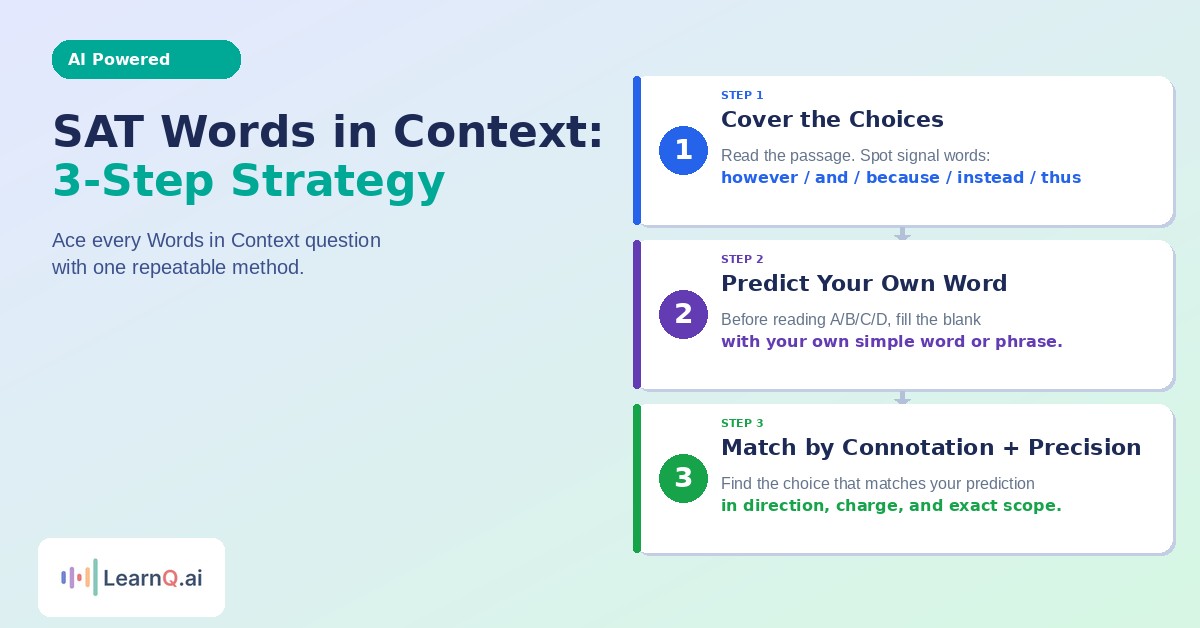
Most students approach Words in Context questions the wrong way: they read the passage, see a word they half-recognise, glance at the choices, and pick the one that sounds most academic. This produces wrong answers. The correct method is the opposite – predict your own word before reading the choices, then use connotation and precision to eliminate. Three steps, applied consistently, will get you the right answer on nearly every Words in Context question regardless of whether you know the vocabulary.
Words in Context questions appear 4-5 times per Digital SAT test, all in the Reading and Writing section under the Craft and Structure domain. They look simple – a short passage with a blank, four word choices – but they fool students at every score level because they are not vocabulary tests in the traditional sense. You are not being asked what a word means. You are being asked which of four near-synonyms fits the precise meaning, tone, and logic of this specific sentence. That is a different skill, and it requires a different method.
Why Students Get These Wrong
The most common failure mode on Words in Context questions is not unknown vocabulary. It is choosing a word that is close but not precise enough.
Consider a question where the blank completes: “The researcher’s findings did not simply support the theory – they __________ it, eliminating any remaining doubt.”
Most students would correctly sense the blank needs a strong positive word meaning something like “confirmed” or “proved.” Then they see choices like:
A. corroborated
B. implied
C. suggested
D. hinted at
Many students eliminate B, C, and D as too weak and select A. That is correct here – but on harder questions, all four choices are close in meaning, and the distinctions are subtle. “Corroborated” (confirmed by separate evidence) versus “substantiated” (proved with direct evidence) versus “validated” (demonstrated as sound or correct) can all seem interchangeable in isolation. In context, only one is precise.
The three-step method below is designed specifically for this: questions where all choices are plausible and you need a repeatable process to identify the one that fits with precision.
The 3-Step Method
Step 1: Cover the Choices and Read for Function
Before looking at A, B, C, or D, cover them. Read the passage and identify two things:
What direction does the blank need to go? Is the blank a word with a positive or negative connotation? Is it strengthening something, weakening it, limiting it, or replacing it?
What signal words surround the blank? These are the most important words in the entire question. Look for:
- Contrast signals – however, but, although, despite, while, yet, instead, rather – these mean the blank goes in the opposite direction from what came before
- Continuation signals – and, also, additionally, furthermore, similarly, as a result – these mean the blank continues in the same direction
- Causal signals – because, since, therefore, thus, consequently – these tell you the blank is either the cause or result of something stated
These signal words are the test-maker’s fingerprints. They tell you exactly what function the missing word needs to serve before you read a single answer choice.
Step 2: Predict Your Own Simple Word
After identifying the function and direction, predict your own word. It does not have to be sophisticated – in fact, simpler is better. You are not guessing the SAT’s answer; you are defining the category the answer must fall into.
If the blank is after “however” and the preceding sentence described a study’s weaknesses, predict something like “fixed” or “addressed.” You do not need to predict “ameliorated” or “mitigated.” Your simple prediction tells you which direction to look when you uncover the choices.
This step is the most important one students skip. Without a prediction, you read the choices with an open mind – and the SAT is designed to exploit an open mind. Wrong answers are calibrated to sound right when you read them without a directional filter. With a prediction, you read the choices looking for one specific thing, which makes elimination much faster and more accurate.
Step 3: Match by Connotation and Precision, Then Eliminate
Uncover the choices. You are not looking for a word that is similar to your prediction – you are looking for the choice that performs the same function as your prediction with the correct connotation.
At this step, eliminate by two criteria:
Connotation mismatch: A word can have the right general meaning but the wrong charge. “Stubborn” and “steadfast” both describe not changing one’s position – but one is negative and one is positive. If the passage describes a character admiringly, “stubborn” is wrong even though it is close in meaning. Check each choice’s positive/negative charge against the passage’s tone.
Precision mismatch: SAT Words in Context questions frequently include one correct answer and one or two “close but not quite” answers. “Asserted” means stated something confidently. “Implied” means suggested without stating. If a scientist states something directly in the passage, “implied” is precisely wrong even though both relate to communication. The distinction is usually about degree, scope, or whether the action is direct or indirect.
After these three steps, the correct answer is the one whose function matches your prediction AND whose connotation matches the passage’s tone AND whose precision matches the specific action described.
10 Worked Examples with the 3-Step Method Applied
The following examples show the method applied to question types at different difficulty levels. Each uses realistic passage content modeled on actual SAT Craft and Structure questions.
Example 1 (Easy – Continuation signal)
Passage: “Early trial results were promising, suggesting the treatment might reduce inflammation. The larger follow-up study __________ these initial findings, confirming the pattern across a wider population.”
Step 1: Continuation context. The larger study found the same thing as the early trials. Function needed: a word meaning “confirmed” or “agreed with.”
Step 2: My prediction: “confirmed.”
Step 3: Choices:
- A. contradicted
- B. corroborated
- C. undermined
- D. questioned
A, C, D all go in the opposite direction. B. “corroborated” means confirmed by independent evidence – precise match. Answer: B
Example 2 (Easy – Contrast signal)
Passage: “Many scientists initially dismissed the discovery as an anomaly. However, subsequent replications __________ its validity, making dismissal increasingly difficult to maintain.”
Step 1: “However” signals contrast. They dismissed it; now the blank does something to its validity that makes dismissal hard. Function: a word meaning “confirmed” or “established.”
Step 2: My prediction: “confirmed.”
Step 3: Choices:
- A. questioned
- B. undermined
- C. established
- D. complicated
C. “established” directly matches. A and B go wrong direction. D is too vague. Answer: C
Example 3 (Medium – Connotation distinction)
Passage: “The documentary filmmaker was known for her __________ style – cutting interviews abruptly, leaving silences to linger, and never explaining transitions between scenes.”
Step 1: Continuation context. The examples (abrupt cuts, lingering silences, unexplained transitions) all point toward a challenging or unconventional style. The word describes this style.
Step 2: My prediction: “unconventional” or “demanding.”
Step 3: Choices:
- A. accessible
- B. uncompromising
- C. collaborative
- D. precise
A and C are positive but wrong direction – accessible means easy to engage with, collaborative means involving others. D “precise” is neutral but doesn’t match “abrupt” and “unexplained.” B “uncompromising” means not willing to concede – describing someone whose artistic choices make no concessions to audience comfort. Precise match. Answer: B
Example 4 (Medium – Precision distinction)
Passage: “The anthropologist did not simply describe the ritual; she __________ its significance within the broader cultural framework, connecting it to the community’s agricultural cycles and seasonal ceremonies.”
Step 1: Continuation context. She went beyond describing – the blank describes something more analytical or interpretive. The rest of the sentence shows she placed it within a larger context.
Step 2: My prediction: “explained” or “interpreted.”
Step 3: Choices:
- A. documented
- B. contextualised
- C. observed
- D. recorded
A, C, D are all about recording or noting – they do not capture the analytical work of connecting something to a larger framework. B “contextualised” means placed within a context to make it better understood – precisely what the sentence describes her doing. Answer: B
Example 5 (Medium – Secondary meaning trap)
Passage: “The committee was asked to __________ its earlier recommendation, as new evidence had emerged that significantly altered the picture.”
Step 1: Causal context (“as new evidence had emerged”). The new evidence caused the committee to do something to its earlier recommendation. Function: change, withdraw, or reconsider.
Step 2: My prediction: “withdraw” or “change.”
Step 3: Choices:
- A. champion
- B. revisit
- C. publish
- D. endorse
C and D go the wrong direction – publishing or endorsing would commit to the old recommendation, not respond to new evidence. A “champion” means to actively support or advocate for – wrong direction. B “revisit” means to return to something for reconsideration – precise match for responding to new evidence by reconsidering a past decision. Answer: B
SAT note: “Champion” as a verb (to support or advocate for) is a secondary meaning trap – students who only know “champion” as a noun (winner) or who read quickly might not recognise it as an option at all, which helps eliminate it.
Example 6 (Hard – Near-synonym precision)
Passage: “The novelist’s prose was praised for its __________ quality – every sentence doing precisely as much work as required, never more.”
Step 1: The examples clarify the blank: “precisely as much as required, never more.” This defines the positive quality being praised. Function: a word describing exactly-right efficiency.
Step 2: My prediction: “efficient” or “exact.”
Step 3: Choices:
- A. economical
- B. simple
- C. concise
- D. minimal
This is the hardest type – all four choices are plausible. Eliminate by precision:
- B “simple” means plain or not complex – doesn’t capture “precisely as much as required”
- D “minimal” means as little as possible – implies less than needed, which contradicts “doing precisely as much work as required”
- C “concise” means brief and clear – close, but “concise” usually describes brevity more than calibration
- A “economical” means using no more of a resource than necessary – exactly matches “precisely as much as required, never more”
Answer: A
Example 7 (Hard – Tone precision)
Passage: “Critics who expected the memoir to be self-congratulatory were surprised by its __________ quality – the author refused to portray herself heroically even in episodes where such a portrait would have been easy to construct.”
Step 1: Contrast signal (“surprised”). Critics expected self-congratulatory; the blank describes what they found instead. Function: a word for the opposite of self-congratulatory. Tone: positive (critics were surprised in a good way).
Step 2: My prediction: “honest” or “self-critical.”
Step 3: Choices:
- A. self-deprecating
- B. ambiguous
- C. restrained
- D. earnest
B “ambiguous” means unclear – doesn’t fit, the author was clear in not portraying herself heroically. D “earnest” means sincere – doesn’t specifically contrast with “self-congratulatory.” C “restrained” is close but describes tone of expression rather than a relationship with self-image. A “self-deprecating” means tending to undervalue oneself – the precise opposite of self-congratulatory, and exactly what “refused to portray herself heroically” describes. Answer: A
Example 8 (Hard – Qualifier trap)
Passage: “The policy had an __________ effect on air quality – emissions dropped significantly within the first six months of implementation.”
Step 1: Continuation context. The blank describes the effect, and the sentence tells us emissions dropped significantly. Function: a strong positive word meaning “marked” or “significant.”
Step 2: My prediction: “dramatic” or “immediate.”
Step 3: Choices:
- A. negligible
- B. immediate
- C. gradual
- D. modest
A “negligible” means unimportant – wrong direction. C “gradual” contradicts “first six months.” D “modest” means limited – contradicts “significantly.” B “immediate” means happening at once, and “within the first six months” supports rapid onset. Answer: B
Example 9 (Hard – Function question)
Passage: “The speaker’s argument did not merely question the policy – it __________ it entirely, leaving no aspect of the proposal unaddressed.”
Step 1: “Merely” signals the blank goes beyond “question.” The blank is a stronger version of questioning, and “leaving no aspect unaddressed” suggests comprehensive rejection or dismantling.
Step 2: My prediction: “dismantled” or “demolished.”
Step 3: Choices:
- A. disputed
- B. challenged
- C. dismantled
- D. modified
A and B are synonyms for “questioned” – the sentence explicitly says the blank goes beyond questioning. D “modified” means changed partially – contradicts “entirely.” C “dismantled” means took apart completely, piece by piece – matches “leaving no aspect unaddressed.” Answer: C
Example 10 (Hard – Secondary meaning)
Passage: “The committee’s findings did not __________ the earlier allegations; instead, they introduced additional complications that made a simple verdict impossible.”
Step 1: “Instead” is a contrast signal. The findings did something in relation to the allegations, and what follows goes in a different direction from that. The contrast is with “additional complications” – so the blank was something that would have simplified or resolved things.
Step 2: My prediction: “resolve” or “settle.”
Step 3: Choices:
- A. resolve
- B. preclude
- C. substantiate
- D. dismiss
C “substantiate” means confirm – opposite of resolve. B “preclude” means prevent from happening – doesn’t fit (the allegations already existed). D “dismiss” means discard as unimportant – close, but “dismiss” implies a verdict rather than a resolution. A “resolve” means settle or find a solution to – directly matches the contrast with “additional complications.” Answer: A
The Four Trap Types to Watch For
The SAT uses four reliable trap patterns in Words in Context questions. Recognising them speeds up elimination significantly.
Trap 1: The Precision Trap
Two or three choices have similar general meanings, but only one has the right specific scope. “Encompasses” (includes within its scope) versus “categorises” (organises into groups) versus “supersedes” (replaces) – all relate to how one thing relates to other things, but each describes a different relationship. The SAT is testing whether you can identify the precise relationship, not just the general domain.
Defence: After predicting your word, ask: does this choice describe exactly what the passage describes, or does it describe something adjacent to it?
Trap 2: The Connotation Trap
Two choices have the same denotative meaning but different connotations. “Thrifty” and “miserly” both describe someone who does not spend much money – one positive, one negative. “Persistent” and “stubborn” both describe someone who does not change their position – one positive, one negative.
Defence: Before matching words, decide whether the passage is describing the person or thing positively or negatively. Lock in the charge before reading the choices.
Trap 3: The Secondary Meaning Trap
A common word appears in an uncommon use. “Champion” as a verb means to advocate for. “Qualify” means to limit or add nuance to a claim. “Check” can mean to examine, to stop, or to verify. “Cultivate” can mean to grow crops or to develop a relationship or skill. Students who only know a word’s primary meaning miss its SAT usage.
Words frequently caught in this trap: champion (advocate), qualify (limit), check (stop), exploit (make use of), acknowledge (recognise), refine (improve), resist (not be affected by). See the full SAT vocabulary master list for more secondary-meaning words pulled from real 2026 administrations.
Defence: When a familiar word appears in an answer choice, ask: is there another meaning this word could have?
Trap 4: The Strength Trap
One word in the choices has the right direction but too strong or too weak an intensity. “Eliminate” versus “reduce” versus “limit” all describe making something smaller, but with very different degrees. The passage signals the correct degree – “significant reduction” points toward stronger language than “slight improvement.”
Defence: After matching direction, check degree. Does the passage describe a dramatic change or a modest one? A final, definitive action or a temporary, partial one?
How Words in Context Fits Your Overall R&W Score
Words in Context accounts for 4-5 of the approximately 54 Reading and Writing questions per test – about 8-9% of the section. That is not the highest-volume question type (Standard English Conventions accounts for about 26% of the section), but it is often the question type with the lowest accuracy among students who have not specifically practiced the prediction method.
See the Digital SAT question types guide for a full breakdown of all 8 R&W question types and where Words in Context sits in your overall accuracy profile. The Digital SAT Standard English Conventions guide covers the grammar question types that appear in the same section.
For Module 1 strategy – including how to manage pacing across all question types so you have enough time to apply the 3-step method properly on every Words in Context question – see the Module 1 strategy guide.
How to Practice This Method
Knowing the 3-step method and applying it automatically under 35-second time pressure are different things. The method needs to become habit through repetition on real questions.
Practice sequence:
Week 1: Do 10 Words in Context questions per session, untimed, with the 3-step method written out explicitly. After each question, note which step identified the right answer and which trap the wrong answers used. Do not just review what was correct – review which trap you almost fell into.
Week 2: Do 10 questions per session with a 45-second limit per question. The method should now be fast enough that 45 seconds feels comfortable. If it does not, you are still working through the steps consciously rather than automatically.
Week 3: Do Words in Context questions embedded in full R&W module practice. The method is ready when you apply it without thinking about it.
For Words in Context questions from actual recent administrations, the May 2026 SAT vocabulary breakdown includes the exact words that appeared on the May 2026 US test with explanations of why specific choices were correct – the best source for understanding how the method applies to recently tested content.
Take LearnQ.ai’s free diagnostic to see how many Words in Context questions you are currently missing and what pattern drives those errors. Mia, the AI tutor, can generate additional Words in Context practice questions on demand and walk through the 3-step method on any question you get wrong. Take a free full-length practice test to see how your Words in Context accuracy holds up under timed module conditions. See all plans at LearnQ’s Digital SAT platform.
If Words in Context is part of a broader score improvement target, the 200-point improvement guide covers how vocabulary improvement fits alongside drilling other R&W question types.
Once you have the method down, practice it on real Bluebook questions from College Board’s Bluebook app – 8 full practice tests available free. The Bluebook practice test accuracy guide explains which tests are most predictive of your actual test day score at your current level.
FAQ
What are SAT Words in Context questions?
SAT Words in Context questions appear in the Craft and Structure domain of the Reading and Writing section. Each question gives you a short passage with a blank and asks you to choose the word or phrase that best fits the meaning of the blank in context. All four choices are valid English words, and often all four are close in meaning – the question tests whether you can identify the most precise word for the specific context, not just any appropriate synonym. There are approximately 4-5 of these questions per full test according to College Board’s test overview.
What is the best strategy for SAT Words in Context?
Cover the answer choices, read the passage and identify the function and direction the blank needs (using signal words like “however,” “and,” “because”), predict your own simple word, then uncover the choices and eliminate by connotation and precision. This 3-step predict-then-match method prevents the most common failure mode: selecting a choice that sounds plausible rather than the one that is precisely correct.
Why do I keep getting Words in Context questions wrong even when I know the vocabulary?
The most common cause is reading the choices before predicting. When you read the choices first, your brain is drawn toward familiar or sophisticated words without first anchoring to what the blank actually needs to do. The prediction step forces you to define what you are looking for before the answer choices can influence you. The second common cause is not identifying signal words – without recognising “however” as a contrast signal, you might miss that the blank needs to go in the opposite direction from the preceding clause.
How do I know whether a blank needs a positive or negative word?
Read the sentence carefully for the tone of surrounding language and the logical relationship between clauses. If the passage describes something improving and the blank is in the same clause, the blank is positive. If the passage uses a contrast signal (however, but, although) and the preceding clause was negative, the blank is likely positive. Specific signal words are more reliable than general tone – train yourself to spot “however,” “instead,” “despite,” “similarly,” and “therefore” before doing anything else.
How many Words in Context questions are on the Digital SAT?
Approximately 4-5 per full test, all in the Reading and Writing section under the Craft and Structure domain. This domain accounts for about 13-15 questions total (roughly 28% of the R&W section), with Words in Context making up the largest single subcategory within it.
Should I memorise SAT vocabulary words to do well on Words in Context?
Vocabulary knowledge helps but is not sufficient on its own. Students who know that “corroborate” means “confirm with separate evidence” will reach the right answer faster than students who have to eliminate the wrong choices first – but both methods can reach the right answer. The 3-step strategy works even on unknown vocabulary because it eliminates by function and direction, not by recognition. Priority: master the strategy first, build vocabulary second.
Sources: College Board Digital SAT Craft and Structure domain overview; Curvebreakers Test Prep Digital SAT vocabulary-in-context strategy (curvebreakerstestprep.com, October 2024); Test Ninjas SAT Words in Context guide (test-ninjas.com); Acely SAT vocabulary guide 2026 (acely.com, April 2026); The Test Advantage March 2026 SAT vocabulary in context breakdown (thetestadvantage.com, April 2026)

The LearnQ Editorial Team is made up of certified Digital SAT tutors, college admissions specialists, and AI education researchers. Our tutors have personally helped over 10,000 US high school students improve their SAT scores, with an average improvement of 150+ points. We combine hands-on tutoring expertise with AI-powered insights from the LearnQ platform, which has analyzed millions of Digital SAT practice questions. Every article we publish is reviewed against the latest College Board Bluebook guidelines and cross-checked with real student performance data. Our mission is simple: give every student the same quality of prep that was once only available at expensive tutoring centers.