

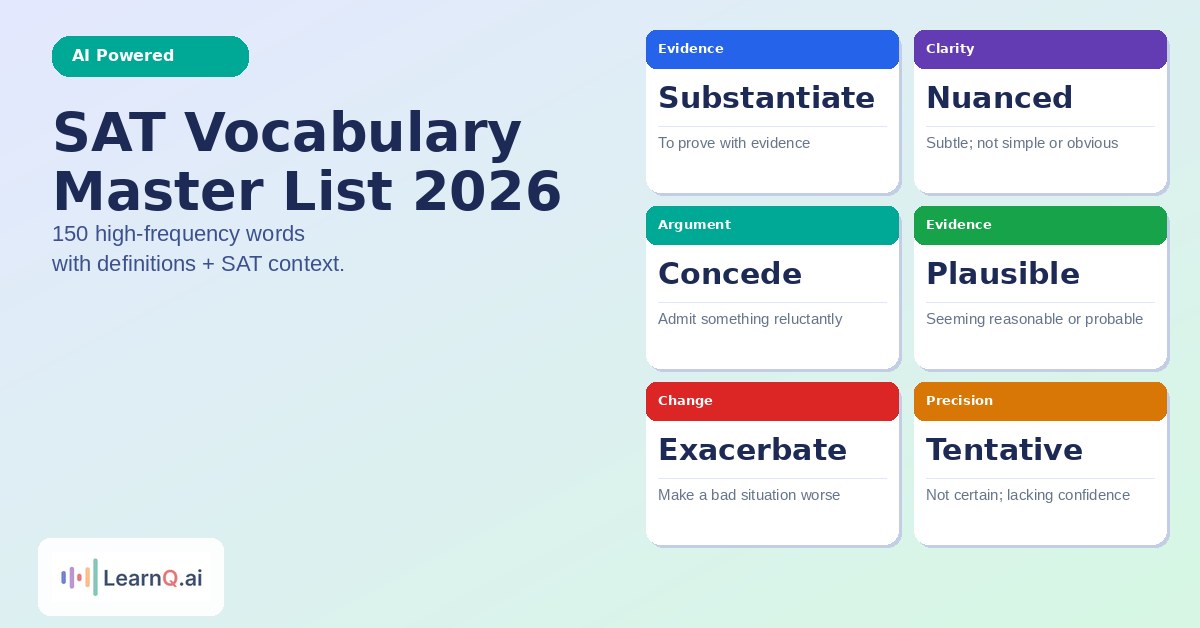
The Digital SAT tests vocabulary through Words in Context questions – approximately 4-5 per test in the Craft and Structure domain. These questions do not ask for definitions; they ask which word best fits the meaning, tone, and logic of a specific passage. This list of 150 words is organized by function so you learn how each word works in SAT contexts, not just what it means.
Unlike older SAT vocabulary lists built around obscure or archaic words, the Digital SAT vocabulary is drawn from academic prose – scientific reports, historical essays, social science passages, and literary criticism. The words are not rare. They are precise. Students miss Words in Context questions not because they have never seen the word, but because they do not know its secondary meaning or its connotation in an academic register.
This list is organized into six functional categories, because the SAT tests vocabulary by function more than by definition. Knowing that “mitigate” and “exacerbate” are opposites is more useful than memorizing either definition alone. Each word includes a brief definition and an example sentence modeled on the academic tone of actual SAT passages.
How Vocabulary Is Tested on the Digital SAT
According to College Board’s official test overview, Words in Context questions fall under the Craft and Structure domain of Reading and Writing. This domain accounts for approximately 28% of the section – around 13-15 questions total. Of those, 4-5 are specifically Words in Context.
The format: a short passage with a word or phrase underlined or highlighted. Four answer choices, all of which are plausible English words. Only one fits the specific meaning, tone, and logic of that passage.
The critical insight: all four choices often have similar general meanings. “Assert,” “claim,” “declare,” and “insist” all mean something like “say.” The correct answer depends on degree, connotation, and whether the tone is neutral, formal, or emphatic. This is why studying definitions alone is not enough.
See the complete Digital SAT question types guide for a breakdown of all 8 R&W question types and how Words in Context fits into your overall R&W prep.
How to Use This List
Study 15-20 words per session. For each word:
- Read the definition and the example sentence
- Identify the word’s connotation: positive, negative, or neutral
- Write one original sentence using the word in a different context
- Compare it to the words listed alongside it – SAT questions often test synonyms with different connotations
Review sessions: go back to each group of 15 words 24 hours later and quiz yourself without the list. Can you recall the word from the definition? Can you use it correctly in a new sentence? Spaced repetition – reviewing at 1 day, 3 days, and 7 days after first learning – produces better long-term retention than marathon review sessions.
Category 1: Evidence and Argumentation Words (30 Words)
These words appear constantly in SAT passages describing what authors, researchers, or data sources do. They are especially common in Command of Evidence questions and in Craft and Structure questions about the function of a sentence or paragraph.
Substantiate (v.) – To provide evidence that proves or confirms a claim.
“The researchers substantiated their hypothesis with data from six independent studies.”
SAT note: When data or evidence agrees with a theory, it substantiates it.
Corroborate (v.) – To confirm or give support to a statement or theory.
“Her account was corroborated by three independent witnesses.”
SAT note: Two sources corroborate each other when they independently reach the same conclusion.
Validate (v.) – To demonstrate or support the truth or value of something.
“The clinical trial results validated the team’s earlier theoretical predictions.”
Affirm (v.) – To state something as a fact; to support or uphold something.
“The panel affirmed that the methodology met rigorous scientific standards.”
Reinforce (v.) – To strengthen or support an existing idea or conclusion.
“The satellite data reinforced the earlier ground-level measurements.”
Refute (v.) – To prove that something is wrong or false; to deny.
“The new evidence refuted the long-held assumption that the species was solitary.”
SAT note: To refute something is stronger than to question it – it means to disprove it.
Undermine (v.) – To lessen the effectiveness or validity of something.
“The contradictory results undermined confidence in the initial findings.”
SAT note: Common in passages where one study calls another into question.
Repudiate (v.) – To refuse to accept; to strongly reject or deny.
“The government repudiated the treaty, citing violations by the other party.”
SAT note: Stronger than “reject” – implies deliberate, official, or public rejection.
Contradict (v.) – To be in conflict with; to deny the truth of.
“The second survey contradicted the optimistic projections of the first.”
Contest (v.) – To challenge or dispute; to compete for.
“Several scientists contested the interpretation of the experiment’s outcomes.”
Assert (v.) – To state a fact or belief confidently and forcefully.
“The author asserts that cultural factors, not economic ones, drove the policy shift.”
SAT note: To assert is not to prove – it means to state something with confidence.
Posit (v.) – To put forward as a basis for argument; to suggest.
“Early cosmologists posited that the universe was static and unchanging.”
Contend (v.) – To assert something as a position in an argument or debate.
“The historians contend that the revolution was economically, not ideologically, motivated.”
Concede (v.) – To admit that something is true, often reluctantly.
“Even the study’s critics conceded that the sample size was adequate.”
SAT note: A concession often comes with “but” – the author admits one thing while maintaining another.
Acknowledge (v.) – To accept or admit the existence or truth of something.
“The report acknowledged significant limitations in the data collection process.”
Qualify (v.) – To limit or modify a statement; to make it less absolute.
“The researchers qualified their conclusions, noting they applied only to urban populations.”
SAT note: On the SAT, “qualify” almost always means to limit or add nuance to a claim, not to meet a requirement.
Substantive (adj.) – Having a firm basis in reality or fact; significant.
“The commission found no substantive evidence linking the two events.”
Empirical (adj.) – Based on observation or experience rather than theory.
“The team sought empirical evidence before drawing conclusions.”
Speculative (adj.) – Based on conjecture rather than firm evidence; theoretical.
“The author’s claims about ancient trade routes remain speculative without archaeological support.”
Plausible (adj.) – Seeming reasonable or probable; believable.
“The simplest and most plausible explanation is that the data were recorded incorrectly.”
Inconclusive (adj.) – Not leading to a clear conclusion or result.
“The initial trials were inconclusive and required further replication.”
Compelling (adj.) – Evoking strong interest; convincing.
“She presented a compelling argument for rethinking urban transportation policy.”
Dubious (adj.) – Hesitant or doubtful; not clearly established.
“The methodology was dubious, relying on self-reported data from a small sample.”
Tenuous (adj.) – Very weak or slight; not firmly grounded.
“The connection between the two variables was tenuous at best.”
Categorical (adj.) – Unambiguous and direct; absolute, without exceptions.
“The committee issued a categorical denial of any wrongdoing.”
Nuanced (adj.) – Characterized by subtle distinctions; not simple or obvious.
“A nuanced reading of the text reveals competing interpretations beneath the surface.”
Provisional (adj.) – Arranged or existing for the time being, subject to change.
“These are provisional findings that will be revised once the full data are collected.”
Tentative (adj.) – Not certain or fixed; done without confidence.
“The team offered only a tentative explanation for the anomaly.”
Definitive (adj.) – Final, conclusive; most authoritative of its kind.
“The study is considered the definitive account of the migration patterns of that era.”
Corroborative (adj.) – Providing evidence that confirms something already partially known.
“The corroborative testimony of three independent sources strengthened the case.”
Category 2: Tone and Attitude Words (25 Words)
These words describe how an author, speaker, or character feels or the tone they project. They are tested in questions about author’s stance, purpose, and perspective.
Skeptical (adj.) – Not easily convinced; having doubts.
“The editorial took a skeptical view of the administration’s economic projections.”
Cynical (adj.) – Believing that people are only motivated by self-interest; distrustful.
“His cynical portrayal of government left little room for optimism about reform.”
SAT note: Cynical is stronger than skeptical – it implies a generally negative worldview.
Ambivalent (adj.) – Having mixed or contradictory feelings about something.
“The review was ambivalent, praising the novel’s ambition while questioning its execution.”
Disparaging (adj.) – Expressing the opinion that something is of little worth; belittling.
“The critic’s disparaging remarks about the exhibition drew an angry response.”
Laudatory (adj.) – Expressing praise; complimentary.
“The biography was broadly laudatory, glossing over the subject’s professional failures.”
Reverent (adj.) – Feeling or showing deep respect and admiration.
“Her reverent tone suggested she viewed her mentor’s work as beyond criticism.”
Indifferent (adj.) – Having no particular interest or concern; unconcerned.
“The public remained indifferent to the policy debate, according to polling data.”
Detached (adj.) – Separate; not emotionally involved; objective.
“The narrator maintains a detached tone, presenting facts without editorial comment.”
Wistful (adj.) – Having a feeling of vague or regretful longing.
“The memoir’s wistful tone reflected the author’s longing for a way of life that had passed.”
Ironic (adj.) – Using words to mean the opposite; expressing incongruity.
“His ironic praise for the committee’s ‘decisive action’ barely concealed his frustration.”
Understated (adj.) – Expressed with less than the full force of the truth; deliberately restrained.
“The understated conclusion – ‘results were mixed’ – masked the severity of the failures.”
Strident (adj.) – Presenting a point of view in an excessively forceful way; shrill.
“Critics found the report strident in its condemnation of existing regulations.”
Measured (adj.) – Having qualities of a careful, deliberate manner; restrained and thoughtful.
“The diplomat responded with measured language, avoiding any inflammatory phrasing.”
Impartial (adj.) – Treating all rivals or disputants equally; fair and just.
“The panel sought an impartial assessment of the competing policy proposals.”
Pragmatic (adj.) – Dealing with things sensibly and practically; matter-of-fact.
“Her pragmatic approach to reform focused on achievable goals rather than ideal outcomes.”
Idealistic (adj.) – Believing in or pursuing high or noble principles despite realities.
“The plan was idealistic in its assumptions about voluntary industry compliance.”
Deferential (adj.) – Showing respect or submission to someone’s judgment or wishes.
“The younger researchers were deferential to the established figures in the field.”
Provocative (adj.) – Causing annoyance, anger, or strong reaction; stimulating thought.
“The author’s provocative thesis generated both fierce criticism and enthusiastic support.”
Conciliatory (adj.) – Intended or likely to make conflict or anger less intense; appeasing.
“After years of dispute, both parties adopted a more conciliatory tone at negotiations.”
Dispassionate (adj.) – Not influenced by strong emotion; rational and impartial.
“The dispassionate analysis made no effort to assign blame to either party.”
Acerbic (adj.) – Sharp and forthright; (of a person or their tone) direct and critical.
“Her acerbic commentary on the industry’s practices earned her few allies inside it.”
Subdued (adj.) – Quiet and rather reflective or depressed; reduced in force or intensity.
“The tone in the final chapter is subdued, reflecting the weight of what has been lost.”
Nostalgic (adj.) – Having a sentimental longing for the past.
“The essay’s nostalgic tone risked romanticizing conditions that were genuinely difficult.”
Earnest (adj.) – Resulting from or showing sincere and intense conviction.
“The scientist’s earnest plea for funding failed to move the skeptical review board.”
Alarmist (adj.) – Creating unnecessary worry or fear; tending to exaggerate risks.
“Some scientists dismissed the coverage as alarmist, noting the risk remained low.”
Category 3: Change and Movement Words (20 Words)
These words describe how things shift, develop, improve, or worsen. They are common in science and social science passages.
Mitigate (v.) – To make less severe, serious, or painful; to reduce harm.
“Several policy measures were introduced to mitigate the economic impact of the drought.”
SAT note: You mitigate something negative. You cannot mitigate a positive thing.
Exacerbate (v.) – To make a problem, bad situation, or negative feeling worse.
“The new regulations inadvertently exacerbated the very shortage they sought to address.”
SAT note: Direct opposite of mitigate. These two are often tested together.
Ameliorate (v.) – To make something bad or unsatisfactory better; to improve.
“Community programs were developed to ameliorate conditions in the most affected neighborhoods.”
Deteriorate (v.) – To become progressively worse; to decline in quality.
“Without preventive maintenance, the structural integrity of the bridge began to deteriorate.”
Augment (v.) – To make something greater by adding to it; to increase.
“The foundation augmented its grant funding with additional private contributions.”
Diminish (v.) – To make or become less; to reduce or lessen.
“Access to better roads diminished the economic isolation of rural communities.”
Catalyze (v.) – To cause or accelerate a reaction or event; to act as a catalyst for.
“The new funding catalyzed a wave of research into renewable energy storage.”
Impede (v.) – To delay or prevent someone or something by obstructing them; to hinder.
“Bureaucratic delays impeded the rollout of the vaccination program.”
Facilitate (v.) – To make an action or process easier; to enable.
“The new software was designed to facilitate collaboration across research teams.”
Precipitate (v.) – To cause something to happen suddenly or prematurely.
“The unexpected shortage precipitated a sharp rise in commodity prices.”
SAT note: In academic writing, to precipitate means to trigger or cause something.
Perpetuate (v.) – To cause to continue indefinitely; to preserve or maintain.
“Critics argued that the policy would perpetuate existing inequalities rather than address them.”
Transform (v.) – To make a thorough or dramatic change in the form or character of.
“The introduction of mechanized harvesting transformed agricultural labor practices.”
Fluctuate (v.) – To rise and fall irregularly in number or amount.
“Consumer confidence continued to fluctuate with each new economic report.”
Erode (v.) – To gradually destroy or diminish; to wear away.
“Decades of neglect eroded public trust in the institution’s ability to self-regulate.”
Evolve (v.) – To develop gradually, especially from a simple to a complex form.
“The theory evolved considerably over three decades of field research.”
Stabilize (v.) – To make or become unlikely to give way; to stop changing.
“Emergency interventions were credited with stabilizing the region’s economy.”
Accelerate (v.) – To increase in rate, amount, or speed; to cause to happen sooner.
“The technological breakthrough accelerated the timeline for commercial deployment.”
Reverse (v.) – To change the direction, order, or result of something; to undo.
“The committee sought to reverse decades of declining investment in public infrastructure.”
Perpetuate (v.) – To make something continue indefinitely; to maintain or preserve.
“The narrative perpetuated a misleading account of events that persisted for decades.”
Impede (v.) – To hinder or obstruct the progress of.
“A lack of funding impeded progress on what was otherwise a promising research program.”
Category 4: Clarity and Ambiguity Words (25 Words)
These words describe how clear, vague, defined, or uncertain something is. They appear constantly in academic passages.
Ambiguous (adj.) – Open to more than one interpretation; not having one obvious meaning.
“The wording of the clause was ambiguous enough to invite competing legal interpretations.”
Explicit (adj.) – Stated clearly and in detail; leaving nothing implied.
“The contract contained explicit terms regarding intellectual property ownership.”
SAT note: Opposite of implicit. Explicit = stated directly. Implicit = suggested without being stated.
Implicit (adj.) – Suggested though not directly expressed.
“The implicit assumption in the study was that access to education was equal across groups.”
Obscure (adj./v.) – Not discovered or known about; not clear; to make unclear.
“The mechanisms by which the drug achieved its effects remained obscure for several decades.”
SAT note: Obscure can be an adjective (unclear) or a verb (to hide or make unclear).
Nebulous (adj.) – In the form of a cloud; unclear, vague, or indistinct.
“The plan lacked specifics, offering only a nebulous vision of the intended outcome.”
Elusive (adj.) – Difficult to find, catch, or achieve; hard to understand or define.
“A definitive answer to the question remained elusive despite years of research.”
Coherent (adj.) – Logical and consistent; forming a unified whole.
“The essay failed to develop a coherent argument, moving between unrelated topics.”
Transparent (adj.) – Easy to perceive or detect; not concealed.
“The organization committed to more transparent reporting of its financial decisions.”
Convoluted (adj.) – Extremely complex and difficult to follow; intricate.
“The tax code’s convoluted structure made compliance costly for small businesses.”
Lucid (adj.) – Clearly expressed; easy to understand; showing clear thinking.
“Despite the complexity of the subject, her explanation was remarkably lucid.”
Paradoxical (adj.) – Seemingly contradictory but actually well-founded.
“It is paradoxical that increasing access sometimes reduces overall quality.”
Abstract (adj.) – Existing in thought or as an idea but not having a physical existence.
“The debate remained abstract until concrete policy proposals were introduced.”
Tangible (adj.) – Perceptible by touch; clear and definite; real.
“The researchers sought tangible evidence that the intervention had measurable effects.”
Subtle (adj.) – Difficult to notice or understand; making use of clever and indirect methods.
“The shift in the author’s tone was subtle but significant.”
Stark (adj.) – Severe or bare in appearance; sharply clear.
“The stark contrast between the two datasets demanded explanation.”
Conclusive (adj.) – Serving to prove a case; providing final, reliable evidence.
“The DNA analysis provided conclusive proof that the two specimens were unrelated.”
Incongruous (adj.) – Out of place; not in harmony with the surroundings.
“The modern building looked incongruous among the surrounding nineteenth-century architecture.”
Inherent (adj.) – Existing in something as a permanent, essential, or characteristic attribute.
“Researchers acknowledged the inherent limitations of a study based on self-reported data.”
Intrinsic (adj.) – Belonging naturally; essential; originating from within.
“The material’s intrinsic properties determined its durability more than its manufacturing process.”
Discernible (adj.) – Able to be discerned; perceptible.
“No discernible pattern emerged from the first round of analysis.”
Pronounced (adj.) – Very noticeable or marked; strongly indicated.
“The age-related effect was most pronounced in participants over 65.”
Distinctive (adj.) – Characteristic of one person or thing, and distinguishing them from others.
“Each of the three traditions had a distinctive approach to the same philosophical problem.”
Conspicuous (adj.) – Clearly visible; attracting notice or attention.
“The study’s most conspicuous finding was the absence of any correlation.”
Definitive (adj.) – Final and not able to be questioned; most complete or authoritative.
“The 1962 study remains the definitive account of the region’s geological history.”
Nuanced (adj.) – Characterized by subtle distinctions or variations; not simple.
“A nuanced understanding of the data reveals patterns invisible in aggregate form.”
Category 5: Relationship and Comparison Words (25 Words)
These words describe how ideas, people, or events relate to each other. They are critical for Cross-Text Connections questions.
Analogous (adj.) – Comparable in certain respects; partially similar.
“The process is analogous to the way immune systems develop resistance over time.”
Parallel (adj./n.) – Occurring at the same time or being similar; a corresponding situation.
“The author draws a parallel between nineteenth-century industrialization and current digitization.”
Divergent (adj.) – Tending to be different or develop in different directions.
“The two economists reached divergent conclusions from the same dataset.”
Convergent (adj.) – Coming together from different points; leading to the same result.
“The convergent findings from multiple research groups strengthened the case for the theory.”
Reciprocal (adj.) – Given, felt, or done in return; mutual.
“The treaty established a reciprocal arrangement for sharing scientific data.”
Complementary (adj.) – Combining in a way that enhances the qualities of each other.
“The two approaches were complementary – each addressing the weaknesses of the other.”
SAT note: Do not confuse with “complimentary” (meaning free or expressing praise).
Disproportionate (adj.) – Too large or too small in comparison with something else.
“The resources allocated were disproportionate to the scale of the problem.”
Pervasive (adj.) – Spreading through every part of something; widespread.
“The influence of the new philosophy was pervasive, affecting every discipline.”
Prevalent (adj.) – Widespread in a particular area or at a particular time.
“The condition was prevalent among urban populations but rare in rural communities.”
Unprecedented (adj.) – Never done or known before; unparalleled.
“The rate of species loss in the twentieth century was unprecedented in recorded history.”
Comparable (adj.) – Able to be likened to another; of equivalent quality.
“No other study of comparable scope had been conducted in the region.”
Distinct (adj.) – Recognizably different in nature from something else of a similar type.
“The three phases of the experiment produced distinct patterns of results.”
Subordinate (adj./v.) – Lower in rank or position; to treat as less important than something else.
“Individual concerns were subordinated to the collective interest during the emergency period.”
Supersede (v.) – To take the place of; to replace.
“The 2019 guidelines were superseded by a more comprehensive regulatory framework.”
Correlate (v.) – To have a mutual relationship or connection; to correspond.
“Higher education levels correlated with, but did not cause, improved health outcomes.”
SAT note: Correlation is not causation – the SAT tests this distinction directly.
Precede (v.) – To come before in time, order, or position.
“The economic crisis preceded the political instability by approximately eighteen months.”
Correspond (v.) – To have a close similarity; to match or agree with something.
“The data from the new study closely correspond to the original findings.”
Coincide (v.) – To occur at the same time; to be in agreement.
“The two crises coincided, making it difficult to assess the impact of either individually.”
Distinguish (v.) – To recognize or treat as different; to make someone or something stand out.
“The study failed to distinguish between correlation and causation.”
Epitomize (v.) – To be a perfect example of; to typify.
“The case epitomized the broader challenge of enforcing environmental regulations.”
Exemplify (v.) – To be a typical example of; to illustrate by example.
“The project exemplified what is possible when community organizations and government collaborate.”
Characterize (v.) – To describe the distinctive nature or features of; to be characteristic of.
“Historians have characterized the period as one of unprecedented social mobility.”
Perpetuate (v.) – To cause to continue indefinitely; to maintain an existing state.
“The narrative perpetuated a misleading account that persisted for decades.”
Diverge (v.) – To separate from another route or go in a different direction.
“The two approaches diverged sharply when it came to questions of implementation.”
Overlap (v./n.) – To cover part of the same area; to share similar properties.
“The overlapping jurisdictions of the two agencies created administrative confusion.”
Category 6: Precision and Scale Words (25 Words)
These words describe how large, small, significant, or limited something is. They appear in passages about research scope, policy reach, and scientific measurement.
Negligible (adj.) – So small or unimportant as to be not worth considering.
“The difference in outcomes between the two groups was negligible – less than 1%.”
Substantial (adj.) – Of considerable importance, size, or worth.
“The intervention produced a substantial reduction in hospital readmission rates.”
Marginal (adj.) – Minor and not important; relating to or at the edge.
“The improvement was marginal and fell below the threshold for statistical significance.”
Nominal (adj.) – Existing in name only; much smaller than the real situation.
“The nominal fee charged bore no relation to the actual cost of the service.”
SAT note: Nominal almost always means “in name only” or “very small” on the SAT.
Extensive (adj.) – Covering or affecting a large area; large in scale or scope.
“The organization conducted extensive research before issuing its recommendations.”
Comprehensive (adj.) – Including or dealing with all or nearly all elements or aspects.
“A comprehensive review of existing literature revealed significant gaps in current knowledge.”
Cursory (adj.) – Hasty and therefore not thorough or detailed; superficial.
“A cursory reading of the report missed the critical caveat buried in the appendix.”
SAT note: Cursory implies insufficient attention – it is always slightly negative.
Meticulous (adj.) – Taking or showing extreme care about minute details.
“The meticulous record-keeping by early naturalists provides invaluable data to modern researchers.”
Exhaustive (adj.) – Tending to exhaust a subject; thorough and comprehensive.
“An exhaustive search of the archives failed to uncover any earlier reference to the event.”
Sparse (adj.) – Thinly dispersed or scattered; not dense.
“The documentation from that period is sparse, leaving historians to rely on inference.”
Abundant (adj.) – Existing or available in large quantities; plentiful.
“The region’s abundant natural resources attracted significant foreign investment.”
Scarce (adj.) – Not enough for the demand; insufficient; in short supply.
“Reliable data were scarce, and the researchers were forced to work with estimates.”
Finite (adj.) – Limited in size or extent; having bounds.
“The planet’s finite resources place absolute limits on population growth trajectories.”
Arbitrary (adj.) – Based on random choice or personal whim, rather than reason or system.
“The cutoff date appeared arbitrary, with no scientific justification offered.”
Systematic (adj.) – Done or acting according to a fixed plan or system; methodical.
“A systematic review of 47 studies found consistent support for the intervention.”
Sporadic (adj.) – Occurring at irregular intervals; not continuous or steady.
“Sporadic rainfall was insufficient to end the drought or replenish groundwater levels.”
Chronic (adj.) – Persisting for a long time or constantly recurring.
“Chronic underfunding left the agency unable to fulfill its regulatory mandate.”
Acute (adj.) – Present or experienced intensely; critical or serious.
“The shortage of qualified personnel created an acute bottleneck in the review process.”
SAT note: Acute means severe or sharp, not long-lasting (that is chronic).
Gradual (adj.) – Taking place or progressing slowly or by degrees.
“The shift toward renewable energy has been gradual but consistent over two decades.”
Abrupt (adj.) – Sudden and unexpected.
“The abrupt change in policy caught stakeholders off guard and disrupted existing agreements.”
Intermittent (adj.) – Occurring at irregular intervals; not continuous.
“Intermittent outages disrupted service throughout the transition period.”
Persistent (adj.) – Continuing firmly despite opposition, difficulty, or failure.
“Persistent inequality across regions complicated efforts to implement uniform standards.”
Transient (adj.) – Lasting only for a short time; impermanent.
“The initial improvement was transient, with most participants reverting to baseline within weeks.”
Enduring (adj.) – Lasting over a long period of time; long-lasting.
“The policy change had an enduring impact on how researchers approached the problem.”
Profound (adj.) – Very great or intense; having or showing great knowledge or insight.
“The discovery had a profound effect on our understanding of early human migration.”
How to Study These Words Effectively
The SAT does not test which student has memorized the most definitions. It tests which student can identify the most precise word for a specific context. These two skills are related but different.
For Words in Context questions, practice this method:
Before looking at the answer choices, cover them. Read the sentence or passage and substitute your own word. If the blank should mean “to make worse,” you predicted “worsen.” When you uncover the choices, you are not looking for “worsen” – you are looking for which choice matches that function. If you see “exacerbate,” “aggravate,” and “amplify,” you need to know which is most precise in context.
See the complete Digital SAT Module 1 strategy guide for how Words in Context questions fit into your overall Module 1 approach and score ceiling management.
Common mistake to avoid: The SAT often includes one answer choice that is a very familiar word (like “increase”) alongside a more precise academic word (like “augment” or “proliferate”). Students who have not studied the precise meanings of the academic words often default to the familiar choice, which is frequently wrong because it lacks the specificity the passage demands.
Understanding the Craft and Structure domain more fully – including how Words in Context fits alongside Text Structure and Purpose and Cross-Text Connections – is covered in the Reading and Writing question types guide.
The Digital SAT Standard English Conventions guide covers the grammar question types that appear alongside vocabulary questions in the R&W section.
Practice Words in Context on Real Digital SAT Questions
Vocabulary study without application produces limited gains. After studying each category in this list, practice on actual Words in Context questions from College Board’s Bluebook app, which contains 8 free full-length practice tests. See which Bluebook tests are most accurate for your score level before choosing which to use.
LearnQ.ai’s free diagnostic test identifies exactly how many Words in Context questions you are missing and what patterns drive the errors – whether it is a connotation issue, a secondary-meaning issue, or a precision issue. Take the diagnostic before investing significant time in vocabulary study, so you know whether vocabulary is actually your highest-leverage gap.
Mia, LearnQ.ai’s AI tutor, can generate additional Words in Context practice questions for any word category and explain why specific answer choices are correct or incorrect – exactly the contextual explanation that deepens retention better than flashcard repetition alone.
If vocabulary is a significant gap, see the guide on improving your SAT score by 200 points for how vocabulary improvement fits into a comprehensive prep approach. Take a free full-length practice test on LearnQ.ai to benchmark your current R&W performance before beginning targeted vocabulary study. Start free on LearnQ’s Digital SAT platform.
Quick-Reference Word Groups
These pairings are useful for the SAT because questions often test the difference between near-synonyms:
Positive/Negative pairs (critical for connotation questions):
- Mitigate (reduce harm) vs. Exacerbate (make worse)
- Substantiate (prove) vs. Refute (disprove)
- Coherent (clear) vs. Convoluted (unclear)
- Lucid (easy to understand) vs. Nebulous (vague)
- Laudatory (praising) vs. Disparaging (criticizing)
Strength spectrum (for precision questions):
- Repudiate > Refute > Contradict > Question (strongest to weakest rejection)
- Assert > Contend > Suggest > Imply (strongest to weakest statement)
- Categorical > Definitive > Conclusive > Plausible (strongest to weakest certainty)
False friends (words students often misread on the SAT):
- Qualify means to limit a claim, not only to meet a requirement
- Nominal means very small or in name only, not related to naming
- Acute means severe or intense, not long-lasting (that is chronic)
- Precipitate as a verb means to cause or trigger, not only falling rain
FAQ
What vocabulary words are on the Digital SAT 2026?
The Digital SAT does not have an official vocabulary list. However, the test consistently draws from academic words found in scientific, historical, and social science passages. High-frequency categories include evidence and argumentation words (substantiate, corroborate, refute), tone words (skeptical, dispassionate, laudatory), and precision words (negligible, comprehensive, cursory). The 150 words in this guide cover the most tested categories based on analysis of recent test administrations.
How many vocabulary questions are on the Digital SAT?
Approximately 4-5 Words in Context questions appear per full test, all in the Reading and Writing section under the Craft and Structure domain. This domain has about 13-15 questions total, accounting for approximately 28% of the R&W section. While the count is modest, each question tests precision – students who know secondary meanings and connotations consistently outperform students who only know primary definitions.
How should I study SAT vocabulary words?
Study 15-20 words per session in functional groups (argumentation words together, tone words together) rather than alphabetically. For each word, identify its connotation (positive, negative, neutral), write an original sentence, and compare it to near-synonyms. Review at 1 day, 3 days, and 7 days after first learning using spaced repetition. Then practice on real College Board Words in Context questions.
What is the difference between Words in Context and vocabulary memorization?
Traditional vocabulary study asks: “What does this word mean?” Words in Context questions ask: “Which of these near-synonyms best fits the meaning, tone, and logic of this specific sentence?” You can know that “assert,” “claim,” and “contend” all mean to say something with confidence but still miss the question if you cannot identify which word best fits the formality level and connotation of the passage.
Do I need to memorize hundreds of SAT vocabulary words?
No. The returns on vocabulary memorization diminish significantly after the first 100-150 high-frequency words. Beyond that threshold, time spent practicing Words in Context questions with context-based strategy – substituting your own word before reading choices, eliminating based on connotation – produces better results than expanding your word list further.
Which SAT vocabulary words are most important?
Evidence and argumentation words are the highest-value category because they appear in the most question types – not only Words in Context but also Command of Evidence and Text Structure and Purpose questions. Words like substantiate, corroborate, refute, concede, assert, and qualify appear directly in questions and answer choices across multiple question types. Master this category of 30 words first before moving to the other five categories.
Sources: College Board Digital SAT test structure and Craft and Structure domain overview; PrepScholar Digital SAT vocabulary analysis (blog.prepscholar.com, June 2026); The Test Advantage 297 must-know SAT vocabulary words (thetestadvantage.com, May 2026); Acely SAT vocabulary guide 2026 (acely.com, April 2026); College Transitions 455 SAT vocab words (collegetransitions.com, May 2026)

The LearnQ Editorial Team is made up of certified Digital SAT tutors, college admissions specialists, and AI education researchers. Our tutors have personally helped over 10,000 US high school students improve their SAT scores, with an average improvement of 150+ points. We combine hands-on tutoring expertise with AI-powered insights from the LearnQ platform, which has analyzed millions of Digital SAT practice questions. Every article we publish is reviewed against the latest College Board Bluebook guidelines and cross-checked with real student performance data. Our mission is simple: give every student the same quality of prep that was once only available at expensive tutoring centers.