
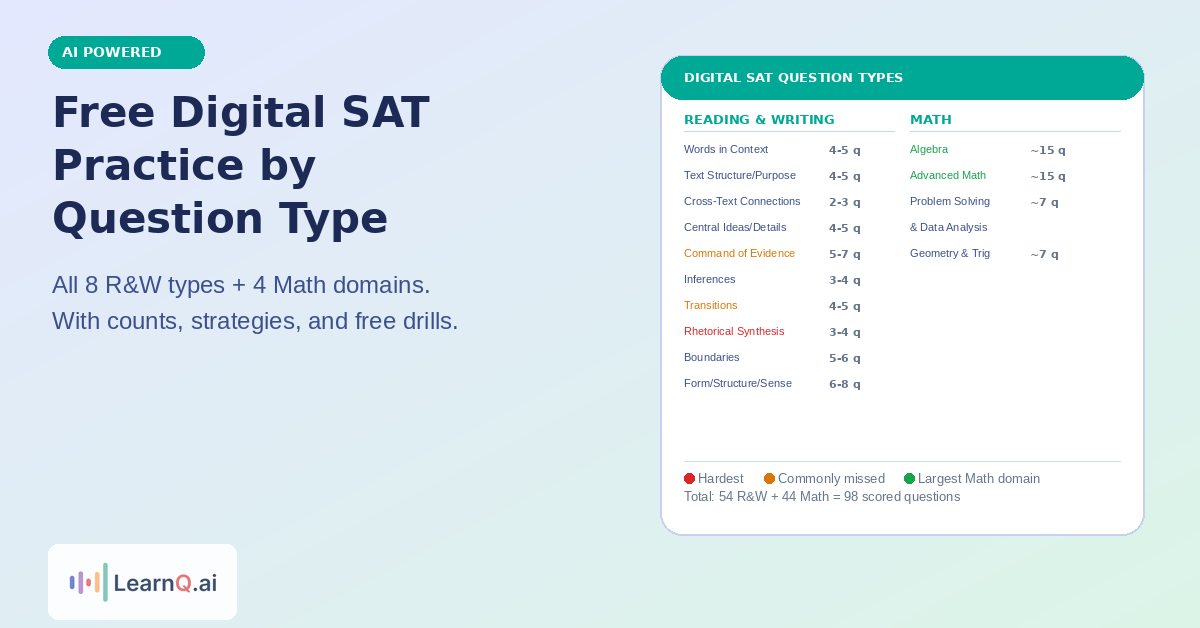
The Digital SAT tests 8 distinct Reading and Writing question types and 4 Math domains across 98 scored questions – drilling each type separately closes score gaps three times faster than repeating full mock tests.
Most students practice wrong. They take a full mock, look at their score, and take another full mock. The score moves 20-30 points and they plateau. What actually produces 100-200 point jumps is identifying the two or three question types bleeding the most points, drilling those types specifically until accuracy climbs, then returning to full mocks to measure the gain.
This guide covers every question type and domain tested on the Digital SAT, with question counts, a strategy note for each, and links to targeted practice. Use it as a drill menu: identify your weakest types from your last Bluebook practice test, work the corresponding sections here, then retest.
The Platform Behind LearnQ.ai Is Now Open to You - Start Free
VEGA AI helps institutes create personalized, automated, and scalable test-prep experiences - no coding, no setup hassle.
Why Question-Type Drilling Works Better Than Random Practice
The Digital SAT is a multistage adaptive test. Your Module 2 difficulty is determined entirely by how well you perform in Module 1 – and Module 1 mixes question types within a fixed sequence. Understanding how adaptive testing works reveals a useful insight: fixing a weak question type does not just recover the points lost on that type. It improves your Module 1 accuracy, which improves your Module 2 routing, which raises your score ceiling.
A student losing 4 points on Transitions questions and 5 points on linear equations in Module 1 might be routing to Easy Module 2 when Hard Module 2 is within reach. Two weeks of targeted drilling on those two types can shift the routing – and shift the score ceiling by 50-80 points before any other content changes.
The Digital SAT Module 1 strategy guide covers the routing thresholds in detail. The short version: accuracy on Module 1 matters more than any individual hard question in Module 2.
Reading and Writing: 8 Question Types Across 4 Domains
The Reading and Writing section has 54 scored questions across two 27-question modules. According to College Board’s official test overview, questions appear in a fixed order within each module – always starting with the easiest question in the first domain cluster and ending with Rhetorical Synthesis, the hardest type.
Domain 1: Information and Ideas (approx. 26% of R&W – ~14 questions)
This domain covers understanding and using information from passages – finding the main point, drawing logical conclusions, and evaluating evidence.
Central Ideas and Details (~4-5 questions per full test): Asks for the main idea, a supporting detail, or specific information stated in the passage. Strategy: The answer is always directly supported by something in the passage. If you cannot point to the specific sentence backing your answer, it is wrong. Do not infer – find the evidence.
Command of Evidence (Textual) (~3-4 questions): Gives you a claim and asks which quotation best supports it. Strategy: Identify what the claim needs (an example? a counterexample? a causal link?) then test each answer choice against that need – not against whether the quotation sounds smart.
Command of Evidence (Quantitative) – commonly missed (~2-3 questions): Pairs a passage with a graph or table. Asks which data point best illustrates a claim. Strategy: Find the specific cell the claim refers to, then check whether the answer choice accurately represents that number. Wrong answers use real numbers from the chart that describe the wrong variable or time period.
Inferences (~3-4 questions): Asks what can be logically concluded from the passage. Strategy: The correct answer must be fully supported by the passage – not probably true, but necessarily true given what is stated. One word in an answer choice that goes beyond the passage makes the whole choice wrong.
Domain 2: Craft and Structure (approx. 28% of R&W – ~15 questions)
This domain tests how authors use language – word choice, structure, purpose, and comparison across two passages.
Words in Context (~4-5 questions): Asks for the most precise word to complete a sentence based on meaning and context. Strategy: Replace the blank with your own word before reading the choices. The correct answer matches your prediction in meaning and tone – not just rough synonym territory. Detailed practice in the Reading and Writing practice hub.
Text Structure and Purpose (~4-5 questions): Asks why the author wrote the passage or what function a specific sentence serves. Strategy: Identify the author’s goal first (persuade? inform? counter?), then map each answer against that goal. Choices describing what the text does rather than why are usually wrong.
Cross-Text Connections (~2-3 questions): Presents two short passages and asks how they relate – agree? contradict? extend? qualify? Strategy: Summarise each passage in one sentence before reading the question, then pick the answer that accurately describes the relationship between your two summaries.
Domain 3: Expression of Ideas (approx. 20% of R&W – ~11 questions)
This domain tests writing skills – logical transitions and synthesising bullet-point notes into a coherent sentence.
Transitions – commonly missed (~4-5 questions): Gives you two sentences and asks which transition word best connects them logically. Strategy: Identify the relationship between the sentences before looking at choices. Is the second sentence a contrast? A result? An example? Then pick the transition matching that relationship. Choosing “however” for a cause-and-effect relationship is the most common error.
Rhetorical Synthesis – hardest type, always last in the module (~3-4 questions): Gives you 2-3 bullet-point notes and asks you to write a sentence that accomplishes a specific stated goal. Strategy: Read the goal in the question first. The sentence must accomplish that specific goal using information from the notes. Wrong answers use notes irrelevant to the goal, state a true fact but fail to accomplish the goal, or combine notes incorrectly.
Domain 4: Standard English Conventions (approx. 26% of R&W – ~14 questions)
This domain covers grammar, punctuation, and sentence structure. The complete rules with examples are in the Standard English Conventions guide.
Boundaries (Punctuation) (~5-6 questions): Tests whether sentence-ending punctuation, commas, and semicolons are placed correctly. Strategy: A period or semicolon needs an independent clause on both sides. A comma before a coordinating conjunction connects two independent clauses. Identify clause types before picking punctuation.
Form, Structure, and Sense (Grammar) (~6-8 questions): Tests subject-verb agreement, pronoun agreement, verb tense consistency, and modifier placement. Strategy: Find the subject and verb first, then check agreement. For modifiers, the noun immediately after the opening phrase must be the thing being modified.
Get 30% OFF on all LearnQ.ai Digital SAT plans
Spring Offer: Use code SPRING30 at checkout to unlock your discount.
Math: 4 Domains Across 44 Questions
The Math section has 44 scored questions across two 22-question modules. The Desmos graphing calculator is available on every question – knowing when to use it is a significant time advantage. See the Desmos SAT calculator guide for specific techniques before drilling Math question types.
Domain 1: Algebra (approx. 35% of Math – ~15 questions)
The largest Math domain. Covers linear equations, systems of equations, linear functions, and linear inequalities.
Linear equations in one variable (~3-4 questions): Set up and solve a single-variable equation. Most errors come from misreading the word problem setup, not from arithmetic. Slow down on the setup, speed up on the calculation.
Linear equations in two variables (~2-3 questions): Interpret slope and intercept from an equation or graph. Desmos makes these instant – graph the equation and read intercepts directly from the labeled points.
Systems of linear equations (~3-4 questions): Find intersection points or determine solution count. The fastest approach: enter both equations in Desmos and click the intersection point. No algebra required.
Linear inequalities and systems of inequalities (~2-3 questions): Identify solution regions. Shade correctly by testing a point not on the boundary line. Comprehensive Algebra practice here.
Domain 2: Advanced Math (approx. 35% of Math – ~15 questions)
Covers everything beyond linear – quadratic and polynomial functions, exponential functions, and nonlinear equations.
Quadratic and polynomial equations (~4-5 questions): Find roots, vertex, and axis of symmetry. Desmos graphing is fastest – graph the function and click on the zeros or vertex directly.
Nonlinear functions – commonly missed (~4-5 questions): Interpret exponential growth or decay, identify function behavior from a graph, and work with function notation. Wrong answers typically confuse the rate with the initial value in exponential models.
Equivalent expressions (~3-4 questions): Factor, expand, or rewrite expressions. These are pure algebra manipulation – Desmos does not help. Know factoring patterns and the quadratic formula cold.
Domain 3: Problem Solving and Data Analysis (approx. 15% of Math – ~7 questions)
Applies quantitative reasoning to real-world contexts – ratios, rates, percentages, statistics, and probability.
Ratios, rates, and proportional relationships (~2-3 questions): Set up proportions correctly and pay attention to units. Unit conversion errors are the top mistake.
Percentages (~1-2 questions): Straightforward calculation but read carefully – “percent of what” is the most common error point.
One and two-variable data and statistics (~3-4 questions): Interpret mean, median, spread, and scatterplots. Know the difference between correlation and causation – the SAT tests this distinction directly.
Domain 4: Geometry and Trigonometry (approx. 15% of Math – ~7 questions)
Covers shapes, angles, area, volume, and basic trigonometry. The Bluebook reference sheet provides all area and volume formulas – use it freely.
Area, perimeter, and volume (~2-3 questions): Use the provided formulas. The trap is usually a two-step problem where you need to find one measurement before applying the formula.
Angles and triangles (~2-3 questions): Know angle relationships (vertical, supplementary, corresponding) and the triangle angle sum. The SAT Math formulas page has all the triangle rules you need.
Trigonometry (~1-2 questions): Know sine, cosine, and tangent ratios. SOHCAHTOA covers 90% of SAT trig. Refer to the SAT math formulas guide for trig ratios, special triangles, and circle formulas.
Circles (~1-2 questions): Arc length, sector area, and circle-line intersections. Desmos can graph circle equations to find intersection points instantly.
Get 30% OFF on all LearnQ.ai Digital SAT plans
Spring Offer: Use code SPRING30 at checkout to unlock your discount.
How to Build Your Question-Type Drill Plan in 5 Steps
Step 1: Establish a baseline
Take a full-length practice test in College Board’s Bluebook app under timed conditions. This is the official testing environment used on test day – baseline scores from Bluebook are the most accurate reflection of your current level. Alternatively, use LearnQ.ai’s free full-length adaptive practice test, which includes question-type breakdown analytics.
Step 2: Identify your 2-3 highest-leverage question types
After your test, review results by question type. The College Board’s Skills Insight tool breaks down performance by domain. Focus on question types where you are missing 2 or more questions per module – these are your biggest score levers. Ignore types where you are already scoring 80%+ accuracy.
Step 3: Drill those specific types for 3-4 weeks
Spend 30-45 minutes per session drilling your target question types only. For R&W: prioritise Rhetorical Synthesis, Transitions, and Quantitative Command of Evidence first – these are the three types most commonly underdrilled. For Math: prioritise Systems of Equations and Nonlinear Functions before anything else. LearnQ.ai’s adaptive diagnostic auto-identifies your weakest types and queues targeted drills in the right sequence.
Step 4: Track accuracy by type, not overall score
Your overall mock score is a lagging indicator – it takes 2-3 weeks of drilling to show up in a full test. In the meantime, track accuracy per question type across sessions. Going from 50% to 75% on Rhetorical Synthesis is a measurable win even before your next full mock confirms it.
Step 5: Retest and repeat
After 3-4 weeks of targeted drilling, run another full Bluebook test. Compare question-type accuracy from your baseline test to this one. The types you drilled should show clear improvement. Promote any newly weak types to your drill queue and retire the types you have mastered.
Mia, LearnQ.ai’s AI tutor for the Digital SAT, tracks your accuracy across all question types and adjusts which questions you see next – so your drill sessions always target the types where you are improving slowest. Start free on LearnQ.ai’s Digital SAT platform and get your question-type breakdown in 45 minutes.
Get a 1500+ SAT Score With Expert Coaches + AI.
Live 1-on-1 and small group coaching from mentors who've scored 1580+, combined with LearnQ.ai's adaptive AI practice platform. The only SAT prep that works both ways.
FAQ
What are the question types on the Digital SAT?
The Digital SAT Reading and Writing section has question types across 4 domains: Information and Ideas (Central Ideas, Command of Evidence Textual, Command of Evidence Quantitative, Inferences), Craft and Structure (Words in Context, Text Structure and Purpose, Cross-Text Connections), Expression of Ideas (Transitions, Rhetorical Synthesis), and Standard English Conventions (Boundaries, Form/Structure/Sense). Math has 4 domains: Algebra, Advanced Math, Problem Solving and Data Analysis, and Geometry and Trigonometry.
What is the hardest question type on the Digital SAT?
Rhetorical Synthesis is the hardest Reading and Writing question type – it is deliberately placed last in every module and requires synthesising information from bullet-point notes to accomplish a specific writing goal. For Math, Nonlinear Functions in the Advanced Math domain produces the most errors among students targeting 650+ on the Math section.
How many questions are in each question type on the Digital SAT?
Approximate counts across both modules: Words in Context 4-5, Text Structure and Purpose 4-5, Transitions 4-5, Boundaries 5-6, Form/Structure/Sense 6-8, Rhetorical Synthesis 3-4, Command of Evidence Textual 3-4, Command of Evidence Quantitative 2-3, Inferences 3-4, Central Ideas and Details 4-5. Math: Algebra ~15, Advanced Math ~15, Problem Solving and Data Analysis ~7, Geometry and Trigonometry ~7. Exact counts vary by module difficulty routing.
What is the best free Digital SAT practice resource?
College Board’s Bluebook app offers six free full-length adaptive practice tests – these are the gold standard because they use the real testing interface and adaptive algorithm. For question-type targeted drilling, LearnQ.ai’s free practice test includes performance breakdown by question type, making it useful for identifying gaps before returning to Bluebook for full simulation practice.
Does drilling by question type really improve SAT scores?
Yes – and the mechanism is the adaptive format. When you close accuracy gaps on specific question types in Module 1, you are more likely to route to Hard Module 2, which has a higher score ceiling. Students who improve Module 1 accuracy from 60% to 75% on targeted question types typically see 50-100 point score improvements from routing effects alone, before any additional content gains materialise.
What question types should I prioritise first?
For R&W: start with Rhetorical Synthesis and Transitions – these two types together account for 7-9 questions per test and are the most commonly underdrilled. For Math: start with Systems of Linear Equations (Algebra) and Nonlinear Functions (Advanced Math) – these types appear frequently and are among the highest sources of errors for students in the 550-700 Math range.
How do I find my weak question types after a practice test?
After a Bluebook practice test, review every wrong answer and tag it by question type using the names in this guide. After 3-4 practice tests, a pattern will emerge. College Board’s Skills Insight tool provides this breakdown automatically if you take the test inside Bluebook. LearnQ.ai’s diagnostic test also categorises your performance by question type automatically after a 45-minute session.
Sources: College Board Digital SAT test structure (satsuite.collegeboard.org); College Board Skills Insight for question-type analysis; PrepMaven Digital SAT question type strategy guide (prepmaven.com, October 2025); OpenExamPrep Digital SAT structure overview (open-exam-prep.com, January 2026)