

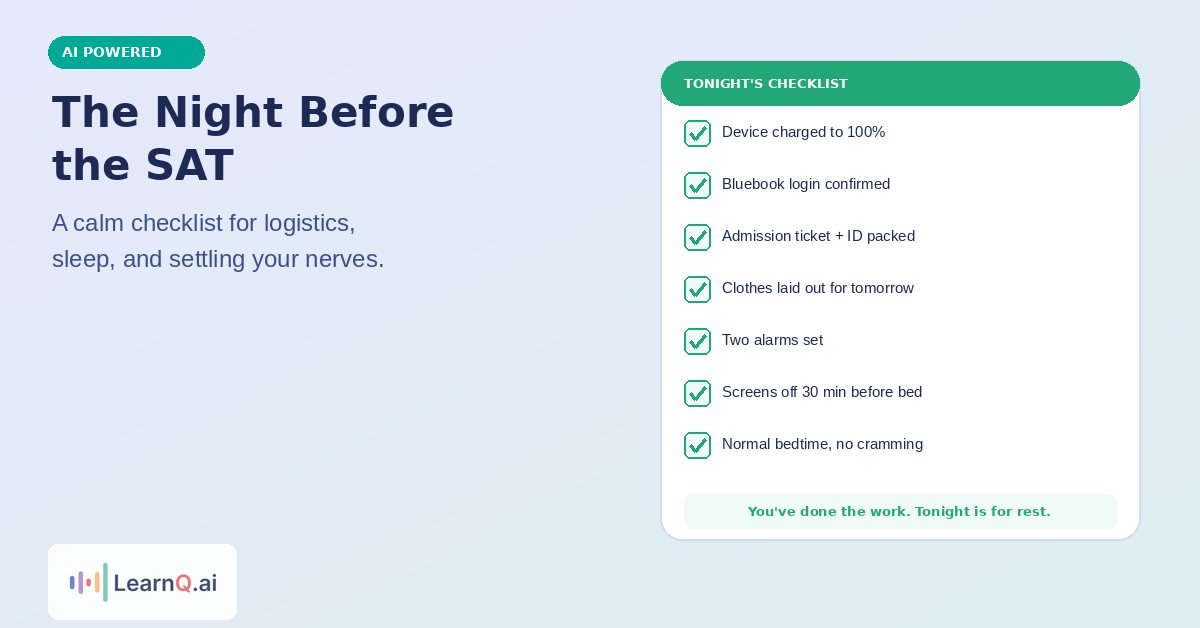
The night before the SAT, stop reviewing new content. Do a light 15-20 minute look at formulas or rules you already know if it helps you feel settled, then shift entirely to logistics and rest. New material does not consolidate into memory in time to help, and a calm, well-slept brain outperforms a crammed, tired one on every section of the test.
If you are reading this the night before your test, take a breath. The preparation you have already done is the preparation that counts tomorrow. Tonight is not for adding more – it is for protecting what you have built. This guide covers exactly what to do this evening, how to actually fall asleep when your mind is racing, and what to do if nerves are still there in the morning.
Why Tonight Is a Logistics Night, Not a Study Night
Cramming the night before a test has a real cost. New content does not have time to move into long-term memory before tomorrow morning, so late studying tends to add stress without adding much real benefit. Sacrificing sleep for extra review time actually reduces comprehension and recall the next day – the trade generally works against you, not for you.
There is a genuinely useful idea from sports psychology worth knowing here: the two-nights rule. Many athletes rely on the principle that the sleep you get two nights before a big event matters more than the sleep you get the night immediately before it. If you slept reasonably well two nights ago, one restless night right before the test will not undo your readiness. This is worth remembering if tonight turns out to be a harder night than you hoped – you are not starting from zero.
Tonight’s job is simple: confirm your logistics, protect your rest, and let your preparation speak for itself tomorrow.
The Night-Before Checklist
Confirm your test logistics
- Double-check your test location, especially if you are not testing at your home school
- Look up the route and travel time; plan to arrive 15-20 minutes before your reporting time
- Confirm who is getting you there, if you are not driving yourself
- Know your reporting time from your admission ticket – doors typically close 30 minutes after reporting time, and arriving after that can mean forfeiting your registration with no refund
Prepare your device and materials
- Charge your testing device to 100% overnight
- Open Bluebook and confirm you can log in successfully – resolve any login issues tonight, not tomorrow morning
- Download and print your admission ticket; most test centers require a printed copy, not a phone screenshot
- Pack your photo ID (original, not a photocopy, not expired)
- Pack sharpened No. 2 pencils with clean erasers for scratch work
- Pack an approved calculator, even though Bluebook includes a built-in calculator
- Pack your charger, a non-beeping watch, and a snack and drink for your break
See the complete test-day checklist for the full printable list, and the Bluebook app guide if you are still getting your device set up.
Lay out tomorrow morning
- Set out your clothes tonight, including a layer you can add or remove – test centers run unpredictably warm or cold
- Set multiple alarms
- Decide what you are eating for breakfast; stick with something familiar rather than trying anything new
How to Actually Fall Asleep Tonight
Knowing you should sleep and actually falling asleep are two different problems, especially with adrenaline running. A few things that genuinely help:
Step away from screens 30-60 minutes before bed. The blue light from phones and laptops delays your body’s natural melatonin release, making it harder to fall asleep even when you are tired.
Keep your normal bedtime routine. If you usually shower before bed, shower before bed tonight too. Familiar routines signal to your body that it is time to wind down; disrupting your normal pattern on the one night you most need sleep tends to backfire.
Do not go to bed dramatically earlier than usual. Trying to force sleep several hours before your body is ready often means lying awake, which creates its own frustration. Aim for your normal bedtime, or slightly earlier if that feels natural.
If you are lying awake, try light stretching, quiet music, or a warm shower. Herbal tea without caffeine can help some people wind down. Reading something unrelated to the SAT works for many students specifically because it gives the mind something else to focus on.
Skip any new sleep aid. Unless a sleep medication is already part of your normal routine, tonight is not the night to try something new – an unfamiliar reaction is not a risk worth taking before a test.
A Simple Breathing Exercise for Tonight or Tomorrow Morning
If your mind is racing, a short, structured breathing pattern can help bring your nervous system down a notch. One simple version:
Breathe in slowly through your nose for a count of four. Hold for a count of four. Breathe out slowly through your mouth for a count of six – the longer exhale is what signals your body to relax. Repeat for two or three minutes.
This is not about eliminating nerves entirely. A bit of adrenaline the morning of a big test is normal, and it can even help you stay alert and focused once you sit down. The goal is simply taking the edge off enough that you can think clearly.
What to Do the Morning Of
Eat something with protein. Eggs, oatmeal with nuts or protein, or Greek yogurt with fruit will keep your energy steadier than a high-sugar breakfast, which tends to produce a crash within the first hour of testing.
Handle caffeine carefully. If you drink coffee or tea daily, have your normal amount – your body is used to it. If you do not normally drink caffeine, this is not the morning to start; the stimulant effect is unpredictable for a first try and can add jitteriness rather than focus.
Get moving before you leave. A short walk or a few minutes of light movement increases blood flow and can genuinely sharpen focus heading into a long test.
Give yourself buffer time. Rushing in the final minutes before a test adds stress you do not need. Extra time in the morning is worth far more than a few extra minutes of sleep.
If Nerves Show Up During the Test
Some nervousness once you are seated and testing is completely normal, and it does not mean anything has gone wrong. A few things that help in the moment:
Use the break intentionally. Step away from your screen, stretch, have your snack, and take a few slow breaths rather than mentally replaying the section you just finished.
Reset between sections rather than reviewing the last one. Mentally replaying uncertain answers from a completed module produces anxiety with no upside – that section is done. A brief mental reset before starting the next one is more useful than dwelling on the last.
Trust your pacing plan. Knowing your approach ahead of time reduces in-the-moment decision fatigue. See the SAT pacing strategy guide for a structured approach to time management that can make the test feel less overwhelming in real time.
A Note for Parents
How you approach tonight matters too. If a student senses stress from a parent, or feels pressure to perform on top of their own nerves, it becomes harder for them to relax. The most helpful thing a parent can do tonight is keep the evening normal and calm – a good meal, a quiet house, and an early bedtime go further than any last-minute pep talk or additional review session.
If test anxiety is a recurring pattern that extends well beyond tonight – not just nerves before one big test, but something that consistently makes testing and other high-pressure situations difficult – it is worth a conversation with a school counselor or trusted adult. That kind of ongoing support is a different thing from the normal jitters most students feel before the SAT, and it deserves more than a night-before checklist can offer.
Trust the Preparation You Have Already Done
Whatever you have put into your preparation up to this point is the preparation that shows up tomorrow. If you have taken diagnostics, practiced consistently, and worked through your weak areas, that groundwork does not disappear because of one night’s sleep or a few nerves in the morning.
If you still have some runway before test day and want to build a bit more confidence in the coming days, LearnQ’s free diagnostic test can confirm exactly where you stand. Mia, LearnQ’s AI tutor, can walk through a handful of light, low-pressure review questions if that helps you feel more settled without turning into a cram session. Take a free full-length practice test on LearnQ’s Digital SAT platform in the days before test day to rehearse the actual testing experience, so tomorrow feels familiar rather than unknown.
Frequently Asked Questions
What should I do the night before the SAT?
Focus on logistics and rest rather than studying. Confirm your test location and route, charge your device and confirm your Bluebook login works, pack your admission ticket and photo ID, lay out your clothes, and set multiple alarms. Stop reviewing new content and prioritize a normal bedtime routine and a full night of sleep.
Should I study the night before the SAT?
No, not new material. New content does not have time to move into long-term memory before test day, and late-night studying tends to increase stress without meaningfully improving performance. A brief, light review of formulas or rules you already know is fine if it helps you feel settled, but the night before should be treated as a logistics night, not a study night.
How can I fall asleep the night before the SAT if I’m anxious?
Step away from screens 30-60 minutes before bed, since blue light delays your body’s natural sleep signals. Keep your normal bedtime routine rather than changing it. Avoid going to bed dramatically earlier than usual, which often backfires into lying awake. Light stretching, quiet music, or a warm shower can help you wind down if you are struggling to settle.
What if I don’t sleep well the night before the SAT?
One restless night is unlikely to undo your preparation. The two-nights rule, used by many athletes, holds that the sleep you get two nights before a big event matters more than the sleep the night immediately before. If you slept reasonably well two nights ago, a single difficult night right before the test is not as costly as it might feel in the moment.
Is it normal to feel anxious before the SAT?
Yes. Some nervousness before a high-stakes test is completely normal and does not indicate a problem. A moderate amount of adrenaline can even help you stay alert and focused once testing begins. The goal is not to eliminate nerves entirely but to keep them from interfering with clear thinking, through steps like a calm evening routine, a simple breathing exercise, and trusting the preparation you have already done.
What should I eat the morning of the SAT?
A protein-rich breakfast such as eggs, oatmeal with protein, or Greek yogurt with fruit tends to provide steadier energy than a high-sugar breakfast, which can cause an energy crash within the first hour of testing. Stick with foods you eat regularly rather than trying something new on test morning.
Should I drink coffee before the SAT?
Only if you drink it regularly. If caffeine is part of your normal routine, have your usual amount – your body is used to it. If you do not normally drink coffee or tea, test morning is not the time to start, since the stimulant effect can be unpredictable and may add jitteriness rather than focus.
Sources: College Board Digital SAT overview; Tutor.com night-before Digital SAT guide featuring Princeton Review editor-in-chief Rob Franek (tutor.com); FullPracticeTests Digital SAT test day guide 2026 (fullpracticetests.com); Test Innovators night-before SAT and ACT guide (testinnovators.com, March 2026); Score At The Top night-before and morning-of SAT/ACT guide (scoreatthetop.com, April 2026)

The LearnQ Editorial Team is made up of certified Digital SAT tutors, college admissions specialists, and AI education researchers. Our tutors have personally helped over 10,000 US high school students improve their SAT scores, with an average improvement of 150+ points. We combine hands-on tutoring expertise with AI-powered insights from the LearnQ platform, which has analyzed millions of Digital SAT practice questions. Every article we publish is reviewed against the latest College Board Bluebook guidelines and cross-checked with real student performance data. Our mission is simple: give every student the same quality of prep that was once only available at expensive tutoring centers.