

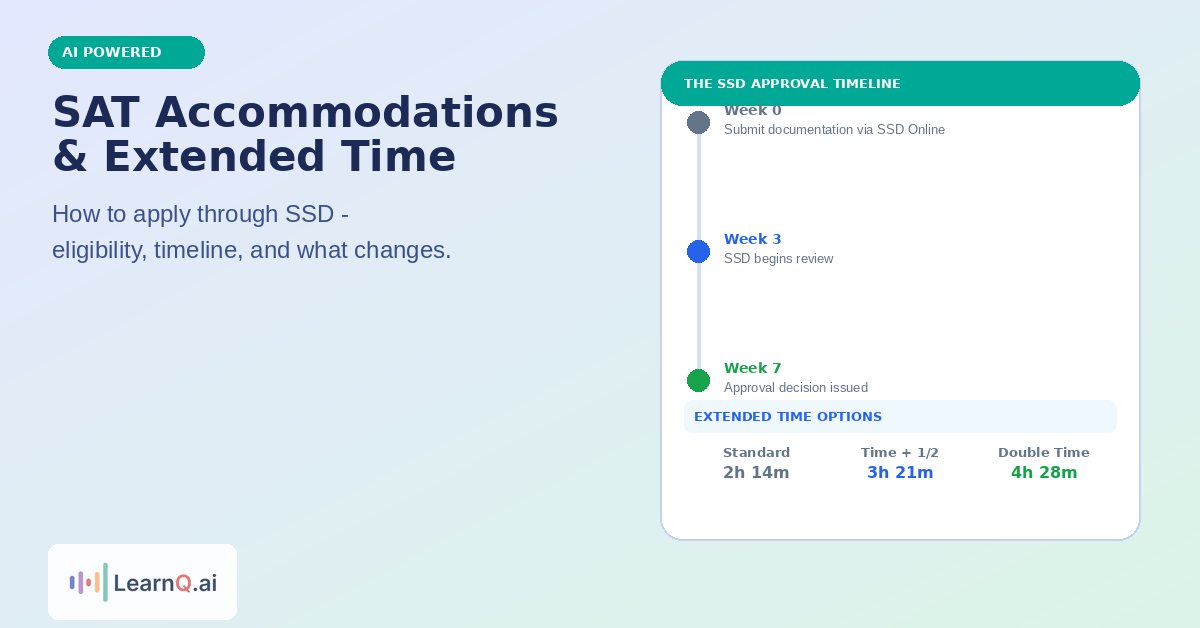
SAT accommodations, including extended time, must be approved through College Board’s Services for Students with Disabilities (SSD) before test day. The review process typically takes up to 7 weeks, so most students should begin the request in spring of the year before they plan to test – not the month before.
Having a 504 plan or an IEP at school does not automatically transfer to the SAT. Accommodations used in class – extended time, breaks, assistive technology, a separate testing room – require a separate, formal approval from College Board before they apply to the SAT, PSAT, or AP Exams. This guide covers who qualifies, exactly how the approval process works, what each accommodation actually changes about test day, and how accommodations function inside the digital Bluebook app.
Who Qualifies for SAT Accommodations
College Board evaluates accommodation requests against three core eligibility criteria, administered through its Services for Students with Disabilities (SSD) office:
- A documented disability that substantially limits a major life activity relevant to the testing environment
- Objective evidence – typically a recent evaluation from a qualified professional – showing the disability results in a functional limitation
- A demonstrated need for the specific accommodation being requested, not simply a general preference for more support
Categories of qualifying disabilities include specific learning disorders (dyslexia, dysgraphia, dyscalculia), ADHD, hearing and vision impairments, physical disabilities affecting motor control, speech and language disorders, chronic illness requiring medication management or rest breaks, documented anxiety or psychiatric conditions with functional impact, and neurological conditions such as epilepsy or traumatic brain injury.
An important distinction: general test anxiety, on its own, does not qualify for accommodations. A diagnosed anxiety disorder with documented functional impairment can qualify – but everyday nervousness about the SAT is not the same thing in College Board’s evaluation framework.
The strongest predictor of approval: if your school already provides extended time or another accommodation through a 504 plan or IEP, SSD is very likely to approve the same accommodation for the SAT. This existing school documentation is the most common and most reliable pathway into the SSD process.
How the SSD Approval Process Works
Step 1: Start with your school’s SSD coordinator
Most students work through their high school’s SSD coordinator, who submits the request through SSD Online. The coordinator uploads your documentation and specifies which accommodations you are requesting.
If you are homeschooled or your school has no SSD coordinator, you can submit a paper-based Student Eligibility Form directly to College Board. This path is typically slower than working through a school, so contact SSD directly as early as possible. Homeschooled students use school code 970000 on the form.
Step 2: Submit documentation
Required documentation varies by accommodation and disability type, but generally includes a recent formal evaluation, the specific diagnosis, and evidence connecting the diagnosis to the functional need for the requested accommodation. If your school already has this documentation on file for a 504 plan or IEP, your SSD coordinator can often use the same records.
Step 3: Wait for SSD review
Documentation review typically takes up to 7 weeks. If SSD requests additional documentation or a request is resubmitted, approval can take another 7 weeks on top of the original review. This is the single most important number in this entire process – it is why timing your request matters more than almost any other factor.
Step 4: Receive your SSD eligibility number
Once approved, College Board issues an SSD eligibility number linked to your College Board account. This number is automatically applied whenever you register for the SAT, PSAT/NMSQT, PSAT 10, or PSAT 8/9 – you do not need to reapply for each individual test. The same approval also covers AP Exams and CLEP.
When to Start: The Timeline That Actually Matters
College Board’s own guidance is direct: a good overall strategy is to make a request during freshman year of high school. For students aiming for a junior-year SAT or PSAT/NMSQT (the National Merit-qualifying test), the recommended approach is to begin the process in spring of the prior school year – well before summer break, when school staff availability drops and documentation gathering slows down.
Why the buffer matters so much: if additional documentation is requested mid-review, the clock restarts on another 7-week window. A request submitted 8 weeks before test day looks safe on paper, but a single request for more documentation can push approval past your test date. Requests submitted with only 2-3 weeks of runway carry real risk of the accommodation not being active in time, even if ultimately approved.
If you are unsure when to start relative to your overall SAT timeline, see the complete guide on when to start SAT prep – accommodations planning should happen on the same early timeline as your first diagnostic test, not as an afterthought once a test date is already booked.
If you miss the window for an upcoming test: an approved-but-late accommodation typically still applies automatically to your next College Board test date, so the investment is not wasted even if it does not arrive in time for the specific test you originally had in mind.
What Each Type of Accommodation Actually Changes
Extended time
The two most common extended time accommodations are time and one-half (+50%) and double time (+100%), with additional levels available for more significant needs.
| Standard Testing | Time and One-Half | Double Time |
|---|---|---|
| 2 hours 14 minutes | 3 hours 21 minutes | 4 hours 28 minutes |
Extended time approved for reading applies to the entire test, since every section of the Digital SAT involves reading. Extended time approved specifically for math only applies only to the Math section, with standard timing elsewhere.
A 2025 policy update worth knowing: students approved for extended time now have the option to move on to the next part of the test once standard time has passed, if they finish early – they are not required to sit for the entire extended time if they are ready to move on sooner. This flexibility applies across the full SAT Suite (SAT, PSAT/NMSQT, PSAT 10, PSAT 8/9) and AP Exams administered through Bluebook.
College Board’s own guidance on requesting extended time: the accommodation should only be requested if a documented disability causes a student to work more slowly than peers – not simply because more time would generically be helpful. For students whose difficulty is more about focus or distraction than raw processing speed, alternatives like a small-group testing setting may be more appropriate than extended time itself.
Breaks
Two distinct break accommodations exist. Extended breaks provide one 20-minute break at the same point in the test as standard testers. Breaks as needed allow a student to pause at any point during the exam for as long as needed within reason – this is the only break accommodation that displays a pause button during testing.
Assistive technology
Text-to-Speech (Embedded) is built directly into Bluebook and requires no special software setup – approved students bring wired, non-Bluetooth headphones (incapable of recording) on test day. It can be approved for the entire test or for math sections specifically.
Screen Reader (Non-Embedded) is a separate accommodation for students requiring more advanced screen-reading software. As of Fall 2025, Screen Reader no longer automatically comes bundled with 50% extended time – the two must be requested and justified separately if both are needed.
Starting Fall 2026, students approved for Embedded Text-to-Speech can take SAT Weekend at any test center rather than needing to arrange school-based testing – a meaningful logistical improvement for students who previously had to test at their own school specifically to access this accommodation.
Other accommodations
A scribe or human reader can be approved for students unable to read or write independently under standard conditions. Small group or one-on-one testing reduces distractions for students whose needs are more attention-related than processing-speed-related. A paper test can be requested through your SSD coordinator for students who cannot use a computer due to their disability. Braille and the newer combined Braille Paper Test accommodation are available for students with visual impairments.
How Accommodations Work Inside Bluebook
Since the SAT moved fully to the digital Bluebook app, several accommodations are now built directly into the testing software rather than requiring separate physical materials. See the complete Bluebook app guide for general setup and device requirements before test day.
Text size can be adjusted within Bluebook for any student, which offers informal support for low-vision needs even outside the formal SSD process. For students approved for extended time, a “Next” button on the Check Your Work screen remains unclickable until standard time has elapsed – only then can an extended-time student choose to continue working or move ahead early. Because the digital format eliminates paper answer sheets, students with motor-control disabilities avoid a category of logistical friction that existed under the old paper SAT entirely.
Most accommodations are available at standard SAT test centers. A smaller set – known as school-based accommodations – can only be administered at the student’s own school, typically during a 14-day testing window surrounding the standard SAT Weekend date. If you are approved for a school-based accommodation, confirm with your SSD coordinator which specific dates within that window you plan to test.
SAT Accommodations vs. ACT Accommodations
If you are deciding between the two tests, the accommodations process differs in a few practical ways. College Board’s SSD process requires no test registration first – you can request accommodations independent of when you register. The ACT’s Test Accessibility and Accommodations (TAA) system generally requires registering for a specific test date first, then submitting the accommodations request afterward.
Review timelines also differ meaningfully: College Board’s SSD review can take up to 7 weeks, while the ACT’s review is typically faster, in the 5-14 business day range – though ACT has also introduced shorter Special Testing windows and earlier deadlines as of 2026. If your accommodation needs are time-sensitive relative to an approaching test date, this difference is worth factoring into which test you sit for first. See the SAT to ACT score conversion guide if you are weighing both tests generally.
Getting Ready Once Accommodations Are Approved
Once your SSD eligibility number is active, register for the SAT normally – your approved accommodations apply automatically. Bring your eligibility letter to every College Board test you take, even if you have used the same accommodation before, and review the what to bring to the SAT checklist alongside any accommodation-specific items like approved headphones for Text-to-Speech.
For prep itself, accommodations do not change what content is tested, only how the test is administered – so the same diagnostic-driven approach applies. Take LearnQ’s free 40-minute diagnostic to identify your specific weak question types regardless of your testing accommodations. Mia, LearnQ’s AI tutor, adapts to your pace during practice, which is especially useful for students building comfort with extended-time pacing before test day. Take a free full-length practice test on LearnQ’s Digital SAT platform to rehearse your approved timing structure under realistic conditions.
Frequently Asked Questions
How long does it take to get SAT accommodations approved?
College Board’s Services for Students with Disabilities (SSD) typically takes up to 7 weeks to review a documentation request. If additional documentation is requested or a request needs to be resubmitted, approval can take another 7 weeks on top of the original timeline. College Board recommends starting the process as early as freshman year of high school, and at minimum in the spring before the school year you plan to test.
Does a 504 plan automatically give you SAT accommodations?
No. A 504 plan or IEP at school does not automatically transfer to the SAT, PSAT, or AP Exams. You must submit a separate, formal request through College Board’s SSD process. However, if your school already provides an accommodation like extended time through a 504 plan or IEP, SSD is very likely to approve the same accommodation for College Board testing, since existing school documentation is the strongest and most common basis for approval.
Does test anxiety qualify for SAT accommodations?
General test anxiety on its own typically does not qualify for accommodations. A diagnosed anxiety disorder with documented functional impairment on major life activities can qualify, but everyday nervousness about testing is evaluated differently by College Board than a formally diagnosed and documented psychiatric condition.
How much extra time do you get with SAT accommodations?
The two most common extended time levels are time and one-half (+50%), which extends the standard 2 hour 14 minute SAT to 3 hours 21 minutes, and double time (+100%), which extends it to 4 hours 28 minutes. Additional levels beyond double time are available for more significant documented needs. Extended time approved for reading applies to the entire test; extended time approved for math only applies solely to the Math section.
Can homeschooled students get SAT accommodations?
Yes. Homeschooled students follow the same SSD approval process but typically submit a paper-based Student Eligibility Form directly to College Board rather than working through a school SSD coordinator, using school code 970000. Because this path can be slower than working through a school, homeschooled families should begin the process with extra lead time.
Do SAT accommodations carry over to the PSAT and AP Exams?
Yes. A single SSD approval covers the SAT (Weekend and School Day administrations), PSAT/NMSQT, PSAT 10, PSAT 8/9, AP Exams, and CLEP. You do not need to reapply separately for each individual test once your accommodation is approved and linked to your College Board account.
What happens if my accommodation request isn’t approved in time for my test?
If a decision is not reached before your intended test date, you can still use any approved accommodations for future College Board tests, including later SAT dates, PSAT-related assessments, and AP Exams. The approval is not wasted – it simply applies starting with whichever test comes after the decision is finalized.
Sources: College Board Services for Students with Disabilities (SSD); College Board Spring 2026 Assessment Accommodations and Supports Handbook (accommodations.collegeboard.org); Compass Prep SAT vs. ACT accommodations request guide (compassprep.com, 2026); FullPracticeTests SAT Accommodations 2026 guide (fullpracticetests.com)

The LearnQ Editorial Team is made up of certified Digital SAT tutors, college admissions specialists, and AI education researchers. Our tutors have personally helped over 10,000 US high school students improve their SAT scores, with an average improvement of 150+ points. We combine hands-on tutoring expertise with AI-powered insights from the LearnQ platform, which has analyzed millions of Digital SAT practice questions. Every article we publish is reviewed against the latest College Board Bluebook guidelines and cross-checked with real student performance data. Our mission is simple: give every student the same quality of prep that was once only available at expensive tutoring centers.