

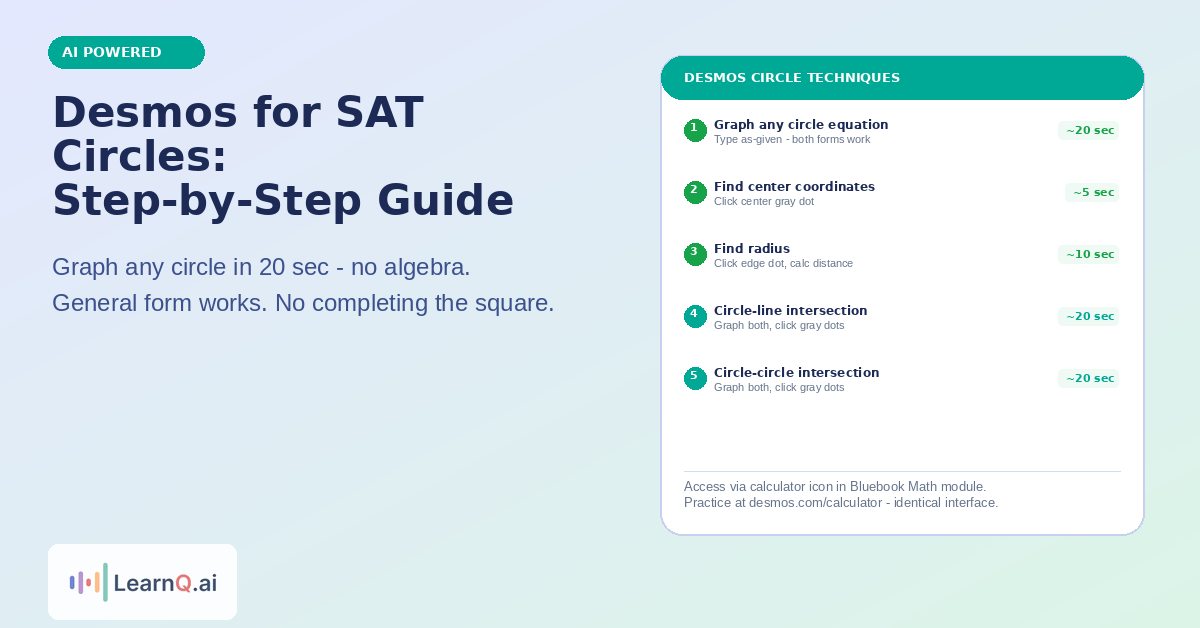
Enter any circle equation directly into Desmos – even in general form like x^2 + y^2 – 6x + 4y – 3 = 0 – and it graphs immediately. Click the center dot to read exact coordinates. Measure the radius by clicking any edge point and calculating the distance. No completing the square required. Total time: under 30 seconds.
Circle questions appear 1-2 times per Digital SAT Math section. They are not high-frequency, but they are disproportionately time-consuming when solved algebraically because completing the square twice under time pressure is error-prone. Desmos eliminates the algebra entirely for most circle question types. This guide covers every circle technique worth knowing, with exact keystrokes for each.
Access Desmos on the SAT
The Desmos graphing calculator is built into every Math question in the Bluebook app – tap the calculator icon in the top-right of the question screen to open it. The interface is identical to desmos.com/calculator, which you should use to practice all techniques in this guide before test day.
Note: Desmos is available on every Math question, including Module 1. Use it freely on any circle, quadratic, or system question throughout the test. See the complete Desmos SAT guide for all 12 high-leverage techniques beyond circles.
Technique 1: Graph Any Circle Equation Instantly
What it solves: Finding the center and radius from an equation in any form.
The problem Desmos eliminates: The SAT frequently gives circle equations in general form (x^2 + y^2 + Dx + Ey + F = 0) rather than standard form ((x-h)^2 + (y-k)^2 = r^2). Solving by hand requires completing the square twice – a multi-step process that takes 2-3 minutes and has several points where sign errors occur.
Desmos method:
Step 1: Open Desmos and click in the first expression line.
Step 2: Type the equation exactly as given. For example:
- Standard form: `(x-3)^2 + (y+2)^2 = 16`
- General form: `x^2 + y^2 – 6x + 4y – 3 = 0`
Desmos accepts both forms directly – no rearranging needed.
Step 3: The circle graphs immediately. Click the center of the circle (Desmos highlights it with a gray dot) to read exact coordinates. The center of this example is (3, -2).
Step 4: Click any point on the edge of the circle to read its coordinates, then calculate the distance from the center. Or: read the radius directly from the standard form. In this example, r^2 = 16, so r = 4.
Time: Under 30 seconds versus 2-3 minutes by hand.
Practice equation: The equation x^2 + y^2 – 6x + 4y – 3 = 0 represents a circle. What is the radius?
Desmos method: Type `x^2 + y^2 – 6x + 4y – 3 = 0` and hit Enter. The circle graphs with center (3, -2). Click the rightmost point of the circle – Desmos shows (7, -2). Distance from (3, -2) to (7, -2) = 4. Radius = 4.
Algebraic method (for comparison): Complete the square for x: (x^2 – 6x + 9) = (x-3)^2. Complete the square for y: (y^2 + 4y + 4) = (y+2)^2. Rewrite: (x-3)^2 + (y+2)^2 = 3 + 9 + 4 = 16. r^2 = 16, r = 4. Four steps, multiple chances for a sign error.
Technique 2: Find Circle-Line Intersections
What it solves: Questions asking for the coordinates where a line crosses a circle, or whether a line is tangent, secant, or non-intersecting.
Desmos method:
Step 1: Type the circle equation on line 1. Example: `(x-2)^2 + (y-1)^2 = 25`
Step 2: Type the line equation on line 2. Example: `y = x + 3`
Step 3: Desmos graphs both and marks intersection points as gray dots. Click each dot to read exact coordinates.
Tangent line check: If the line touches the circle at exactly one point, Desmos shows one gray dot – the line is tangent. If it shows two dots, the line is secant. If it shows no dots, the line does not intersect the circle.
Practice question: The circle (x-2)^2 + (y-1)^2 = 25 intersects the line y = x + 3. What are the coordinates of both intersection points?
Desmos method: Type both equations. Click the two gray intersection dots. Coordinates: (-2, 1) and (4, 7). Total time: 20 seconds.
Technique 3: Identify Center and Radius for Multiple-Choice
What it solves: Multiple-choice questions asking which values for center coordinates or radius are correct.
Desmos method:
Step 1: Graph the circle equation as above.
Step 2: Read the center by clicking the highlighted center point.
Step 3: Read the radius by noting the horizontal or vertical distance from center to edge (the topmost point has the same x-coordinate as the center; its y-coordinate minus the center y-coordinate equals the radius).
Key shortcut: If the equation is in standard form (x-h)^2 + (y-k)^2 = r^2, you can read center (h, k) and radius r directly without graphing. Only use Desmos for general form equations where the center is not immediately readable.
Example: Which of the following represents the center and radius of the circle x^2 + y^2 + 8x – 6y + 9 = 0?
Desmos method: Type `x^2 + y^2 + 8x – 6y + 9 = 0`. Graph appears. Center dot is at (-4, 3). Rightmost point is at (0, 3), so radius = 0 – (-4) = 4.
Answer: center (-4, 3), radius 4.
Technique 4: Circle-Circle Intersections
What it solves: Finding where two circles intersect each other.
Desmos method:
Step 1: Type first circle equation on line 1.
Step 2: Type second circle equation on line 2.
Step 3: Click any gray intersection dots for exact coordinates.
This technique appears rarely on the SAT but is instant in Desmos versus several minutes by hand.
Technique 5: Arc Length and Sector Area (Without Desmos)
Important note: Desmos does not directly calculate arc length or sector area. These questions require the formulas from the SAT reference sheet. However, Desmos can help by identifying the radius from an equation first, then you apply the formula manually.
Arc length formula: (central angle / 360) x 2*pi*r
Sector area formula: (central angle / 360) x pi*r^2
Combined Desmos approach for arc/sector questions:
If the question gives you a circle equation and asks for arc length or sector area:
Step 1: Graph the equation in Desmos to find the radius (as in Technique 1).
Step 2: Apply the arc length or sector area formula manually using the radius Desmos just gave you.
Example: A circle has equation x^2 + y^2 – 10x + 6y + 18 = 0. A central angle of 60 degrees creates a sector. What is the sector area?
Step 1 (Desmos): Type `x^2 + y^2 – 10x + 6y + 18 = 0`. Center is at (5, -3). Rightmost point is at (9, -3). Radius = 9 – 5 = 4. So r = 4.
Step 2 (formula): Sector area = (60/360) x pi x 4^2 = (1/6) x 16*pi = 8*pi/3.
Total time: 45 seconds. Without Desmos, finding r = 4 from the general form equation takes 90+ seconds.
All circle formulas, arc formulas, and sector formulas are in the SAT math formulas guide – check which ones are on the reference sheet versus which need to be memorized.
What Circle Question Types Appear on the SAT
Circle questions appear in the Geometry and Trigonometry domain, which accounts for approximately 15% of Math questions (about 7 questions per full test). Not all of those are circles – circles appear roughly 1-2 times per test.
The specific circle question types you will see:
Center and radius from equation (most common): Given an equation, identify center coordinates and/or radius. Pure Desmos technique – graph and click.
Circle-line intersection: Given a circle and a line, find intersection coordinates or determine relationship (tangent/secant). Graph both in Desmos and click dots.
Arc length or sector area: Given radius and central angle (or arc), calculate arc length or area. Formula-based – use Desmos only to find radius if it is not given directly.
Point on a circle: Does a given point (a, b) lie on a specific circle? Substitute into the equation and check, or graph the circle in Desmos and inspect whether the point falls on the curve.
Tangent line properties: The tangent line to a circle at a point is perpendicular to the radius at that point. Use Desmos to visualize, then verify perpendicularity by checking slopes.
Understanding all 14 Digital SAT Geometry question types – not just circles – is covered in the question types guide.
Desmos Circle Keystrokes Quick Reference
| What you want | What to type in Desmos |
|---|---|
| Circle in standard form | `(x-h)^2 + (y-k)^2 = r^2` (substitute values) |
| Circle in general form | Type exactly as given: `x^2 + y^2 + Dx + Ey + F = 0` |
| Circle + line intersection | Line 1: circle equation. Line 2: line equation. Click gray dots |
| Two circles intersecting | Line 1: circle 1. Line 2: circle 2. Click gray dots |
| Squared exponents | Use `^2` notation – Desmos renders as proper superscript |
| Read a coordinate | Click any gray dot on the graph |
Critical tip: Do not rearrange or simplify the circle equation before typing it. Desmos accepts general form directly. Rearranging wastes time and introduces sign errors.
When to Skip Desmos on Circle Questions
Desmos is not always the fastest tool. Skip it when:
- The equation is already in standard form and you just need to read h, k, and r from the equation directly
- The question only involves the formula (arc length, sector area) with the radius already given – just apply the formula
- The question asks about properties (tangent perpendicularity, diameter = 2r) that are definitional – no calculation needed
Desmos is fastest when you need to find the center and radius from a messy general-form equation, or when you need exact intersection coordinates.
The Digital SAT Module 1 strategy guide covers when to use Desmos versus mental math across all 22 Module 1 questions – time allocation across question types is as important as knowing the techniques.
Practise Before Test Day
The Bluebook Desmos interface is identical to desmos.com/calculator. All five techniques in this guide work exactly the same in both. Practise each technique on at least 3-5 real SAT circle questions before your test date – the goal is to execute them in under 30 seconds each under time pressure.
According to College Board’s SAT test overview, Geometry and Trigonometry accounts for approximately 15% of Math questions, with circles being a recurring question type across difficulty levels.
For circle questions in context – inside a real adaptive Math module under timed conditions – take LearnQ.ai’s free full-length practice test. The question-type breakdown shows exactly how many Geometry questions appeared in your attempt and how you performed on them. If circles or other Geometry types are a weak area, LearnQ.ai’s Mia AI tutor can generate additional circle questions and walk through the Desmos approach step-by-step until it is automatic. Start with the free diagnostic to see where Geometry sits relative to your other weak areas – 1-2 circle questions per test are not usually the highest-leverage gap for most students.
FAQ
Can Desmos solve circle equations on the SAT?
Yes. Type any circle equation directly into Desmos – including general form equations like x^2 + y^2 – 6x + 4y – 3 = 0 – and Desmos graphs it immediately, showing the center and allowing you to click any point to read exact coordinates. This bypasses completing the square and takes under 30 seconds.
How do I find the center of a circle using Desmos on the SAT?
Type the circle equation into Desmos (any form). Once graphed, Desmos highlights the center with a gray dot – click it to read the exact (x, y) coordinates. For an equation in standard form (x-h)^2 + (y-k)^2 = r^2, the center is simply (h, k) and you can read it without graphing.
How do I find where a circle and line intersect using Desmos?
Type the circle equation on line 1 and the line equation on line 2 in Desmos. Both graph simultaneously, and intersection points appear as gray dots. Click each dot to read exact coordinates. If there are two dots, the line is secant. If one dot, tangent. If no dots, the line does not intersect the circle.
Does Desmos calculate arc length or sector area?
No – Desmos graphs equations but does not compute arc length or sector area directly. Use Desmos to find the radius from a circle equation, then apply the formula manually: arc length = (central angle/360) x 2*pi*r; sector area = (central angle/360) x pi*r^2.
Is the Desmos calculator on the SAT the same as desmos.com?
Yes. The Bluebook Desmos calculator is identical to the interface at desmos.com/calculator. All techniques you practice on the website work exactly the same on the actual test. Practice circle techniques at desmos.com before test day so the interface is automatic.
How many circle questions are on the Digital SAT?
Circle questions appear approximately 1-2 times per full test in the Geometry and Trigonometry domain. The domain as a whole accounts for about 7 of the 44 Math questions (~15%). Circle questions are not the most frequent Geometry type – angles, triangles, and area/volume questions appear more often – but they are disproportionately slow to solve without Desmos.
Sources: Desmos graphing calculator; College Board Digital SAT test overview; Pursu SAT circles Desmos guide (pursu.io, September 2025); Pursu Desmos SAT techniques (pursu.io, May 2026); The Test Advantage Desmos SAT guide (thetestadvantage.com, June 2026)

The LearnQ Editorial Team is made up of certified Digital SAT tutors, college admissions specialists, and AI education researchers. Our tutors have personally helped over 10,000 US high school students improve their SAT scores, with an average improvement of 150+ points. We combine hands-on tutoring expertise with AI-powered insights from the LearnQ platform, which has analyzed millions of Digital SAT practice questions. Every article we publish is reviewed against the latest College Board Bluebook guidelines and cross-checked with real student performance data. Our mission is simple: give every student the same quality of prep that was once only available at expensive tutoring centers.