
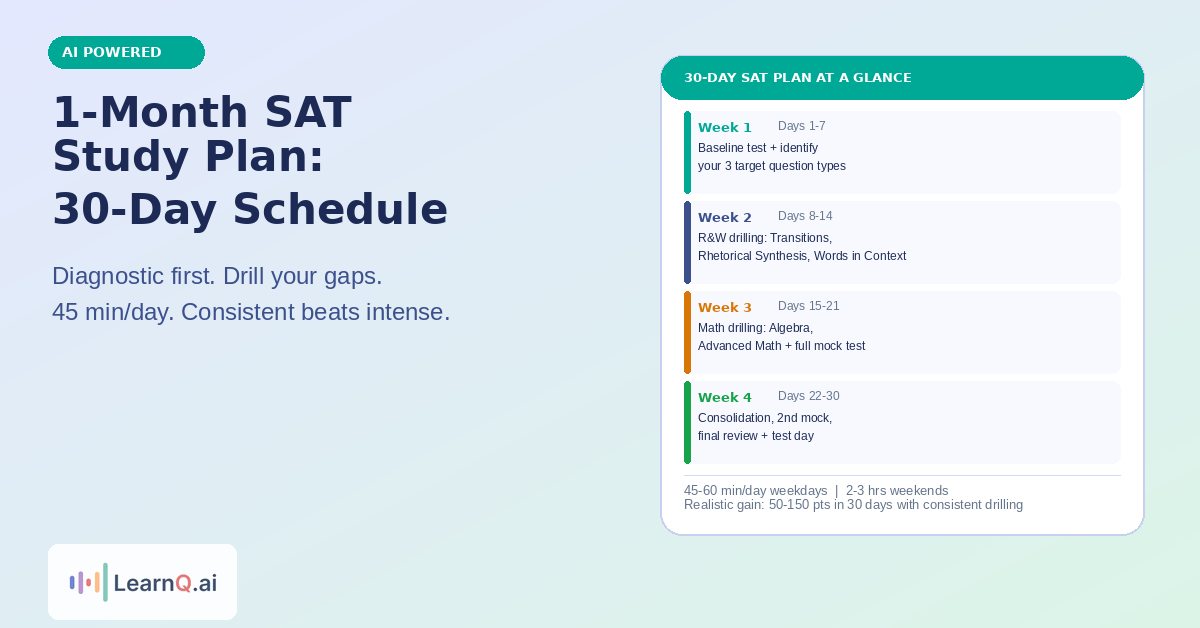
Most students can improve their SAT score by 50-150 points in 30 days with targeted, consistent prep – roughly 45-60 minutes per day. The key is spending the first week diagnosing exactly which question types are costing you points, then drilling those specific types for weeks two and three, before using the final week for full-length practice and consolidation.
A 30-day window is tight but genuinely workable. What does not work: trying to review every topic equally, spending most of your time on full-length tests without targeted drilling between them, or studying for 3 hours one day and skipping the next two. Consistent daily sessions of under an hour outperform sporadic long sessions for score improvement on standardized tests.
This plan assumes you have 30 days until your test date and can commit 45-75 minutes per day on weekdays and 2-3 hours on weekends. If you have less time per day, follow the structure but reduce the question volume by 40%. The sequence matters more than the exact number of questions.
The Platform Behind LearnQ.ai Is Now Open to You - Start Free
VEGA AI helps institutes create personalized, automated, and scalable test-prep experiences - no coding, no setup hassle.
Before Day 1: Set Your Starting Point
Before following any day-by-day schedule, you need a baseline score. Without it, you will not know which question types to prioritize and you may spend most of your 30 days drilling areas where you are already strong.
Baseline step: Take a full-length practice test in College Board’s Bluebook app under real timed conditions. Use Tests 11 or 7 – they are the most accurate predictors of current real SAT difficulty. See the Bluebook practice test accuracy guide for which tests to use and why.
Alternatively, take LearnQ.ai’s free 45-minute diagnostic to get your score breakdown by question type without a full 2-hour commitment. The diagnostic tells you exactly which question types are costing you the most points – which is the information you actually need to build a 30-day plan.
Score your baseline and identify:
- Your current total score and approximate score target
- Your weakest 2-3 question types in Reading and Writing
- Your weakest 1-2 domains in Math
Everything from Day 1 forward is built around those weak areas.
Score-Based Targets: What Is Realistic in 30 Days?
Your realistic improvement range depends on your starting score:
| Starting Score | Realistic 30-Day Target | What Makes the Difference |
|---|---|---|
| Below 1000 | +80-120 pts | Algebra basics + Boundaries/grammar |
| 1000-1100 | +80-150 pts | Transitions + linear equations + Conventions |
| 1100-1200 | +70-130 pts | Rhetorical Synthesis + Advanced Math |
| 1200-1300 | +60-100 pts | Hard question types + Module 1 routing |
| 1300-1400 | +40-80 pts | Hard Module 2 types + time management |
| 1400+ | +30-60 pts | Specific Hard Module 2 gaps only |
Students closer to their theoretical ceiling gain less per unit of prep. A student at 1100 with untrained Algebra and Transitions can improve faster in 30 days than a 1400 student who needs to close Hard Module 2 gaps. Be realistic about your range.
Week 1 (Days 1-7): Diagnostic and Foundation
Goal: Understand your exact weaknesses, not your general weaknesses. Build a targeted drill list.
Daily commitment: 45-60 minutes on weekdays, 2 hours on Day 1 (baseline).
Day 1: Baseline test and analysis
Take your full Bluebook practice test or LearnQ diagnostic. After completing it, do not just look at your total score. Go through every wrong answer and tag it by question type using the framework in the Digital SAT question types guide. Build a list: which 3 question types had the most errors?
Days 2-3: Reading and Writing foundation
Focus on your weakest R&W question types from Day 1. If Transitions and Rhetorical Synthesis were your biggest losses, spend these two days drilling those exclusively. Do 20-25 questions of each type, review every wrong answer, and write a one-sentence explanation of why the correct answer is right before moving on.
Do not drill question types you got right. Time is limited.
Days 4-5: Math foundation
Shift to your weakest Math domains. For most students at 1100-1300, this is Algebra (linear systems and inequalities) and Advanced Math (nonlinear functions). Spend these two days drilling 25-30 questions per domain, using Desmos on every applicable question. See the Desmos SAT guide for the exact techniques (intersection points, regression, sliders) that save the most time.
Days 6-7: Mixed review + Module 1 strategy
Day 6: review every question you got wrong during Days 2-5. Identify any patterns – if you kept missing Quantitative Command of Evidence questions or Systems of Equations setups, those get added to your Week 2 drill list.
Day 7: read the Digital SAT Module 1 strategy guide and understand how adaptive testing works. The concept that your Module 1 accuracy determines your Module 2 difficulty – and therefore your score ceiling – changes how you should approach test-taking strategy in every practice session going forward.
Week 1 checkpoint: By end of Day 7, you should have a clear list of your 3-4 target question types. If you do not, retake a half-length test (one R&W module + one Math module) to generate more data.
Get 30% OFF on all LearnQ.ai Digital SAT plans
Spring Offer: Use code SPRING30 at checkout to unlock your discount.
Week 2 (Days 8-14): Targeted Drilling – Reading and Writing
Goal: Increase accuracy on your 2 weakest R&W question types from 50-60% to 70-75%.
Daily commitment: 45-60 minutes weekdays, 2.5 hours Saturday, 1.5 hours Sunday.
Days 8-9: Transitions and Expression of Ideas
Transitions is one of the most commonly missed question types and one of the fastest to improve because it has a clear method: identify the logical relationship between sentences (contrast? result? example?) before reading the answer choices. Drill 30-40 Transitions questions across these two days. Track your accuracy at the end of each session.
Days 10-11: Rhetorical Synthesis
Rhetorical Synthesis is the hardest R&W type and always the last question in each module. The method: read the task in the question first, then match the notes to that specific task. Wrong answers either use irrelevant notes, accurately state a true fact but fail the task, or combine notes incorrectly. Drill 25-35 Rhetorical Synthesis questions. This type rewards practice more than almost any other.
Days 12-13: Words in Context + Command of Evidence
Words in Context (4-5 questions per test): substitute your own word before reading choices. Command of Evidence Quantitative (2-3 questions per test): find the exact cell in the graph that the claim refers to before reading choices. Drill 20-25 of each type. These two types together are relatively fast to improve.
Day 14: Saturday – Half Bluebook test (R&W focus)
Take one full Reading and Writing module under timed conditions (32 minutes, 27 questions). This is not a full mock – just the section you have been drilling. Compare your accuracy on your target question types to your Day 1 baseline. You should see improvement. If you are not seeing improvement in Transitions or Rhetorical Synthesis, spend Sunday reviewing the method, not doing more questions – method is the bottleneck, not volume.
Week 2 checkpoint: You should be 5-10 percentage points more accurate on your drilled R&W types. If not, something about your review process needs to change – are you actually understanding why each wrong answer is wrong, or just noting the correct answer and moving on?
Week 3 (Days 15-21): Targeted Drilling – Math
Goal: Increase Math accuracy on your 2 weakest domains. Integrate Desmos into every applicable question.
Daily commitment: 45-60 minutes weekdays, full Bluebook test Saturday, 2 hours Sunday.
Days 15-16: Algebra (Linear Systems and Inequalities)
For most students, Systems of Linear Equations and Linear Inequalities are the biggest Math gaps. Drill 30-40 questions across these two days. For every system of equations problem, practice both the graphing approach (Desmos intersection) and the algebraic approach – the Desmos method is faster but knowing the algebra keeps you from panicking if you mistype in Desmos.
Days 17-18: Advanced Math (Nonlinear Functions)
Nonlinear functions – exponential growth and decay, interpreting function behavior from graphs, quadratic roots and vertex – are the most commonly missed Advanced Math questions. Drill 25-35 questions. The key distinction: in exponential models, know which value is the initial value and which is the growth/decay rate. These questions frequently use real-world context to obscure which is which.
Days 19-20: Problem Solving and Data Analysis + Geometry
For most students, these domains are already relatively strong. If they are a weakness for you, spend these two days drilling statistics interpretation (mean vs. median, correlation vs. causation) and the core geometry formulas (area, arc length, similar triangles). If these domains are already above 70% accuracy, use these days for additional Algebra or Advanced Math drilling instead.
Day 21: Saturday – Full Bluebook Mock Test
This is the first full mock test since your Day 1 baseline. Take it under full timed conditions in Bluebook – 2 hours 14 minutes, no interruptions. After you finish, compare your section scores and question-type accuracy to Day 1. This comparison tells you:
1. Whether your Week 2-3 drilling produced real accuracy gains on target types
2. Whether your overall score has moved
3. What new types need attention in the final week
Most students see 30-70 point improvements at this stage. If you see less than 30 points of improvement despite consistent drilling, review whether you are actually drilling differently (understanding the method) or just completing more questions.
Sunday: review every wrong answer from the mock test in detail. Add any newly identified weak types to your final-week drill list.
Week 3 checkpoint: Your Day 21 Bluebook score should reflect meaningful improvement from your Day 1 baseline. If your target is 1200 and you are at 1160, you need to be more precise in Week 4 about which specific types to target. If you are at 1190, you are on track.
Get 30% OFF on all LearnQ.ai Digital SAT plans
Spring Offer: Use code SPRING30 at checkout to unlock your discount.
Week 4 (Days 22-30): Consolidation and Test Simulation
Goal: Solidify gains, eliminate any remaining weak spots, and build test-day confidence.
Daily commitment: 40-50 minutes weekdays, full Bluebook test Day 27, lighter prep Days 28-29, logistics Day 30.
Days 22-23: Consolidation drilling
Return to your 2-3 highest-value target question types from Weeks 2 and 3. Do 20 questions of each type – this is not new drilling but reinforcement. You are building automaticity, not learning new methods.
Days 24-25: Mixed practice (simulating real module conditions)
Instead of drilling by question type, do timed mixed practice: one full module of 27 R&W questions in 32 minutes, one full module of 22 Math questions in 35 minutes. This simulates the real module experience and reveals whether your question-type improvements hold up under time pressure. If accuracy drops significantly under time pressure on specific types, those types need speed work – drilling 10 questions in 5 minutes rather than careful, untimed practice.
Days 26-27: Second full Bluebook mock test
Day 26: review your notes, light review of the Desmos techniques most relevant to your target score range. No heavy studying.
Day 27: take your second full Bluebook mock test under real conditions. For students targeting 1300+, use Test 11 (the most accurate predictor of Hard Module 2 difficulty). Compare your score to Day 21 to see the Week 4 gain. Compare to Day 1 to see the full 30-day gain. This is your most reliable prediction of your actual test day score.
LearnQ.ai’s full-length adaptive practice test provides question-type breakdown analytics alongside your score – useful for a detailed final diagnostic if you want to see your accuracy by type rather than just your total. Between sessions, Play and Practice keeps your daily drilling engaging without burning you out in the final days.
Days 28-29: Final targeted review
Based on your Day 27 mock test, identify the 1-2 question types where you lost the most points. Do 15-20 questions of each – focused, careful review, not volume drilling. This is your last opportunity to close specific gaps. Do not try to learn new content or address question types where your accuracy is already above 70%.
Day 29: stop studying after 30 minutes. Your score on test day reflects the work done across the full 30 days – last-minute cramming does not add to it.
Day 30: Test day
Pack your bag the night before (Day 29): printed admission ticket, valid photo ID, fully charged device with Bluebook installed and exam setup complete, charger, light jacket, snack for the break. Arrive 30 minutes before your reporting time. Sleep at least 7-8 hours the night before – sleep has a measurable effect on cognitive performance and reaction time. On test day, apply the Module 1 strategy: prioritize accuracy on the first 15 questions of each module, where routing decisions are made.
If your performance on this test does not reflect your preparation, review the SAT retake guide – most students who have done 30 days of targeted prep and are considering a retake benefit significantly from another 4-6 week cycle focused on whatever Hard Module 2 types did not perform as expected.
Using LearnQ.ai to Run This Plan
This study plan tells you what to drill. LearnQ.ai automates the targeting:
- The free diagnostic test replaces the Day 1 manual question-type tagging with an automatic breakdown in 45 minutes
- The session-level adaptive algorithm serves harder questions as your accuracy improves – so your drilling automatically adjusts difficulty as you get better, without you needing to track it manually
- Mia, the AI tutor, explains wrong answers conversationally and generates similar questions on demand for any type you want more reps on
- The daily streak and XP system in Play and Practice builds the consistency habit this plan depends on
You can run this entire 30-day plan through LearnQ.ai without needing to manually track which question types to drill next. Start free – no payment required for the diagnostic and limited daily practice.
Get a 1500+ SAT Score With Expert Coaches + AI.
Live 1-on-1 and small group coaching from mentors who've scored 1580+, combined with LearnQ.ai's adaptive AI practice platform. The only SAT prep that works both ways.
FAQ
Can you realistically improve your SAT score in one month?
Yes – most students improve 50-150 points in 30 days with consistent targeted prep. The range depends on your starting score: students at 1000-1200 typically see larger gains than students at 1350+ who are already close to their ceiling. The key variable is whether you drill your specific weak question types rather than studying generally. Generic review rarely produces meaningful gains in a short timeline.
How many hours a day should I study for the SAT in one month?
45-60 minutes on weekdays and 2-3 hours on weekends is the optimal range for a 30-day plan. More than 90 minutes of active drilling per day shows diminishing returns for most students – fatigue reduces the quality of review and the effectiveness of practice sessions. Consistent shorter sessions outperform sporadic long ones.
Should I take practice tests every week during a 1-month SAT plan?
No more than two full-length Bluebook practice tests in 30 days – one around Day 1 as a baseline and one around Day 21 to measure progress. A third test on Day 27 is optional. Taking more tests without targeted drilling between them produces diminishing score improvement. The test reveals weaknesses; drilling closes them. The ratio of drilling to testing matters more than total test volume.
What is the most important thing to focus on in a 1-month SAT plan?
Identify your 2-3 weakest question types in the first week and spend the majority of Days 8-21 drilling those specific types. Students who drill their actual weaknesses consistently outperform students who study more hours but spread their attention across all content areas equally. The question types guide covers all 8 R&W types and 4 Math domains so you can identify which to target.
What should I do the week before the SAT?
Take a full Bluebook practice test on the Saturday of your final week (around Day 27). After reviewing it, do light targeted review of your 1-2 remaining weak spots on Days 28-29. Stop studying after 30 minutes on Day 29. Day 30 (test day) focus is entirely on logistics – printed ticket, charged device, good sleep, breakfast, and arriving 30 minutes early.
What is the best free resource for a 1-month SAT plan?
Khan Academy’s Official SAT Prep is free and works well for the drilling phases of this plan – it has a large question bank organized by skill. Combine it with College Board’s Bluebook for full-length tests and LearnQ.ai’s free diagnostic to identify your target question types before you start.
How do I know if my 1-month plan is working?
Track accuracy by question type across sessions, not just your overall mock test score. A student going from 50% to 75% on Rhetorical Synthesis in two weeks is making real progress even if their overall mock score has not yet fully reflected it. The 30-day plan works when your Day 21 mock score is meaningfully higher than your Day 1 baseline – typically 40+ points for most students doing consistent targeted drilling.
Sources: College Board Digital SAT overview; IvyStrides 30-day SAT study plan (ivystrides.com, January 2026); Test Ninjas 1-month SAT plan (test-ninjas.com); Cuemath 2026 Digital SAT study guide (cuemath.com, March 2026); TestInnovators 1-month SAT prep guide (testinnovators.com, May 2026)