
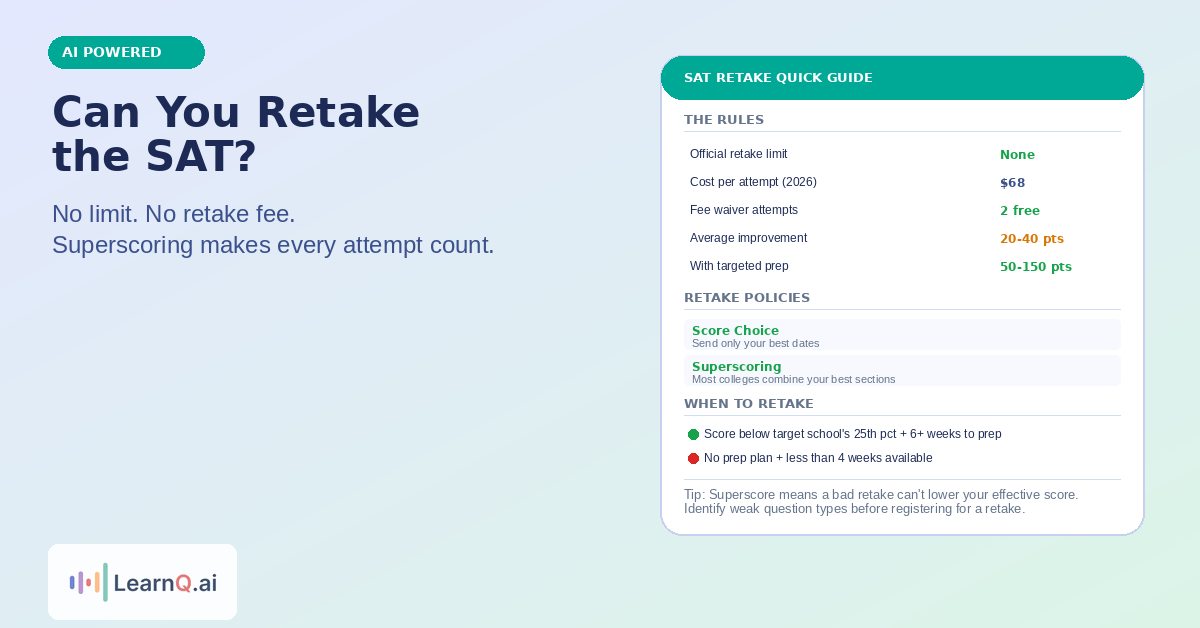
Yes – you can retake the SAT with no official limit. College Board places no cap on the number of times you can take the test. Most students improve by 20-40 points on a second attempt, and superscoring policies at most colleges mean retaking is almost always worth considering if you have time to prepare properly.
The decision to retake is more nuanced than the yes/no question suggests. Retaking without changing your preparation approach rarely produces meaningful improvement. And with Score Choice, superscoring, and “all scores required” policies varying by college, how you retake matters as much as whether you retake.
This guide covers every dimension of the retake question: College Board’s actual rules, average improvement data, how superscore and Score Choice work, when retaking is worth it versus when to stop, and what to do differently to actually move the needle.
The Platform Behind LearnQ.ai Is Now Open to You - Start Free
VEGA AI helps institutes create personalized, automated, and scalable test-prep experiences - no coding, no setup hassle.
The Rules: No Official Limit, But Practical Constraints Exist
College Board has no official limit on SAT retakes. You can register for and take the SAT as many times as the test is offered – currently 7-8 times per year in the US (typically August, October, November, December, March, May, and June). There is no “retake fee” beyond the standard registration cost. As of 2026, standard SAT registration costs $68.
Practical constraints that do matter:
- Test date availability: The SAT is offered roughly 7 times per year. If you are applying Early Decision in November, you have at most 2-3 test dates available in your junior and senior year windows.
- Registration deadlines: Each test date has a registration deadline about 4 weeks before the test and a late registration window (with a $30 surcharge) closing about 3 weeks out. Missing deadlines means waiting for the next available date.
- Score reporting timing: Scores are released 2-3 weeks after test day. If you need scores sent to colleges by a specific deadline, plan backward from that date.
- Fee waivers: Students eligible for College Board fee waivers receive two free test registrations. Additional retakes cost the standard $68 each.
The practical limit for most college applicants is 3-4 attempts across junior and senior year, constrained by the application timeline rather than any College Board rule.
How Much Do Scores Improve on a Retake?
The honest data: most students who retake the SAT improve, but the improvement is usually modest without significant additional preparation.
Students who retake without changing their study approach typically see gains of 20-30 points – well within the natural score variation range and unlikely to move them into a meaningfully different admissions category.
Students who add 6+ hours of targeted prep per week for 6-8 weeks before their retake, focused specifically on their weakest question types, typically see gains of 50-100 points. Students who take their first attempt with minimal preparation and prepare seriously for the retake can see gains of 100-200+ points.
The key insight: the retake itself does not produce improvement. The preparation between attempts produces improvement – the retake just measures it. Taking the test a second time immediately after a first attempt, without changing anything about your preparation, is unlikely to produce a meaningful score change.
For a structured improvement approach before retaking, see the guide on improving your SAT score by 200 points.
Get 30% OFF on all LearnQ.ai Digital SAT plans
Spring Offer: Use code SPRING30 at checkout to unlock your discount.
Score Choice: Can You Hide a Bad Score?
Score Choice is College Board’s policy that allows you to choose which test dates’ scores to send to colleges. You are not required to send all scores from all test dates.
How Score Choice works in practice:
By default, when you request a score report for a college, you select which test date(s) to send. You can send one date, multiple dates, or all dates. Colleges only see the scores from the dates you select.
The important exceptions:
Some colleges do not participate in Score Choice and require you to submit all scores from all test dates. As of 2026, this includes a small number of selective schools. Always check each school’s score policy on their admissions website – Score Choice policies are updated periodically and can differ from what you read elsewhere.
For most colleges, you will never have to reveal a score you do not want to share. This makes retaking lower-stakes: a bad day on the second attempt stays private if you choose not to send it.
Superscoring: The Policy That Makes Retaking More Valuable
Superscoring is a college admissions policy where an institution calculates your best possible composite score by combining your highest Math score and your highest Reading and Writing score across all test dates you submit, regardless of whether those highs came from the same sitting.
Example:
- Attempt 1: Math 680 + R&W 700 = 1380
- Attempt 2: Math 750 + R&W 660 = 1410
With superscoring, the college uses Math 750 (from Attempt 2) + R&W 700 (from Attempt 1) = 1450 superscore, even though neither single attempt reached 1450.
Most selective colleges superscore as of 2026, including many in the Ivy League and top-50 universities. Some colleges require all scores to be submitted but still superscore from whatever you send. A small number of colleges use only your highest single-sitting score. Check each school’s Common Data Set or admissions FAQ for their exact policy.
The strategic implication: if a college superscores, there is almost no downside to retaking – your effective score can only stay the same or go up, even if one section regresses slightly. The SAT score percentile guide is useful context for understanding how much a superscore improvement actually moves your admissions position.
When to Retake: A Clear Decision Framework
Retake if all of the following are true:
1. There is a meaningful gap between your score and your target school’s 25th percentile. If you scored 1380 and your target school’s 25th percentile is 1450, retaking is clearly worthwhile. If you scored 1450 and the 25th percentile is 1460, the effort is unlikely to change your admissions outcome. Compare your score to each school’s middle 50% range, not a general “good score” benchmark. See what a 1400 means for specific college tiers.
2. You have identified specific question types costing you points. Retaking without knowing where your losses came from produces the same score. Review your score report, identify the 2-3 question types with your worst accuracy, and focus all prep on those.
3. You have at least 6 weeks before the retake date. Six weeks of consistent, targeted prep (45-60 minutes daily) is the minimum viable improvement cycle. Less than 6 weeks and you are unlikely to see meaningful score movement from preparation – though natural test-day variance could still produce a small gain.
4. The school superscores or you are confident you can improve both sections. If a school uses only your highest single sitting, a retake that improves one section while regressing the other could actually lower your effective score. Check the policy first.
Do not retake if:
- Your score is already above the 75th percentile of your target schools and you have no schools where it is a weakness
- You have fewer than 4 weeks to prepare before the next test date
- You have taken the test 3+ times without meaningful score movement – at some point, prep approach (not retakes) is the variable to change
- Your application deadline is imminent and you cannot submit updated scores in time to matter
- You want to “see if you can do better” without any specific preparation plan
The ACT Alternative: When to Switch Tests Instead of Retaking
If you have retaken the SAT twice without meaningful improvement, consider whether the ACT might be a better fit before scheduling a third attempt. The two tests reward different cognitive styles:
- The SAT rewards careful reading, logical inference, and multi-step reasoning
- The ACT rewards faster pacing, direct retrieval, and science reasoning
Some students who plateau on the SAT see significant gains on the ACT without any additional subject matter prep – the format shift itself can be the improvement lever. Use the SAT to ACT conversion table to estimate what an ACT score equivalent to your current SAT target would look like, then take a practice ACT to see if the format feels more natural.
How to Prepare Differently for a Retake
The single most important thing you can do before a retake is different from what most students actually do: review every wrong answer from your previous Bluebook practice tests and categorize each by question type.
Most students review their score reports, feel bad about the low sections, and then do general prep in those areas. This is not targeted enough to produce meaningful gains. The more useful approach:
Step 1: Get your question-type breakdown
Your Bluebook score report shows your performance by domain. For each wrong answer, identify the specific question type (Transitions, Rhetorical Synthesis, Algebra, Nonlinear Functions, etc.). Track this across 2-3 practice tests to identify patterns.
Step 2: Identify your 2-3 highest-leverage types
The question types you miss most consistently are your retake focus. These are the types where 4-6 weeks of targeted drilling will produce real accuracy gains. For many students at the 1300-1400 range, Rhetorical Synthesis and Systems of Equations are the two types most worth targeting. Understanding the Module 1 strategy is essential here – improving Module 1 accuracy on these types directly affects your Module 2 routing.
Step 3: Drill those types exclusively for 3-4 weeks
Do not do general review. Do not take full mocks during this phase. Drill 30-50 questions of your target types per session, 5 days per week.
Step 4: Return to full mocks 2 weeks before the retake
Take two full Bluebook practice tests – ideally Tests 11 and 7, the most accurate predictors of current real SAT difficulty. Review the Bluebook practice test accuracy guide to understand which practice tests best simulate Hard Module 2 difficulty at your score range.
LearnQ.ai’s free diagnostic test identifies your specific weak question types in 45 minutes and builds a targeted drill plan around them – exactly what you need to focus a retake prep cycle. The full-length practice test provides question-type analytics alongside your total score so you can measure improvement by type, not just by composite.
Get 30% OFF on all LearnQ.ai Digital SAT plans
Spring Offer: Use code SPRING30 at checkout to unlock your discount.
What If My Score Goes Down on a Retake?
A lower score on a retake is more common than most students expect. Score variation of plus or minus 30-40 points is normal from one sitting to the next even without any change in actual ability – this is called measurement error and it affects every standardized test.
If your score drops on a retake, Score Choice means you can simply not send that score to colleges. For schools that superscore, a drop in one section does not hurt you as long as the other section stayed the same or improved.
The score drop most students worry about – a significant regression on both sections – is rare and typically signals a specific issue (illness, anxiety, poor testing conditions) rather than a real change in ability. If this happens, take a few more weeks, address the specific factor that affected your performance, and schedule another attempt if the timeline allows.
For context on score variation and what constitutes a meaningful change vs. normal fluctuation: a score swing of 30 points or fewer is within normal measurement error. A swing of 50+ points in either direction reflects a genuine change in performance.
Get a 1500+ SAT Score With Expert Coaches + AI.
Live 1-on-1 and small group coaching from mentors who've scored 1580+, combined with LearnQ.ai's adaptive AI practice platform. The only SAT prep that works both ways.
FAQ
Can you retake the SAT?
Yes. College Board places no official limit on SAT retakes. You can register for and take the SAT as many times as it is offered. Test dates are available approximately 7 times per year in the US. Each retake costs the standard registration fee of $68 (or uses a fee waiver if eligible) with no additional retake surcharge.
How many times can you take the SAT?
There is no official maximum. College Board allows unlimited attempts. In practice, most students take the SAT 2-3 times due to the application timeline – there are only so many test dates available between junior year fall and senior year application deadlines. Taking it more than 4 times is rare and generally not recommended without a specific improvement strategy for each attempt.
Does retaking the SAT hurt you?
Only at schools that require all scores to be submitted AND use your highest single sitting score (not a superscore). At most colleges, Score Choice lets you send only your best scores, and superscoring means your effective score can only stay the same or improve. Retaking does not flag you negatively in most admissions systems.
What is SAT superscoring?
Superscoring is an admissions policy where a college combines your highest Math score and highest Reading and Writing score across multiple test dates to create a composite. If you score 700M + 680R&W on one attempt and 660M + 730R&W on another, a school that superscores uses 700 + 730 = 1430. Most selective colleges superscore as of 2026, making retaking strategically advantageous.
What is Score Choice?
Score Choice is College Board’s policy allowing you to select which test dates’ scores to send to colleges. You are not required to send all scores. If you have a bad retake, you can simply not send that date’s score to any college. Some colleges (a minority) require all scores regardless of Score Choice – always verify each school’s policy.
How much does it cost to retake the SAT?
The standard SAT registration fee is $68 per attempt as of 2026. There is no discounted “retake fee” – each attempt costs the same as the first registration. Students eligible for College Board fee waivers receive two free registrations; additional attempts at the standard cost. There is also a $30 late registration surcharge for registering within approximately 3 weeks of test day.
When should I stop retaking the SAT?
Consider stopping when: your score is already at or above the 75th percentile of all your target schools, you have retaken 3+ times without meaningful improvement despite targeted prep, or you are running out of time before application deadlines. If the SAT is plateauing after multiple attempts, consider whether the ACT might be a better format fit before scheduling another SAT retake.
How long should I wait between SAT retakes?
At minimum, allow enough time to complete a full preparation cycle: 6-8 weeks of targeted drilling on your weak question types, plus 1-2 weeks of full Bluebook practice tests before the next test date. Retaking after only 2-3 weeks without additional prep rarely produces meaningful score changes and wastes the registration fee.
Sources: College Board SAT retake and Score Choice policies; College Board SAT score data and percentiles; FullPracticeTests SAT retake guide with improvement statistics (fullpracticetests.com); IvyStrides SAT retake strategy 2026 (ivystrides.com)