

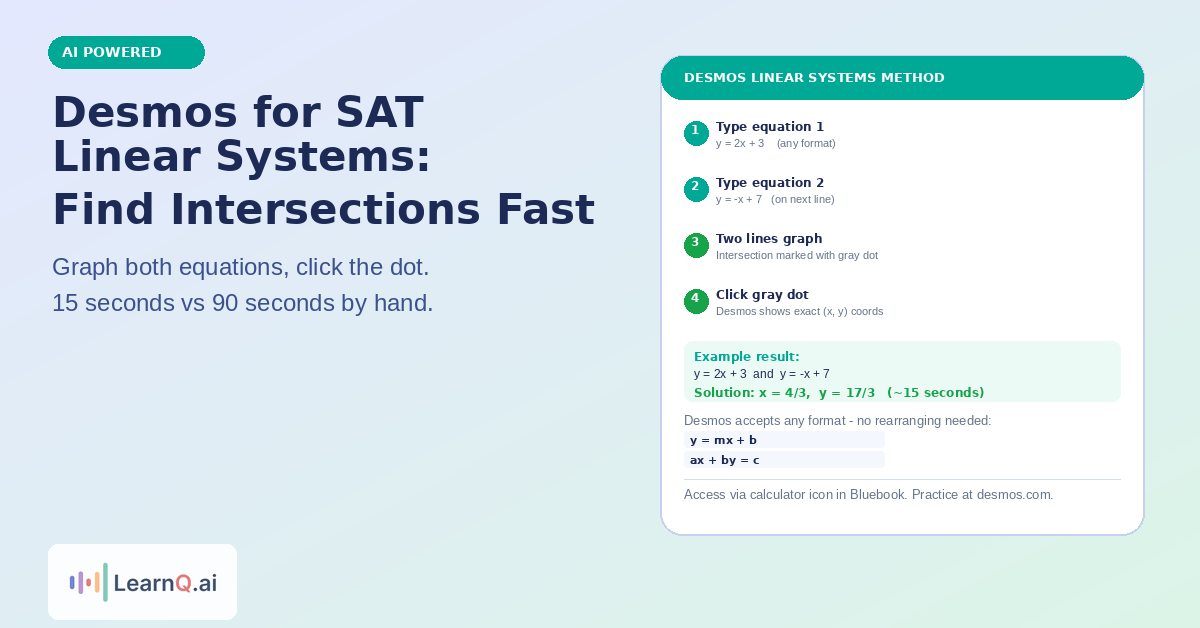
Graph both equations in Desmos, click the gray intersection dot, and read the exact (x, y) coordinates. Systems of linear equations that take 90 seconds to solve by hand take under 15 seconds in Desmos. This single technique alone can save you 3-4 minutes per Math module.
Systems of linear equations appear on every Digital SAT Math module – typically 3-4 questions per test across both modules. They are among the highest-volume Algebra question types, which makes them one of the highest-leverage Desmos techniques to master. Students who use Desmos fluently on system questions consistently outperform students solving by hand, not because the algebra is beyond them, but because Desmos eliminates the 2-3 minute window where arithmetic errors accumulate under pressure.
How Desmos Handles Linear Systems: The Core Technique
What Desmos does: Graphs both equations simultaneously and marks all intersection points with clickable gray dots that display exact coordinates.
What you do: Type each equation on a separate line. Click the dot. Done.
The technique works for every linear equation format the SAT uses. You do not need to convert to slope-intercept form first.
Step-by-Step: Basic Linear System
Problem: Solve the system: y = 2x + 3 and y = -x + 7. Find the x-coordinate of the solution.
Algebraic method (for comparison): Set equal: 2x + 3 = -x + 7. Combine: 3x = 4. x = 4/3. Substitute: y = 2(4/3) + 3 = 17/3. Time: 60-90 seconds, with sign errors possible.
Desmos method:
Step 1: Open Desmos (calculator icon in Bluebook, or desmos.com/calculator for practice).
Step 2: Type `y = 2x + 3` on line 1. Hit Enter.
Step 3: Type `y = -x + 7` on line 2. Hit Enter.
Step 4: Two lines appear. Click the gray dot at the intersection.
Step 5: Desmos displays: (1.333, 5.667) or equivalently (4/3, 17/3).
Read the x-coordinate: 4/3 (or 1.333 as a decimal). Answer in under 15 seconds.
Key insight: Desmos gives you exact fractions for intersection coordinates when possible. If the display shows a decimal, look for a fraction equivalent – most SAT answers involving systems use clean fractions or integers.
Desmos Accepts Every Equation Format
This is the most overlooked feature. You do not need to rearrange equations before typing them.
| SAT equation format | Type into Desmos exactly as written |
|---|---|
| Slope-intercept form | `y = 2x + 3` |
| Standard form | `2x + 3y = 12` |
| Point-slope form | `y – 4 = 3(x – 1)` |
| Variable on both sides | `3x – y = 5` |
| Non-standard arrangement | `y + 2x = 7` |
All five formats graph correctly without any rearranging. This matters because SAT problems often give systems in standard form or mixed format precisely to slow students down who are solving algebraically. Desmos does not care which form the equation is in.
Worked Examples by Question Type
Example 1: Find the solution coordinates directly
Problem: What is the solution (x, y) to the system: 3x + 2y = 18 and x – y = 1?
Desmos method:
- Line 1: `3x + 2y = 18`
- Line 2: `x – y = 1`
- Click intersection dot: (4, 3)
Answer: x = 4, y = 3. Time: 12 seconds.
What the algebraic method requires: Solve one equation for one variable (x = y + 1), substitute into the other (3(y+1) + 2y = 18 → 3y + 3 + 2y = 18 → 5y = 15 → y = 3), substitute back. Three steps, 60-90 seconds.
Example 2: The question asks for one variable only
Problem: In the system 5x – y = 10 and 2x + 3y = 26, what is the value of y?
Desmos method:
- Line 1: `5x – y = 10`
- Line 2: `2x + 3y = 26`
- Click intersection dot: (4, 6)
Answer: y = 6 (the question only asked for y – ignore x). Time: 12 seconds.
Example 3: Finding a value other than x or y
Problem: In the system y = 3x + 1 and y = -x + 9, what is the value of x + y?
Desmos method:
- Line 1: `y = 3x + 1`
- Line 2: `y = -x + 9`
- Click intersection dot: (2, 7)
Answer: x + y = 2 + 7 = 9. One additional mental addition step, still under 20 seconds total.
Example 4: Number of solutions question
Problem: How many solutions does the system 2x + 4y = 8 and x + 2y = 3 have?
Desmos method:
- Line 1: `2x + 4y = 8`
- Line 2: `x + 2y = 3`
The two lines graph as parallel lines with no intersection. Desmos shows no gray dot.
Answer: No solution (0 solutions). Time: 10 seconds.
Note: If the two lines overlap completely (infinitely many solutions), Desmos draws one line on top of the other. If you see a single line where two should be, they are the same line – infinitely many solutions.
Example 5: System with a word problem setup
Problem: A store sells apples for $1.50 each and oranges for $2.00 each. Cary buys 10 pieces of fruit total and spends $17.00. How many apples did Cary buy?
Setup (the only step requiring thought):
- Let a = apples, r = oranges
- a + r = 10
- 1.5a + 2r = 17
Desmos method:
- Line 1: `x + y = 10` (using x for apples, y for oranges)
- Line 2: `1.5x + 2y = 17`
- Click intersection: (6, 4)
Answer: Cary bought 6 apples. Time: 20 seconds (including setup).
The only skill Desmos does not replace here is setting up the two equations from the word problem. That remains a reading comprehension task. Everything after setup is instant.
When Desmos Is Faster vs. When Algebra Is Faster
Desmos wins on every system with two or more steps of algebra:
| Situation | Use Desmos | Use algebra |
|---|---|---|
| Both equations in any form, need exact answer | Yes – always | No |
| Clean small integers (e.g., y = 2x, y = x + 1) | Yes – still faster | Only if you can see the answer in your head instantly |
| Need to find x + y, x – y, 2x + y, etc. | Yes – find (x,y) then add | No |
| Number of solutions question | Yes – count gray dots | Only for “parallel lines” check |
| Equation with unknown constant (parametric) | Use slider technique | Sometimes faster for simple cases |
When to skip Desmos: If both equations are in slope-intercept form and the intersection is clearly visible at integer coordinates (y = x + 2, y = -x + 4 intersect at (1, 3)), mental math is instant. Desmos is not faster than “I can see the answer.”
The Slider Technique for Parametric System Questions
A common SAT question type asks: “For what value of k does the system have exactly one solution?” or “no solution?” These involve an unknown constant in one equation.
Example: For what value of k does y = kx + 3 and y = 2x – 1 have exactly one solution?
Any two distinct non-parallel lines have exactly one intersection – so this question is really asking when the lines are parallel (no solution) or identical (infinitely many solutions). But if the question is phrased as “how many solutions,” Desmos + slider answers it visually:
Step 1: Type `y = k*x + 3` on line 1. Desmos prompts “add slider” – click it.
Step 2: Type `y = 2x – 1` on line 2.
Step 3: Drag the slider for k. When k = 2, the lines become parallel (no intersection dot). For any other k value, one intersection dot appears.
Answer depends on what the question asks. If “exactly one solution”: any k not equal to 2. If “no solution”: k = 2.
This slider technique is covered in depth in the complete Desmos SAT guide alongside 11 other high-leverage Desmos techniques beyond systems of equations.
Important Limitations to Know
Desmos gives decimal approximations for irrational answers. If the intersection is at (√2, √3), Desmos shows (1.414, 1.732). For free-response questions, you need the exact form – recognize that 1.414 ≈ √2 and 1.732 ≈ √3.
Zoom may be needed. The default Desmos view shows roughly -10 to 10 on each axis. If the intersection is at (50, 100), it will not be visible by default. Use the scroll wheel or pinch to zoom out until the intersection dot appears. This is a common pitfall – if you cannot see an intersection, zoom out before assuming no solution.
Variables must be x and y. If the SAT problem uses other variables (a and b, p and q), rewrite using x and y before entering. Desmos treats unknown letters as parameters and creates sliders rather than graphing a line.
Systems with more than two equations. Simply add a third line in Desmos. For three-equation systems, the solution is the point where all three lines intersect – Desmos marks it if all three pass through a common point.
Linear Systems in the Adaptive SAT Context
Systems of linear equations appear in the Algebra domain, which makes up approximately 35% of all Math questions – the largest single domain. The Digital SAT question types guide shows that Systems of Linear Equations is consistently one of the highest-volume Algebra subtypes, appearing 3-4 times across both Math modules.
Because Algebra dominates Module 1, strong Desmos technique on system questions directly affects your routing. How adaptive testing works means that getting 3 system questions right in Module 1 instead of losing 1-2 to arithmetic errors under time pressure can shift you from Easy Module 2 to Hard Module 2 – raising your score ceiling by 50-100 points without touching any other content area.
This is why Desmos fluency on systems is a higher-leverage prep investment than studying additional content. The technique takes 15 minutes to learn and saves time on 3-4 questions per test indefinitely.
Practice at desmos.com Before Test Day
The Bluebook Desmos calculator is identical to desmos.com/calculator. Practice every technique in this guide on the website so the keystrokes are automatic on test day.
Practice sequence for Desmos linear systems fluency:
1. Graph 5 standard-form system pairs at desmos.com – confirm intersection coordinates match the algebraic solution
2. Graph 5 slope-intercept pairs – confirm same
3. Practice 3 word problems: set up equations, graph, read coordinates
4. Practice 2 parametric questions using the slider
5. Test yourself on 10 mixed-format system questions from Bluebook
For SAT Math formulas you need to have memorized alongside Desmos techniques, see the SAT math formulas guide. Not everything can be graphed – equivalent expressions, factoring patterns, and quadratic formula are still algebraic skills worth maintaining.
According to College Board’s test overview, the Algebra domain includes linear equations, linear functions, and systems – all of which Desmos handles with the same core graphing technique.
Take LearnQ.ai’s free practice test to see systems questions in the context of a real adaptive module. If linear systems or other Algebra types are a consistent weak area, LearnQ.ai’s Mia AI tutor can generate targeted systems questions and demonstrate the Desmos approach on each one. Start with the free diagnostic to see exactly how many Algebra points you are currently losing on LearnQ’s Digital SAT platform.
Keystroke Reference Card
| Task | Type in Desmos | Note |
|---|---|---|
| Enter first equation | Type as-given, hit Enter | Any format accepted |
| Enter second equation | New line, type as-given, hit Enter | Any format accepted |
| Find intersection | Click gray dot | Displays exact (x, y) |
| No dot visible | Scroll to zoom out | Intersection may be off-screen |
| Parametric system | Type equation with unknown letter, click “add slider” | Drag to find critical value |
| Three-equation system | Add third line | Dot appears if all three share a point |
FAQ
How do you solve systems of equations on Desmos for the SAT?
Type each equation on a separate line in Desmos – any format works, no rearranging needed. Both equations graph as lines. Click the gray dot at the intersection to read the exact (x, y) coordinates. For a linear system with one solution, this takes under 15 seconds.
Does Desmos accept standard form equations for systems?
Yes. Desmos accepts any equation format directly: slope-intercept (y = mx + b), standard form (ax + by = c), and point-slope. You do not need to rearrange to slope-intercept form before typing. Enter the equation exactly as the SAT gives it.
What does it mean if no intersection dot appears in Desmos?
If no gray dot appears after graphing both equations, either the intersection is outside the current view (zoom out) or the lines are parallel (no solution). Zoom out first. If the lines are clearly parallel even after zooming, the system has no solution. If the two lines completely overlap, there are infinitely many solutions.
How do I use Desmos for parametric system questions on the SAT?
When a system contains an unknown constant (like k or a), type the equation with that unknown into Desmos. It will prompt you to add a slider – click “add slider.” Drag the slider to find the value that makes the lines parallel (no solution) or tangent (one solution). Read the slider value when the graph shows your target condition.
Is the Desmos calculator available on all Digital SAT Math questions?
Yes. The Desmos graphing calculator is available on all 44 Math questions across both modules in Bluebook. Access it by tapping the calculator icon in the upper portion of the question screen. It is available from question 1 in Module 1.
How many linear system questions appear on the Digital SAT?
Systems of linear equations typically appear 3-4 times across both Math modules combined. They fall in the Algebra domain, which accounts for approximately 35% of Math questions (~15 of 44). Mastering the Desmos intersection technique for systems covers a recurring, high-frequency question type efficiently.
When should I solve a linear system algebraically instead of using Desmos?
Only when the answer is immediately obvious by inspection – for example, y = x and y = -x + 4 intersect at (2, 2) by mental math in 3 seconds. In every other case, Desmos is faster and more reliable under time pressure. The substitution and elimination methods are valuable for understanding but should not be your primary method on the actual test when Desmos is available.
Sources: College Board Digital SAT test structure; Pursu Desmos SAT cheat sheet 2026 (pursu.io, May 2026); The Test Advantage systems of equations Desmos guide (thetestadvantage.com, March 2026); MentoMind Desmos SAT tips Part 3 (mentomind.ai, February 2026); Acely Desmos SAT cheat sheet (acely.com)

The LearnQ Editorial Team is made up of certified Digital SAT tutors, college admissions specialists, and AI education researchers. Our tutors have personally helped over 10,000 US high school students improve their SAT scores, with an average improvement of 150+ points. We combine hands-on tutoring expertise with AI-powered insights from the LearnQ platform, which has analyzed millions of Digital SAT practice questions. Every article we publish is reviewed against the latest College Board Bluebook guidelines and cross-checked with real student performance data. Our mission is simple: give every student the same quality of prep that was once only available at expensive tutoring centers.