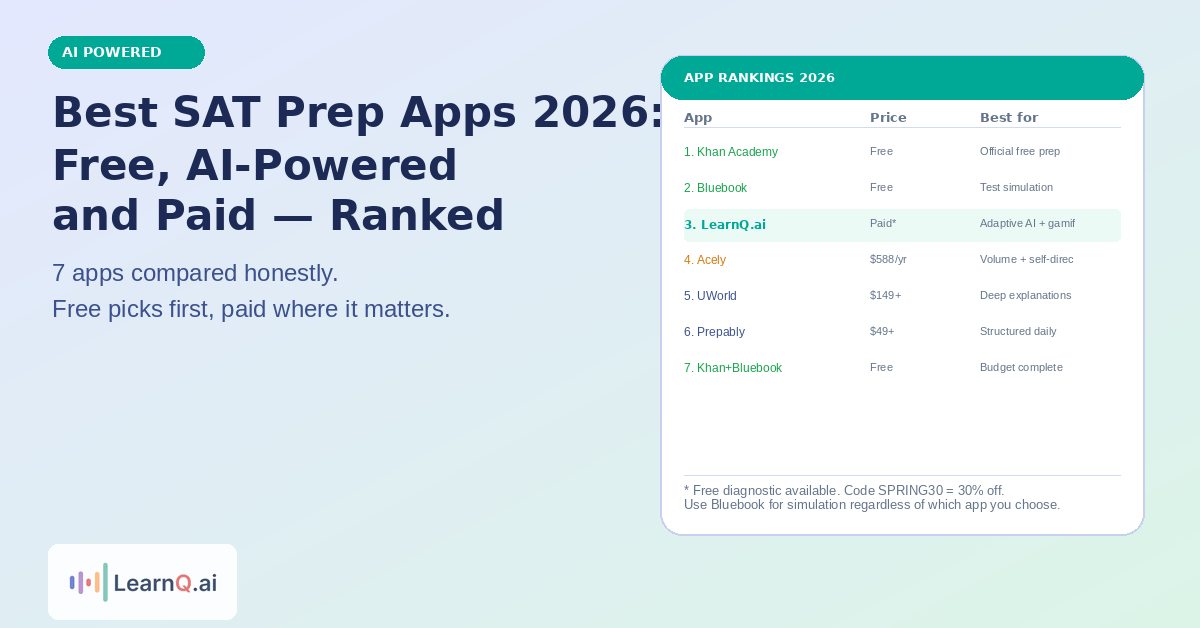
The best SAT prep app in 2026 depends on your score goal and budget: Khan Academy is the best free option (official College Board partner), Bluebook is the only realistic test simulation, and LearnQ.ai leads the paid field for students who want session-level adaptive AI and gamified daily practice.
Most SAT prep app rankings are written by people who earn commissions from the apps they recommend. This one is not. The goal here is simple: tell you what each app is actually good for, what it lacks, and which type of student it suits – so you can stop switching tools and start improving your score.
One important context note: the Digital SAT is now fully established. Any app still built around the paper SAT format – long passages, multiple questions per text, no built-in Desmos calculator – is preparing you for the wrong test. Every app on this list is Digital SAT-specific.
The Platform Behind LearnQ.ai Is Now Open to You - Start Free
VEGA AI helps institutes create personalized, automated, and scalable test-prep experiences - no coding, no setup hassle.
The 7 Best SAT Prep Apps in 2026
1. Khan Academy – Best Free Option (Official Partner)
Best for: Students on a budget, students starting from scratch, anyone who wants to use official College Board-partnered content.
Price: Free.
Khan Academy’s Official SAT Prep is the College Board’s official free prep partner. The practice questions are developed in collaboration with the actual test makers. If you connect your College Board account, Khan Academy imports your PSAT or practice test scores and personalizes what to drill. That is a genuinely useful feature no paid app can match.
The limitation is depth. Khan Academy teaches the concepts behind each question type, but the question bank is smaller than most paid platforms and the interface does not simulate the Bluebook adaptive format. It is the right starting point for any student – but most students prepping for 1400+ will outgrow it within a few weeks.
What it does well: Free, official content, personalized practice when connected to College Board account, strong conceptual explanations.
What it lacks: Limited question volume for heavy drilling, no Bluebook-format simulation, no AI tutor for explanations.
2. Bluebook (College Board) – Best Practice Test Simulation
Best for: Every student – non-negotiable for realistic test simulation regardless of what else you use.
Price: Free.
College Board’s Bluebook app is the actual software used on test day. It offers 8 free full-length adaptive practice tests (Tests 4 through 11) and is the only environment that accurately replicates the Desmos calculator, timer logic, adaptive routing, and interface you will face at the test center. No third-party app can substitute for this.
Bluebook is not a study tool – it has no lessons, no explanations, and no flashcards. But taking at least two Bluebook tests before test day (one as a baseline, one as a final check) is as close to non-negotiable as SAT prep gets. Understanding how adaptive testing works matters most in the context of Bluebook – it is the only place where the real Module 1 to Module 2 routing actually happens.
What it does well: Exact test-day interface, real adaptive algorithm, 8 free full-length tests, the Desmos integration is identical to test day.
What it lacks: No study or lesson features, no explanations for wrong answers, not designed for daily drilling.
3. LearnQ.ai – Best for AI-Adaptive Prep and Daily Consistency
Best for: Students targeting 1200-1550 who want the algorithm to direct their prep and need gamification to stay consistent.
Price: Free tier (full diagnostic + limited daily practice); paid plans from competitive price – see learnq.ai/pricing. Use code SPRING30 for 30% off.
LearnQ.ai is the strongest paid option for students who want the platform to drive their prep. The session-level adaptive algorithm adjusts question difficulty in real-time within each practice session – if you get three algebra questions right in a row, the next one gets harder automatically. This mirrors how the real SAT’s adaptive format works across modules, making practice more predictive of actual test performance.
The free diagnostic test is the most useful free feature among paid platforms: it identifies your weak question types in 45 minutes and gives you a projected score before you commit to a subscription. Take it first – it tells you whether you need a paid app at all and which question types to focus on. Start the free diagnostic here.
LearnQ’s Play and Practice feature is underrated. The research behind why gamified prep raises scores comes down to consistency: 30 minutes every day beats three hours on Sunday. The XP streaks and daily challenges make daily sessions feel rewarding rather than like homework.
Mia, the AI tutor (GPT-4 powered), explains wrong answers, generates similar problems on demand, and adapts to your learning style in a back-and-forth conversation. It is more capable than a static explanation chatbot.
What it does well: Session-level adaptive AI, gamified daily habit building, GPT-4 AI tutor, free diagnostic, score improvement guarantee.
What it lacks: Smaller question bank than Acely (5,000+ vs 9,000+), ACT prep limited to calculator tools.
4. Acely – Best for Question Volume and Self-Directed Students
Best for: Self-motivated students who want maximum question volume, or students who also need ACT prep in the same subscription.
Price: $49/month billed annually ($588/year); $149/month billed monthly.
Acely’s main advantage is its question library: 9,000+ SAT-specific questions and 30+ full-length practice tests give self-directed students months of material before repetition becomes an issue. The AI chatbot explains questions step-by-step on demand. Students input their target score and test date and Acely generates a study plan that updates as they practice.
The caveat is that Acely’s “adaptive” system lets students choose their own difficulty level rather than adjusting automatically per session. For students preparing specifically for the Digital SAT’s adaptive format, that is a meaningful distinction. Read more in our LearnQ vs Acely comparison – but the short version is: Acely suits self-directed learners; LearnQ suits students who want the algorithm to make the decisions.
What it does well: Largest question bank in the market, 30+ practice tests, clear study plan, AI explanations, ACT prep included.
What it lacks: No gamification, no session-level adaptive difficulty, higher price point than most alternatives.
5. UWorld SAT – Best for Detailed Answer Explanations
Best for: Students who learn best by deeply understanding why an answer is wrong, especially strong students aiming for 1450+.
Price: $69.99/month or $149.99/3-month subscription.
UWorld is known primarily for medical board exam prep, but its SAT product applies the same philosophy: exceptionally detailed explanations for every answer choice (both right and wrong), visual rationales where helpful, and question quality that is consistently high. If your primary need is understanding the reasoning behind hard questions rather than drilling volume, UWorld’s explanations are among the best available.
The interface is less modern than LearnQ or Acely, and there is no AI tutor component – explanations are written rather than conversational. But for students who read explanations carefully and want to understand the underlying logic of every question type, UWorld’s depth is worth the trade-off.
What it does well: Best-in-class written explanations, high question quality, detailed performance tracking by skill.
What it lacks: No AI tutor, older interface, no gamification, higher price than some alternatives.
6. Prepably – Best for Students Who Want Structured Daily Plans
Best for: Students who struggle to self-organize their prep and want a day-by-day schedule rather than a dashboard.
Price: Plans from $49/month.
Prepably generates a structured daily study plan based on your test date and score target, then assigns specific lessons and question sets each day. For students who open LearnQ or Acely, see a dashboard of options, and freeze up without knowing where to start, Prepably’s prescriptive daily structure removes that friction. It is not as adaptive as LearnQ, but it is more actionable than a generic study plan document.
What it does well: Prescriptive daily structure, clear task lists, good for students who need external structure.
What it lacks: Less adaptive than LearnQ, smaller question bank than Acely, limited AI explanation depth.
7. Khan Academy + Bluebook (Combined) – Best Free Complete Stack
Best for: Budget-constrained students who are disciplined and self-directed.
Price: Free.
Khan Academy for concept learning and question drilling, Bluebook for full-length test simulation. This combination covers the full prep loop at zero cost: identify weak areas with Khan Academy’s personalized skill plan, drill those areas, then simulate the real test in Bluebook. Students who have used this stack consistently and honestly (meaning they actually review wrong answers rather than just taking tests) regularly reach 1300-1400 without paying for anything.
The limitation is discipline. There is no AI tutor to explain hard questions, no gamification to build daily habits, and no adaptive algorithm to surface the right question at the right moment. For students who need those features to stay consistent, a paid app is worth considering.
Get 30% OFF on all LearnQ.ai Digital SAT plans
Spring Offer: Use code SPRING30 at checkout to unlock your discount.
How to Choose the Right App for You
| Your situation | Recommended approach |
|---|---|
| Budget is tight | Khan Academy + Bluebook (free) |
| Starting from zero, unsure of score gaps | LearnQ.ai free diagnostic first, then decide |
| Need daily habit structure and gamification | LearnQ.ai |
| Want maximum question volume and self-direct | Acely |
| Targeting 1450+ and want deep explanations | UWorld or LearnQ + Bluebook |
| Need ACT prep in the same subscription | Acely |
| Need realistic test simulation only | Bluebook (non-negotiable regardless of what else you use) |
What to Do First: The Right Prep Sequence
Regardless of which app you choose, the prep sequence matters more than the app itself.
Step 1: Run a diagnostic (before buying anything)
Take the LearnQ free diagnostic or a Bluebook practice test. Identify your weak question types before committing to any paid tool. This prevents spending money on a platform whose strengths do not match your gaps.
Step 2: Use Bluebook for your first full-length test
Your first full-length practice test should always be in Bluebook. It is the only environment where the adaptive routing mirrors test day. Your Bluebook score is your baseline – everything else is measured against it.
Step 3: Match your app to your learning style and gaps
If your gaps are in Algebra and Systems of Equations, you need an app that drills Math question types adaptively. If your gaps are in Reading inference and Transitions, you need an app with strong Reading and Writing explanations. Understanding which question types you need to drill prevents wasting prep time on areas where you are already strong.
Step 4: Practice the Desmos calculator daily
Every Math question on the Digital SAT comes with the Desmos calculator. Students who learn specific Desmos techniques – intersection points, regression, sliders – gain measurable time advantages on test day. The Desmos SAT guide covers every technique worth learning before your exam.
Step 5: Retest in Bluebook after 4-6 weeks
After 4-6 weeks of targeted drilling, take another Bluebook test under timed conditions. Compare your question-type accuracy to your baseline. The types you drilled should show clear improvement. Repeat until you hit your target score – then stop and maintain until test day.
LearnQ.ai’s platform tracks your question-type accuracy across sessions and adjusts what you see next automatically. The Play and Practice feature makes the daily drilling sustainable. If you are serious about hitting a specific score target, the free diagnostic is where to start – it tells you exactly which three or four question types are costing you the most points.
Get 30% OFF on all LearnQ.ai Digital SAT plans
Spring Offer: Use code SPRING30 at checkout to unlock your discount.
Get a 1500+ SAT Score With Expert Coaches + AI.
Live 1-on-1 and small group coaching from mentors who've scored 1580+, combined with LearnQ.ai's adaptive AI practice platform. The only SAT prep that works both ways.
FAQ
What is the best free SAT prep app in 2026?
Khan Academy is the best free SAT prep app – it is the official College Board partner and uses real SAT content. Pair it with the Bluebook app (also free) for full-length practice tests. This combination covers the full prep loop at no cost. LearnQ.ai also offers a free tier with a full diagnostic test that identifies your weak question types before you commit to any paid plan.
Is Khan Academy enough for SAT prep?
For many students targeting 1200-1350, Khan Academy plus Bluebook practice tests is sufficient if used consistently. For students targeting 1400+, the limited question volume and lack of adaptive AI tutoring become constraints. Most high-scorers use Khan Academy as a supplemental resource for concept review rather than as their primary prep tool.
What SAT prep app does College Board recommend?
College Board’s official free prep partner is Khan Academy. For test simulation, College Board recommends using the Bluebook app, which is the actual software used on test day and offers 8 free full-length adaptive practice tests.
How many practice tests should I take before the SAT?
At minimum, take one Bluebook test as a baseline (before any prep) and one in the final two weeks before your test date. Most prep specialists recommend 3-5 full-length tests over a prep period of 2-3 months. Quality matters more than quantity: reviewing every wrong answer carefully after each test is more valuable than taking more tests without review.
Is the Bluebook app free?
Yes. The Bluebook app is free and offers 8 full-length adaptive practice tests (Tests 4 through 11 as of mid-2026). It is the official testing software from College Board and is the only app that accurately simulates the real test interface, adaptive routing, and built-in Desmos calculator.
Which SAT app is best for students targeting 1500+?
For 1500+, the combination of LearnQ.ai (for adaptive drilling and AI tutoring on hard question types) and Bluebook (for realistic simulation) is the strongest approach. Students at this level have specific question types costing them points – identifying and drilling those types precisely matters more than general volume. The Digital SAT Module 1 strategy is particularly important at this score range, where Hard Module 2 routing determines the score ceiling.
Does LearnQ.ai have a free trial?
LearnQ.ai offers a permanently free tier that includes a full 45-minute diagnostic test (not just a short quiz), a question-type performance breakdown, and limited daily practice questions. This is more generous than most platforms’ free tiers and gives you meaningful data before committing to a paid plan.
Sources: College Board Digital SAT overview (satsuite.collegeboard.org); Khan Academy Official SAT Prep; Tutoremy AI SAT app rankings 2026; AlphaTest SAT prep comparison (alphatestai.com, December 2025)