
Gamified SAT prep raises scores by solving the real problem most students have – not that they do not know how to study, but that they do not study consistently enough for long enough.
Most students who plateau on the SAT are not stuck because the content is too hard. They are stuck because their prep is inconsistent. They grind for two days, burn out, take a week off, and start over. The actual skill-building never compounds.
Gamification fixes the consistency problem. XP systems, daily streaks, level unlocks, and adaptive challenges create the same motivation loop that keeps people playing mobile games for hours – and redirect it toward SAT practice questions. When that motivation engine is wrapped around real Digital SAT content, the score gains follow.
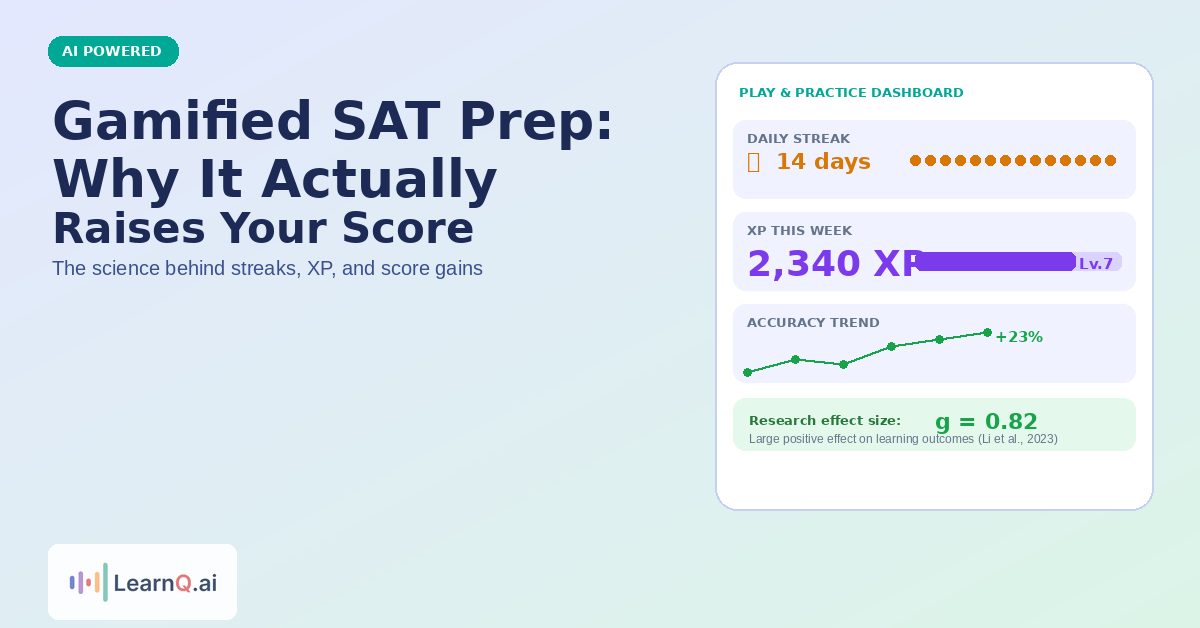
This is not a theory. A 2023 meta-analysis covering hundreds of educational studies found that gamification produces a large positive effect on learning outcomes, with an average effect size of g=0.82 (Li et al., 2023, cited in Engageli’s 2026 gamification research roundup). That is a meaningful, replicated result across K-12 and higher education settings. And College Board’s own data shows it in action: students who completed 20 hours on Khan Academy’s gamified SAT platform gained an average of 115 points on the SAT – nearly double the average gain for students who skipped prep entirely.
The Platform Behind LearnQ.ai Is Now Open to You - Start Free
VEGA AI helps institutes create personalized, automated, and scalable test-prep experiences - no coding, no setup hassle.
What Gamification Actually Is (And Is Not)
Gamification is not the same as playing a game. It means applying game-design mechanics – points, levels, badges, streaks, leaderboards, progress bars – to a non-game activity to increase motivation and engagement.
A student who earns XP for completing a math drill, maintains a 7-day study streak, and unlocks a new challenge tier after hitting 80% accuracy is experiencing gamification. The underlying content is still SAT math. The game layer makes them want to come back tomorrow.
This is completely different from vocabulary matching apps or trivia-style quiz games that happen to touch on SAT topics. Those are games. They may or may not involve meaningful SAT content. The distinction matters enormously for whether your prep time produces score gains.
The question for any gamified SAT prep tool is always: what is the game wrapped around? If it is real Digital SAT questions in the correct format with quality explanations, the gamification multiplies the value of that content. If it is generic educational content or poorly written questions, the game layer is just entertainment.
Why Consistency Is the Actual Driver of SAT Score Growth
Score improvements on the SAT are not primarily a function of how smart a student is. They are a function of how many hours of high-quality, targeted practice a student completes – and whether those hours are spread across enough weeks to allow genuine skill consolidation.
Research on SAT prep consistently shows this pattern. College Board data confirms that 20 hours of focused practice produces average gains of 115 points. Students who approach improving their SAT score by 200 points need roughly 60 to 80 hours spread across 8 to 12 weeks. That is not a sprint – it is a sustained habit.
Sustained habits are exactly what gamification is designed to create. The same psychological mechanisms that make daily streaks powerful in language-learning apps (Duolingo’s retention data is the most cited example) apply directly to SAT prep. A student who does 30 minutes of focused Digital SAT practice every day for 60 days will almost always outperform a student who does 3-hour marathon sessions twice a week and skips the rest.
Gamification makes the daily 30-minute session feel rewarding in the short term, which is what drives long-term habit formation. The XP bar filling up after a session, the badge unlocking after a streak, the leaderboard position climbing – these are small, immediate rewards that reinforce the behavior you want to keep repeating.
The Three Game Mechanics That Actually Move SAT Scores
Not all gamification elements are equal. Three specific mechanics show the strongest evidence for driving real learning outcomes in a test-prep context.
Streak Systems: The Habit Engine
Daily streaks create loss aversion – once you have a 10-day streak, the idea of breaking it creates genuine motivation to study even on days you do not feel like it. This is the same mechanism behind Duolingo’s notorious streak feature.
For SAT prep, streaks matter because skill development on the Digital SAT compounds. A student who practices reading inference questions for 15 minutes every day for three weeks will develop pattern recognition that cannot be replicated in a single 3-hour session. The streak system is the enforcement mechanism for that daily habit.
XP and Level Progression: Making Progress Visible
One of the most demoralizing aspects of traditional SAT prep is that progress is invisible until you take another full mock test. A student can work hard for two weeks and have no tangible sense of whether they are improving.
XP systems solve this. Earning 150 XP for correctly solving a set of quadratic word problems is immediate feedback that something happened in this session. Watching the level bar fill is a concrete representation of cumulative effort. This keeps students engaged through the periods when their mock test scores have not yet caught up to their actual skill improvement.
Adaptive Challenges: Difficulty That Grows With You
The most sophisticated gamification mechanic – and the one most directly connected to SAT score gains – is adaptive difficulty. Good gamified SAT prep does not give you the same questions regardless of performance. It identifies where you are strong, where you are weak, and serves progressively harder challenges in your weak areas as you improve.
This mirrors exactly how adaptive testing works on the Digital SAT itself. The real exam escalates difficulty in Module 2 based on your Module 1 performance. Training on a platform that also adapts difficulty trains you for the cognitive experience of the actual test, not a simplified version of it.
Get 30% OFF on all LearnQ.ai Digital SAT plans
Spring Offer: Use code SPRING30 at checkout to unlock your discount.
What the Research Says About Gamification and Learning Retention
The evidence base for gamification in education has strengthened considerably since 2020. A few findings are particularly relevant for SAT prep students.
| Research Finding | Source | Relevance to SAT Prep |
|---|---|---|
| Gamification produces effect size g=0.82 on learning outcomes | Li et al. meta-analysis, 2023 | Large positive effect across hundreds of studies |
| 88% of teachers using game-based learning report increased engagement | Level Up Learning national survey | Engagement drives practice volume |
| Active learning produces 1.5x better knowledge retention than passive learning | Engageli Active Learning Impact Study, 2024 | Gamified practice is active; reading prep books is passive |
| Students in gamified courses show statistically significant exam performance gains | Lampropoulos and Sidiropoulos, 2024 | Transfers to standardized test performance |
The retention finding is especially important for SAT prep. Reading a prep book is passive learning. Working through adaptive practice questions, checking your reasoning, earning XP for correct answers, and reviewing mistakes in a feedback loop is active learning. Active learning produces roughly 1.5 times better retention of the content – which is exactly what you need to answer SAT questions correctly weeks after you first studied the concept.
The Wrong Kind of Gamified SAT Prep to Avoid
Understanding what works also means understanding what does not. There are a lot of gamified study apps on the market, and most of them will not raise your SAT score – not because gamification does not work, but because the content underneath is wrong.
The most common failure mode is vocabulary games. Many apps gamify SAT vocabulary with flashcards, matching challenges, and definition quizzes. These feel productive and can be genuinely engaging. But the Digital SAT’s Words in Context questions do not test whether you know what a word means in isolation. They test whether you can read a sentence, identify the logic the blank is completing, and pick the most precise word for that specific context. Memorizing definitions is a different skill from what the test actually asks.
The same problem applies to math games that drill arithmetic or basic algebra without replicating the format, complexity, and reasoning demands of actual Digital SAT math questions. See our guide to the best SAT prep games for a breakdown of which apps use real SAT content and which do not.
The test for any gamified prep tool is simple: could a question from this app appear on the actual Digital SAT, in this format, at this difficulty level, with this kind of reasoning required? If the answer is no, the gamification is entertainment – not prep.
How LearnQ.ai’s Play and Practice Feature Applies This
LearnQ.ai’s Play and Practice feature is built on the specific mechanics that research identifies as effective – and wraps them around actual Digital SAT question formats.
Students earn XP for completing question sets, build streaks for daily sessions, and unlock progressively harder challenge tiers as their accuracy improves. The adaptive algorithm underneath the game layer is the same system driving the platform’s personalized study paths – it knows which question types you are missing, how your accuracy changes with difficulty escalation, and where to serve you harder problems as you improve.
This is not cosmetic gamification. The game mechanics are tied directly to the Digital SAT’s adaptive structure – the platform mirrors how the actual test escalates difficulty in Module 2, so the challenge progression you experience in practice is the same cognitive ramp you will face on test day.
The result is prep that feels engaging enough to sustain a daily habit, builds the right skills for the actual test, and tracks your improvement in real time so you always know where to focus next.
Get 30% OFF on all LearnQ.ai Digital SAT plans
Spring Offer: Use code SPRING30 at checkout to unlock your discount.
Building Your Gamified Prep Routine: A Practical Framework
Gamification works best when it is the engine behind a structured routine, not a replacement for one. Here is how to use it effectively.
Set a daily session target, not a weekly hour target
A 30-minute daily session beats a 3.5-hour weekend session for skill consolidation. Use the streak system to enforce the daily habit. If you miss a day, restart the streak – do not use the miss as a reason to take a week off.
Use mock tests as checkpoints, not as daily practice
Full-length mock tests should come every two to three weeks, not daily. They are diagnostic tools. The gamified daily sessions are where the actual skill-building happens. Understand how long the Digital SAT is so you schedule mock tests when you have a full 2 hours and 14 minutes to commit, not as a quick check-in.
Let the adaptive difficulty drive your weak areas
Do not manually select which skills to practice based on what feels comfortable. Let the adaptive system serve you the questions that are hardest for you, even if they are frustrating. The discomfort of working at your actual difficulty ceiling is what produces skill growth. Working through questions you already know how to solve feels good but does not improve your score.
Track XP trends, not just total score
Your XP earning rate in specific skill categories tells you more than your total score on a mock. If your XP in Math: Advanced Math is climbing but your XP in Reading: Command of Evidence is flat, that tells you where to focus your next week of sessions before you run another full mock.
Start Free With LearnQ.ai’s Play and Practice
LearnQ.ai is free to start. The Play and Practice feature, the diagnostic, and the personalized study path are all available without a subscription. You can see your XP breakdown, your streak, your accuracy by skill category, and your adaptive challenge progression from day one.
The August SAT is 12 weeks away. Twelve weeks of consistent gamified practice – 30 minutes a day, every day – is more than enough time to see a 100 to 200-point improvement if you are working with real Digital SAT content and a platform that adapts to your performance. Consistency, compounded over 60 days, is what the score gain comes from. The game mechanics just make that consistency sustainable.
Get a 1500+ SAT Score With Expert Coaches + AI.
Live 1-on-1 and small group coaching from mentors who've scored 1580+, combined with LearnQ.ai's adaptive AI practice platform. The only SAT prep that works both ways.
FAQ
Does gamification actually help SAT scores?
Yes, when it is applied to real SAT content. A 2023 meta-analysis found gamification produces a large positive effect on learning outcomes (effect size g=0.82) across hundreds of educational studies. College Board’s own data shows students using Khan Academy’s gamified SAT platform gained an average of 115 points. The mechanism is consistency: gamification makes students more likely to practice daily, and daily practice over 8 to 12 weeks is what produces meaningful score gains.
What is gamified SAT prep?
Gamified SAT prep applies game mechanics – XP systems, daily streaks, level progression, leaderboards, and adaptive challenges – to SAT practice questions and study sessions. The goal is to make consistent daily practice more motivating and sustainable. Effective gamified prep wraps these mechanics around real Digital SAT questions in the correct format. Ineffective gamified prep wraps them around generic educational content or games that do not resemble the actual test.
Is LearnQ.ai gamified?
Yes. LearnQ.ai’s Play and Practice feature uses XP, streaks, adaptive challenge tiers, and level progression tied directly to Digital SAT question practice. The gamification is built on top of the platform’s adaptive algorithm, which adjusts question difficulty based on your real-time performance – the same structure the Digital SAT uses in its two-module format.
What is the difference between gamification and game-based learning for SAT prep?
Gamification adds game mechanics (points, badges, streaks) to an existing learning activity – the core content is still SAT practice questions. Game-based learning uses games themselves as the learning vehicle, where the game design and the learning objective are integrated. For SAT prep, gamification is the more relevant approach: the goal is to practice real SAT content more consistently, not to learn SAT skills through a game narrative.
How long does gamified SAT prep take to work?
Score improvements from consistent gamified practice typically become measurable after 4 to 6 weeks of daily sessions. The first two weeks are habit-formation – the streak system is most valuable here. Weeks 3 to 5 are when adaptive difficulty acceleration produces the sharpest skill gains. A full-length mock test at week 6 typically shows the first significant score jump. Students aiming for a 200-point improvement should plan for a full 8 to 12-week consistent practice window.
Can streaks and XP really improve my SAT score, or is it just motivation?
It is both, and the two are connected. Streaks and XP improve your SAT score by making you practice more consistently – and consistency is the primary driver of score improvement. The motivation is not separate from the learning. A student who does 30 minutes of real SAT practice daily for 60 days will almost always outperform one who studies in sporadic multi-hour sessions, even if the total hours are similar. Gamification makes the daily habit sustainable enough to reach that 60-day threshold.
What should I look for in a gamified SAT prep app?
Look for three things: first, question quality that matches the actual Digital SAT format (short passages, single-question reading items, calculator-allowed math with Desmos); second, adaptive difficulty that increases as your accuracy improves rather than serving you the same difficulty regardless of performance; third, specific error feedback that explains why a wrong answer is wrong, not just what the correct answer is. Apps that meet all three criteria will produce score gains. Apps that only meet the first criterion will still help. Apps that meet none of the three are entertainment, not prep.
Sources: Li et al. (2023), meta-analysis on gamification effect sizes in education (cited in Engageli 2026 gamification statistics roundup); College Board SAT practice research on Khan Academy 20-hour prep gains; Engageli Active Learning Impact Study, 2024; Lampropoulos and Sidiropoulos (2024), gamified formative assessment and student performance