The best Khan Academy alternatives for Digital SAT prep in 2026 are platforms that mirror the adaptive two-module format, diagnose your specific skill gaps, and adjust question difficulty in real time – not just serve you a library of static practice problems.
Khan Academy is the official College Board SAT prep partner and a genuinely strong free resource. Millions of students use it every year, and the eight free full-length practice tests alone are worth bookmarking. But for students who have already run through those tests and want a platform that reacts to how they are actually performing, Khan Academy hits a ceiling fast.
The Digital SAT is a multistage adaptive test. Your Module 2 difficulty is determined entirely by how well you do in Module 1. Static platforms that give you the same question stream regardless of your performance cannot replicate that. And if your practice environment does not match the test environment, your prep is working against you.
This guide compares the top Khan Academy alternatives built specifically for the 2026 Digital SAT – with a focus on adaptive logic, question quality, and tools that close score gaps rather than just log practice hours.
The Platform Behind LearnQ.ai Is Now Open to You - Start Free
VEGA AI helps institutes create personalized, automated, and scalable test-prep experiences - no coding, no setup hassle.
What Khan Academy Gets Right (And Where It Stops)
Khan Academy’s strengths are real. The platform is free, the content is College Board-aligned, and the eight official full-length Bluebook-format practice tests are among the best free resources available anywhere. For a student starting from zero, Khan Academy is a logical first stop.
The limitations surface once you move past foundational content. Khan Academy does not adapt question difficulty to your live performance within a session. If you have mastered linear equations but keep missing quadratic word problems, the platform will not automatically serve you more of the latter. You have to manually identify and navigate to weak skill areas yourself.
Khanmigo, the platform’s AI tutoring add-on at $4 per month, can answer concept questions in a Socratic style, but it is still tied to Khan Academy’s fixed curriculum. It cannot build a personalized study roadmap, track your error patterns across sessions, or adjust what you see next based on your real-time performance.
For students who understand how adaptive testing works and are targeting scores above 1350, a tool that adapts at the session level is not optional – it is the main thing separating effective prep from busy prep.
The 5 Criteria That Actually Matter for Digital SAT Prep Tools
Before comparing platforms, here is what to evaluate. Any tool that fails two or more of these checks should not be your primary prep resource.
| Criterion | Why It Matters |
|---|---|
| Adaptive difficulty within sessions | Mimics the real Digital SAT’s module routing |
| Digital SAT question format accuracy | Paper-SAT question banks train the wrong skills |
| Error-tagged analytics | Tells you what to drill next, not just what you got wrong |
| Full-length adaptive mock tests | Essential for pacing and module routing practice |
| Explanation quality | “Answer is C” is not prep – reasoning walkthrough is |
The Best Khan Academy Alternatives for Digital SAT Prep in 2026
1. LearnQ.ai – Best for AI-Adaptive Personalized Prep
LearnQ.ai is built specifically for the Digital SAT with an AI tutor (Mia) that does what Khanmigo cannot: build a personalized study path from your diagnostic results and adapt every session to your current performance level.
The platform’s adaptive algorithm identifies your weakest skill tags across both Reading and Writing and Math, then feeds you a prioritized question queue that adjusts difficulty as you improve. You are never drilling problems you have already mastered or questions that are too advanced for your current level.
Key features include 5,000+ Digital SAT-style questions, full-length adaptive mock tests that replicate the Bluebook two-module format, gamified practice sessions that keep daily study sustainable, and real-time error analytics that show exactly which question types are costing you points. If you want to understand why gamified practice works for long-term retention, see our breakdown of gamified SAT prep.
LearnQ.ai is free to start with no credit card required. The diagnostic and initial study plan are available at no cost.
Best for: Students targeting 1300+ who want a personalized AI-driven prep path without hiring a tutor.
2. Bluebook (College Board Official) – Best Free Simulation Environment
The College Board’s Bluebook app is the actual testing environment used on SAT test day. Taking practice tests inside Bluebook is the closest simulation available – the interface, timing, calculator, annotation tools, and adaptive module structure all match the real exam exactly.
Bluebook offers six free full-length Digital SAT practice tests. These should be treated as diagnostic checkpoints, not daily practice tools. Running a Bluebook test every two to three weeks gives you the most accurate baseline data possible.
The limitation is the same as Khan Academy: Bluebook does not analyze your errors, build a study plan, or adapt question difficulty between tests. It is a simulation environment, not a prep platform. Use it for measurement; use a platform like LearnQ.ai for the prep work between checkpoints.
Best for: All students as a simulation and scoring benchmark tool, used alongside an adaptive prep platform.
3. PrepScholar – Best for Algorithm-Driven Study Plans
PrepScholar builds automated study plans using a placement diagnostic that maps your skill level across every SAT domain. The platform then generates a week-by-week study schedule that prioritizes your highest-leverage improvement areas.
Its score improvement guarantee (160 points) and structured curriculum make it a strong option for self-directed learners who want more structure than Khan Academy provides but are not ready to pay for a live tutoring program. The question bank is adaptive and includes detailed explanations for wrong answers.
PrepScholar costs around $397 per year, which is substantially more than a free platform but less than most live tutoring options.
Best for: Self-motivated students who want a structured plan with accountability built in.
4. Magoosh – Best Budget Paid Option
Magoosh offers 200+ video lessons covering every Digital SAT concept alongside a large adaptive question bank. The platform’s score improvement guarantee (100 points) and accessible pricing starting around $129 make it one of the most affordable paid options.
The video instruction quality is consistently strong, and the question explanations go beyond just stating the correct answer. Magoosh also includes email support from tutors for students who get stuck.
The platform is not as deeply adaptive as LearnQ.ai at the session level, but it provides solid structured content for students who benefit from video-based learning alongside practice questions.
Best for: Students on a budget who want video instruction plus a structured question bank.
5. Kaplan – Best for Structured Live Instruction
Kaplan’s Digital SAT courses feature dual-teacher live classes with embedded SAT strategy instruction. For students who struggle with self-paced online prep and need the accountability of scheduled sessions, Kaplan provides a proven structured environment.
Score improvement guarantees of up to 180 points, extensive live class hours, and access to practice tests make Kaplan a strong option for high-achieving students who want formal instruction. Pricing starts around $199 and scales up with live tutoring tiers.
The trade-off is flexibility: Kaplan’s scheduled class format does not adapt to your personal weak areas in the same way an AI-driven platform does. You follow the curriculum, not a personalized path.
Best for: Students who thrive in structured, instructor-led environments and want live accountability.
Get 30% OFF on all LearnQ.ai Digital SAT plans
Spring Offer: Use code SPRING30 at checkout to unlock your discount.
Head-to-Head: How the Top Alternatives Compare
| Platform | Adaptive AI | Full Mocks | Free Tier | Best For |
|---|---|---|---|---|
| LearnQ.ai | Yes – session-level | Yes | Yes | Personalized AI prep, any score target |
| Bluebook | No | Yes (6 tests) | Yes | Simulation benchmarking |
| PrepScholar | Partial | Yes | No | Structured self-study plans |
| Magoosh | Partial | Yes | No | Budget video + practice |
| Kaplan | No | Yes | No | Live structured instruction |
| Khan Academy | No | Yes (8 tests) | Yes | Free foundational content |
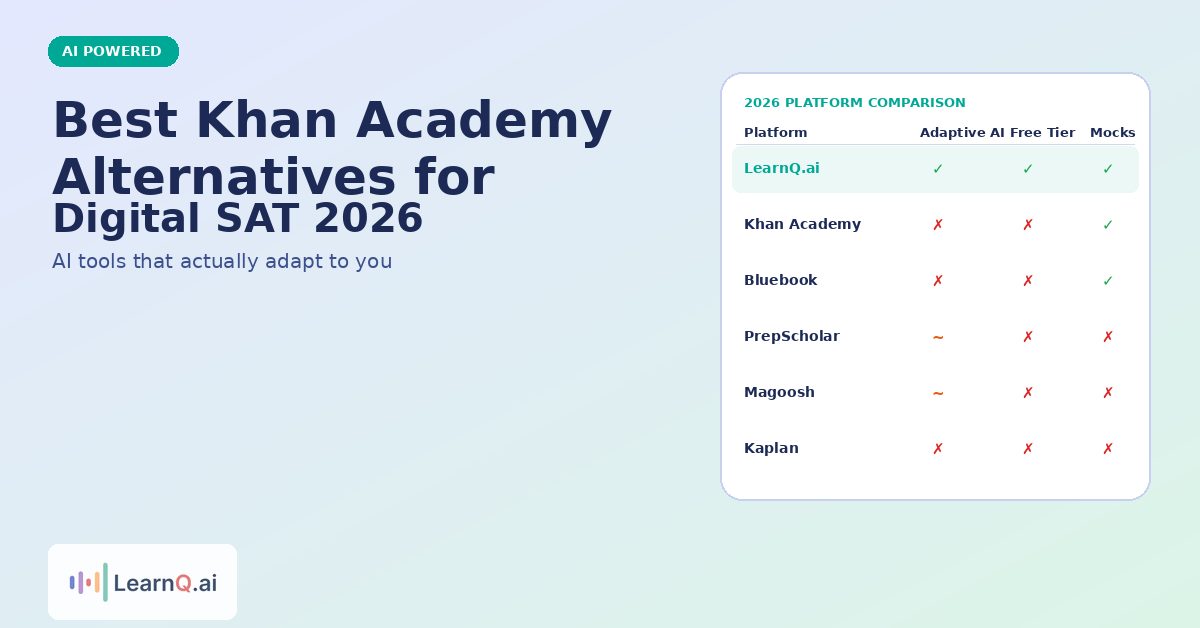
The column that separates LearnQ.ai from most competitors is session-level adaptive AI. Khan Academy, Kaplan, and Bluebook all give you practice – but none of them change what you see next based on how you are performing right now.
Why Adaptivity Matters More in 2026 Than Ever
The Digital SAT’s section-adaptive format means your Module 2 difficulty is locked in by your Module 1 performance. Students who train on non-adaptive platforms develop a linear test-taking mindset that does not match what they experience on test day.
Understanding Digital SAT Module 1 strategy is essential for any student targeting the hard module – and the hard module is the only path to scores above roughly 1400. Practicing on a platform that mirrors this routing structure trains you to manage the pacing and difficulty escalation you will actually face.
For more on what a 1400 score means and whether it fits your college targets, see our guide on whether 1400 is a good SAT score.
Get 30% OFF on all LearnQ.ai Digital SAT plans
Spring Offer: Use code SPRING30 at checkout to unlock your discount.
How to Choose the Right Alternative for You
You do not need all five platforms. Match your situation to the right tool.
If you are starting prep from scratch and have no budget, begin with Khan Academy and Bluebook to build a baseline. Once you have a diagnostic score and understand your weak areas, switch to a platform with adaptive AI for your targeted drilling.
If you have a score already and want to push 100 to 200 points higher, you need a platform with session-level adaptivity and error-tagged analytics. That is where LearnQ.ai, PrepScholar, or Magoosh become the primary tools and Khan Academy becomes supplementary at best. For a detailed 60-day improvement plan, see our guide on how to improve your SAT score by 200 points.
If you understand how long the Digital SAT is and are confident with timing, your biggest gains will come from quality of practice rather than volume. Choose a platform with deep analytics over one with the largest question bank.
Start With LearnQ.ai – Free, Adaptive, Built for the Digital SAT
LearnQ.ai is free to start. Take your diagnostic, get a personalized study path from Mia, and see exactly which skill gaps are holding your score back – before you commit to any paid resource.
The platform is built specifically for the 2026 Digital SAT format: adaptive algorithm, Bluebook-format mocks, 5,000+ questions, gamified sessions, and real-time error analytics. Join thousands of students who have used LearnQ.ai to close the gap between their current score and their target.
Get a 1500+ SAT Score With Expert Coaches + AI.
Live 1-on-1 and small group coaching from mentors who've scored 1580+, combined with LearnQ.ai's adaptive AI practice platform. The only SAT prep that works both ways.
FAQ
What is better than Khan Academy for SAT prep?
For students who want adaptive AI-driven prep, LearnQ.ai is the strongest alternative to Khan Academy in 2026. It offers session-level adaptive question difficulty, a personalized study path built from your diagnostic results, and Bluebook-format mock tests – features Khan Academy does not provide. For live instruction, Kaplan or Princeton Review are the top options.
Is Khanmigo good for SAT prep?
Khanmigo is useful for explaining individual concepts in a Socratic question-and-answer format, but it does not build personalized study plans or adapt question difficulty based on your performance data. It is best used as a supplementary explanation tool alongside a platform with full adaptive functionality, not as a standalone prep solution.
Are there any completely free Khan Academy alternatives for the Digital SAT?
Yes. College Board’s Bluebook app is free and provides six full-length official Digital SAT practice tests in the exact test-day environment. LearnQ.ai also offers a free tier with diagnostic access and a personalized study path at no cost. Khan Academy itself remains free and is worth using for its official content and eight free full-length tests.
Which SAT prep app adapts to my weak areas automatically?
LearnQ.ai’s adaptive algorithm automatically adjusts question difficulty and skill focus based on your live performance across sessions. PrepScholar also builds adaptive study plans from a placement diagnostic, though its within-session adaptivity is less granular than LearnQ.ai’s.
Do I need to pay for a good Digital SAT prep tool?
Not necessarily. LearnQ.ai’s free tier and Bluebook together cover diagnostic testing, adaptive practice, and full simulation at no cost. Paid options like Magoosh and PrepScholar add structured curricula, video instruction, and score guarantees for students who want more scaffolding or accountability.
How is the Digital SAT different from the old paper SAT?
The Digital SAT is shorter (approximately 2 hours 14 minutes) and section-adaptive. Each section has two modules, and your Module 2 difficulty is determined by your Module 1 performance. This means prep materials that do not replicate adaptive difficulty escalation are training you for a different test than the one you will take. For a full timing breakdown, see our guide on how long the Digital SAT is.
Can I use multiple SAT prep platforms at once?
Yes, and combining platforms strategically is often the most effective approach. A common high-performing setup is: Bluebook for full-length simulation benchmarks every two to three weeks, LearnQ.ai for daily adaptive practice between checkpoints, and Khan Academy for targeted concept video review when you encounter an unfamiliar topic. Avoid using more than two active platforms simultaneously to prevent scattered prep.
How many months before the SAT should I start using a prep platform?
For a 200-point improvement, plan for 8 to 12 weeks of structured prep. For a 100-point improvement, 6 to 8 weeks of focused, daily practice is typically sufficient. Starting earlier gives you more full-length test cycles to identify and close skill gaps before test day.
Sources: College Board Digital SAT program data (2026); EdisonOS SAT prep tools comparison (March 2026); Makon AI question bank guide (April 2026)