

Most competitive US colleges superscore the SAT, combining your highest section scores across multiple test dates into a new composite. But policies vary meaningfully by school, and even schools that superscore often still require or recommend submitting your complete testing history – so always confirm directly with each school on your list.
If you are deciding whether to retake the SAT, whether your target schools superscore is one of the most important pieces of information you can have. A school that superscores turns a retake into a low-risk, potentially high-reward move: your best Math score from one sitting and your best Reading and Writing score from another combine into a total higher than either individual attempt. This guide covers how superscoring actually works, a categorized snapshot of major schools’ current policies, and the nuances that trip students up.
What Superscoring Actually Means
Superscoring is a college-specific admissions policy, not a feature of the SAT itself – College Board reports your individual section and total scores from each sitting, and it is up to each college to decide whether and how to combine scores across multiple test dates. Superscoring means a college takes your highest section score from each SAT sitting and combines them into a new composite total, rather than only considering your single best full-sitting score. If you scored 720 Math and 650 Reading and Writing on one attempt, then 660 Math and 730 Reading and Writing on a later attempt, a superscoring school would combine the 720 Math and 730 R&W into a new total of 1450 – higher than either individual sitting produced on its own.
This is different from a school that only considers your highest single sitting, where the entire 1370 or 1390 total (whichever attempt scored higher overall) would be used as-is, without mixing and matching sections across dates.
Two nuances that matter:
“Same-version” superscoring. Some schools, notably Princeton, only superscore across sittings of the same SAT version – meaning only Digital SAT scores combine with other Digital SAT scores, not with older paper-based SAT scores. For current students this is rarely an issue since the SAT is now fully digital, but it is worth knowing if you have an older paper SAT score on file.
“Considers highest scores” vs. official superscoring. A small number of schools, including Harvard, describe their policy as considering your highest section scores during review without officially calling it superscoring. In practice this functions similarly for applicants, but it is a distinct official policy worth noting if a school’s admissions page uses this specific language rather than the word “superscore.”
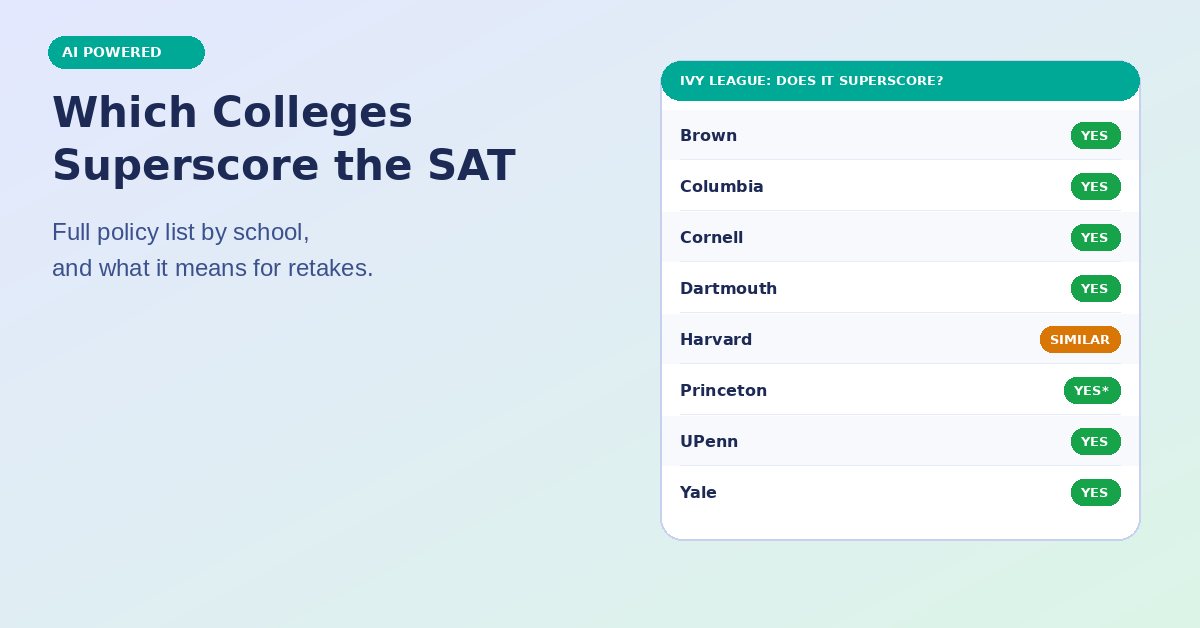
Ivy League Superscoring Policies (2026 Snapshot)
| School | Superscores? | Score Reporting |
|---|---|---|
| Brown | Yes | Recommends all scores; accepts Score Choice |
| Columbia | Yes | Accepts Score Choice |
| Cornell | Yes | Test-required for 2026; 3 undergrad colleges (Agriculture and Life Sciences, Architecture Art and Planning, Business) do not consider test scores at all |
| Dartmouth | Yes | Requires all scores; test-required since 2024 |
| Harvard | Considers highest scores, not officially “superscore” | Requires all scores; accepts Score Choice |
| Princeton | Yes, same-version sittings only | Recommends all scores |
| University of Pennsylvania | Yes | Requires all scores |
| Yale | Yes | Recommends all scores; test-required |
Six of the eight Ivy League schools officially superscore. Harvard and Princeton are the two notable exceptions – Harvard’s policy functions similarly without using the official term, and Princeton’s superscoring applies only within the same SAT version.
Other Highly Selective Schools
Beyond the Ivy League, most peer-tier schools follow a similar pattern:
- MIT, Stanford, Caltech – all superscore the SAT. Stanford notably superscores the SAT but does not superscore the ACT.
- Johns Hopkins, Rice, Georgetown – generally superscore, consistent with most private elite institutions.
- Ohio State University and the University of Tennessee System – both reinstated test requirements for 2026 with superscoring policies attached.
2026 context worth knowing: several selective schools that went test-optional during the pandemic have reinstated testing requirements for the 2026 admissions cycle, including Dartmouth, Brown, Yale, Cornell, and Caltech. This shift matters for two reasons: it means test scores carry real weight again at these schools, and it means average score ranges reported by these schools may shift over the next few cycles as the full applicant pool (not just self-selected score-submitters) is represented again.
Public University Flagships
Superscoring policy at public universities is set at the campus or system level far more often than at private schools, meaning two campuses within the same state system can have completely different policies. There is no reliable single rule for “public universities” as a category – always check the specific campus’s admissions page directly, since state system-wide policies are the exception, not the norm.
Schools That Are Test-Optional or Test-Blind
A meaningful number of schools, including NYU as of this writing, remain test-optional with no announced plans to reinstate requirements. For test-optional schools, the superscoring question becomes secondary to a different decision: whether to submit scores at all. As a general guide, if your score sits above the school’s published middle-50% range, submitting typically strengthens your application; if it sits below that range, many admissions counselors suggest leaning on other application components instead. This calculation is specific to each school and each applicant, so treat it as a starting framework, not a rule.
Why Superscoring Changes Your Retake Strategy
If your target schools superscore, a retake focused entirely on your weaker section is often the highest-leverage move available – you are not required to beat your previous total score, only to improve one section enough to raise the combined result. This is a different calculus from a school that only looks at your best single sitting, where an uneven retake (stronger in one section, weaker in the other) might not help at all.
See the SAT retake strategy guide for the full framework on deciding whether and when to retake, and the guide to recovering from a disappointing SAT score if your most recent attempt did not go the way you hoped. To calculate exactly what your current superscore would be across your existing attempts, see the how to calculate your SAT superscore guide.
What to Do With This Information
Verify directly with every school on your list. Testing policies, and specifically superscoring policies, change – sometimes year to year. The information in this guide reflects a 2026 snapshot compiled from multiple current sources, but admissions pages are updated more frequently than any third-party guide can track in real time.
Most schools still want your full testing history, even if they superscore. Submitting only your “best” individual scores from each sitting is rarely an option – most schools that superscore still require or strongly recommend that you send every official score report, which will show your complete testing history regardless of how the final composite is calculated.
Don’t let superscoring justify unlimited retakes. A pattern of many attempts with only marginal improvement can raise questions about planning, even at schools that superscore generously. See the SAT retake guide for guidance on how many attempts is reasonable.
Before committing to a retake, practice under real conditions using College Board’s Bluebook app, the same platform your official test runs on. Take LearnQ’s free diagnostic test to identify which specific section is holding your score back before deciding whether a targeted retake makes sense. Mia, LearnQ’s AI tutor, can build a study plan focused specifically on your weaker section if superscoring is part of your strategy. Take a free full-length practice test on LearnQ’s Digital SAT platform to confirm real progress before your next official attempt.
Frequently Asked Questions
Do all Ivy League schools superscore the SAT?
No. Six of the eight Ivy League schools (Brown, Columbia, Cornell, Dartmouth, Princeton, and the University of Pennsylvania) officially superscore. Harvard does not officially use the term “superscore” but considers your highest section scores during review, which functions similarly in practice. Princeton superscores only within the same SAT version, meaning digital scores combine with other digital scores but not with older paper-based scores.
What does it mean when a college superscores the SAT?
Superscoring means a college takes your highest section score from each SAT sitting – your best Reading and Writing score from any attempt and your best Math score from any attempt – and combines them into a new composite total, even if those two highest scores came from different test dates.
If a college superscores, do I still need to send all my scores?
In most cases, yes. Many schools that superscore still require or strongly recommend that you submit your complete testing history rather than selecting only your best individual scores. Check each specific school’s score reporting policy, since requirements vary even among schools with similar superscoring practices.
Does superscoring mean I should retake the SAT more times?
Not automatically. Superscoring makes a targeted retake more valuable if one specific section is meaningfully weaker than the other, since improving that section alone can raise your composite. However, repeated retakes with only marginal improvement can raise questions about planning at any school, superscoring or not – there are diminishing returns after a certain number of attempts.
Do public universities superscore the SAT?
It varies significantly and is usually set at the individual campus level rather than as a single state-wide policy. Two campuses within the same public university system can have entirely different superscoring policies, so there is no reliable general rule – always check the specific campus’s admissions website directly.
Does Harvard superscore the SAT?
Not officially by name. Harvard’s stated policy is that admissions officers consider your highest section scores across all submitted test dates during review, which produces a similar practical outcome to superscoring even though the university does not use that specific term. Harvard also requires submission of your complete testing history.
What is the difference between superscoring and Score Choice?
Superscoring determines how a college combines your section scores across multiple sittings into a final composite. Score Choice is a separate College Board feature that lets you choose which test dates to send to a college in the first place. A school can accept Score Choice, superscore, both, or neither – the two policies operate independently of each other.
Sources: Empowerly SAT ranges for top colleges 2026 (empowerly.com, May 2026); Alia Education SAT superscoring policies 2026 (aliaeducation.com); CollegeVine Ivy League SAT superscoring guide (collegevine.com); Target Test Prep top 25 schools that superscore SATs (sat.blog.targettestprep.com); IvyWise superscoring guide (ivywise.com); PrepMaven good SAT score for Ivy League 2026 data (prepmaven.com, January 2026)

The LearnQ Editorial Team is made up of certified Digital SAT tutors, college admissions specialists, and AI education researchers. Our tutors have personally helped over 10,000 US high school students improve their SAT scores, with an average improvement of 150+ points. We combine hands-on tutoring expertise with AI-powered insights from the LearnQ platform, which has analyzed millions of Digital SAT practice questions. Every article we publish is reviewed against the latest College Board Bluebook guidelines and cross-checked with real student performance data. Our mission is simple: give every student the same quality of prep that was once only available at expensive tutoring centers.